

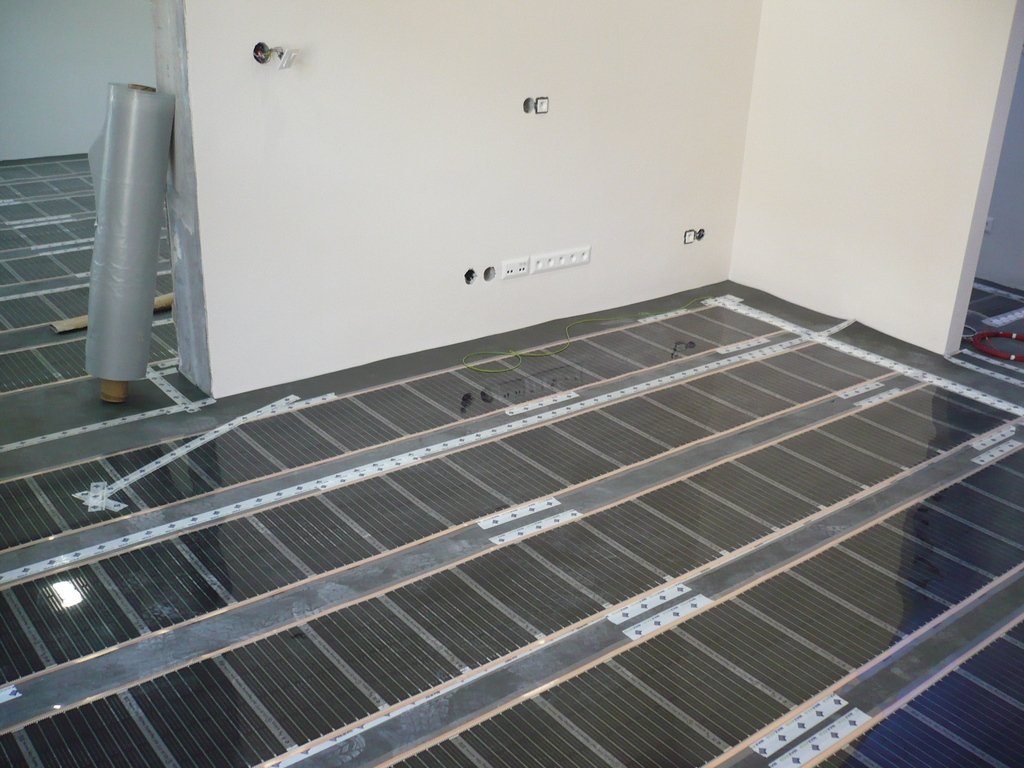
Infrared heating: how does it work, and which solution is right for you?
Infrared heating is electric, radiant heating: the heating element (heating film, infrared panel or dark radiator) warms the floor, walls, furniture and people directly with long-wave infrared radiation, and the air warms only from them.
In brief
- It heats by radiation: first the surfaces and the person, the air only afterwards.
- It runs on electricity: no boiler, chimney, pipework or moving part.
- Three main types: infrared panel (visible, can be fitted retrospectively), heating film (under the floor covering, invisible), dark radiator (outdoors).
- Consumption is decided by the heat loss of the house, not by the name of the heating. 1 kWh of electricity = 1 kWh of heat.
- Under the floor covering it is infrared heating too: the floor warms up and itself becomes the radiating surface.
- It does not make hot water and does not cool: we describe its limits just as we describe its advantages.
- A 15.5-year warranty on 4th-generation heating film when we do the installation.
What is infrared heating, and how does it work?
Infrared heating is electric heating that transfers its heat predominantly by radiation. The surface of the heating element warms up and emits infrared radiation. The floor, walls, furniture and the people in the room absorb it and warm up themselves; the air is warmed by them, secondarily.
The heating element can be heating film hidden under the floor covering, a visible infrared panel mounted on the wall or ceiling, or, outdoors, a dark radiator. All three run on electricity: there is no boiler, chimney, pipework or moving part.
This is not a new technology
Tiled stoves and traditional masonry ovens also heat predominantly by radiation, only not with electricity, and they could not be controlled room by room. Infrared radiation was described by William Herschel in 1800; it began to be used for heating in the Second World War, when it warmed the crews aboard bombers. This was the forerunner of today's heating panels and infrared panels. The story in detail: the history of infrared heating.
What kind of radiation is it?
Infrared is the radiation between 780 nm and 1 mm that is invisible to the eye. Within it, the long-wave (LWIR) range is 8–15 µm. Heating film radiates here: according to Wien's displacement law (λmax · T ≈ 2,898 µm·K), the radiation of a 40–45 °C surface peaks at about 9.1–9.3 µm.
It is the same kind of thermal radiation that every warm surface emits, a sunlit wall or a tiled stove too. That is why the warmth of radiant heating feels similar to the warmth of the sun or a stove.
Heat travels in three ways
Heat travels by conduction between particles in contact, by convection with the movement of warmed air, and by thermal radiation as electromagnetic radiation, without an intermediate medium. Every heating system gives off heat in all three ways, only in different proportions: in hot-water underfloor heating conduction dominates, in a radiator convection, in infrared heating radiation.
- Conduction: between particles in direct contact, the way a warm mug warms our palm and a heated floor warms our soles.
- Convection: with the movement of warmed air or water. This is the main principle of the radiator and the panel heater: warm air rises, cold air sinks. Air movement and stirred-up dust come with it.
- Thermal radiation: electromagnetic radiation, mainly in the form of infrared. It needs no intermediate medium; this is how the warmth of the Sun reaches us.
You have felt this warmth before
Infrared radiation is the part of sunlight that gives warmth. That is why your skin feels warm in the sun while the air is cold.
- Skiing in sunshine. The air is minus five, yet your skin is warm, and many people ski in a T-shirt. The heat is brought not by the air but by radiation.
- The beach in the afternoon. The Sun disappears behind a cloud and it instantly turns cold, although the air temperature has not changed. The radiation has stopped, and with it the sensation of warmth.
- A tiled stove, a masonry oven. It is warm next to it, but not in the far corner of the room. The stove does not heat the air but radiates, and the warmed mass keeps radiating after the fire has gone out.
- A car in winter. On a cold but sunny day the sun almost burns through the windscreen. What you feel then is purely the Sun's infrared radiation.
One clarification, because many people think otherwise: long-wave infrared radiation does not penetrate solid bodies. It is absorbed in the first few micrometres of the surface and turns into heat there, and from there it travels on by conduction.
Where is the infrared, and which range heats?
Infrared is the radiation between 780 nm and 1 mm that is invisible to the eye. It got its name from beginning below red in the series of visible light. For heating, the long-wave range of 8–15 µm is used.
The electromagnetic spectrum is very wide, from radio waves to X-rays, and infrared takes up only a small slice of it, directly below the range of visible light.
The ranges of infrared
- Near infrared: optical communication, night-vision devices.
- Short-wave infrared: telecommunications.
- Mid-wave infrared: heat tracking.
- Long-wave infrared (8–15 µm): this is the range of heating, and it is also what a thermal camera uses.
- Far infrared.
What radiates where?
Wien's displacement law (λmax · T ≈ 2,898 µm·K) tells us where the radiation of a surface peaks. The surface of the Sun (~5,770 K) peaks in visible light, at about 0.5 µm; heating film at 40–45 °C at 9.1–9.3 µm; human skin (~33 °C) at about 9.5 µm; a heated floor surface (24–29 °C) at about 9.6–9.8 µm. Heating film, the floor and human skin therefore radiate in the same long-wave range.
Why can this kind of warmth be healthy?
The thermal radiation of infrared heating is non-ionising radiation: the same kind that every warm surface emits, the sunlit wall, the tiled stove and the human body itself.
Four things that follow from this
- The same range. Heating film radiates at 9.1–9.3 µm, human skin at about 9.5 µm (Wien's displacement law). The same long-wave range, which is why it feels natural.
- It does not dry the air, because it does not heat the air. Unlike high-temperature systems that heat the air, it does not lower the relative humidity in the same way.
- It creates no air movement, so it stirs up less dust and fewer allergens than radiator or convector heating. More on this: why infrared heating is ideal for allergy sufferers (in Hungarian).
- A warmer wall surface, less condensation. Less moisture condenses on a warmer wall, which reduces the chance of mould. We write about this in detail on the wall heating page.
The real question about electric heating is not thermal radiation but the electric and magnetic field. We answer that not with opinion but with our own measurement.
Why does it feel warmer at the same temperature?
Our thermal sensation depends on more than the air temperature. The thermal comfort standards (ASHRAE 55, ISO 7730) work with the so-called operative temperature. For calm, seated activity and little air movement this is roughly the midpoint between the air temperature and the mean radiant temperature of the surrounding surfaces.
So if the floor, wall or ceiling is warmer, we get the same sensation at a lower air temperature. In a room with cold walls we feel the opposite: the thermostat says it is warm, yet we are cold.
In our experience, with infrared heating the thermostat can be set 2–3 °C lower for the same sensation than with heating that warms the air. Why this matters: according to ista's guidance, just one degree lower temperature can cut heating costs by at least 6%.
Heating film creates no air movement, so it does not stir up dust, and it does not dry the air, because it does not heat the air.
The three types of infrared heating: which is which?
All three heat by radiation, but they look different, go in different places and do different things. First recognise them, then comes the detailed comparison.
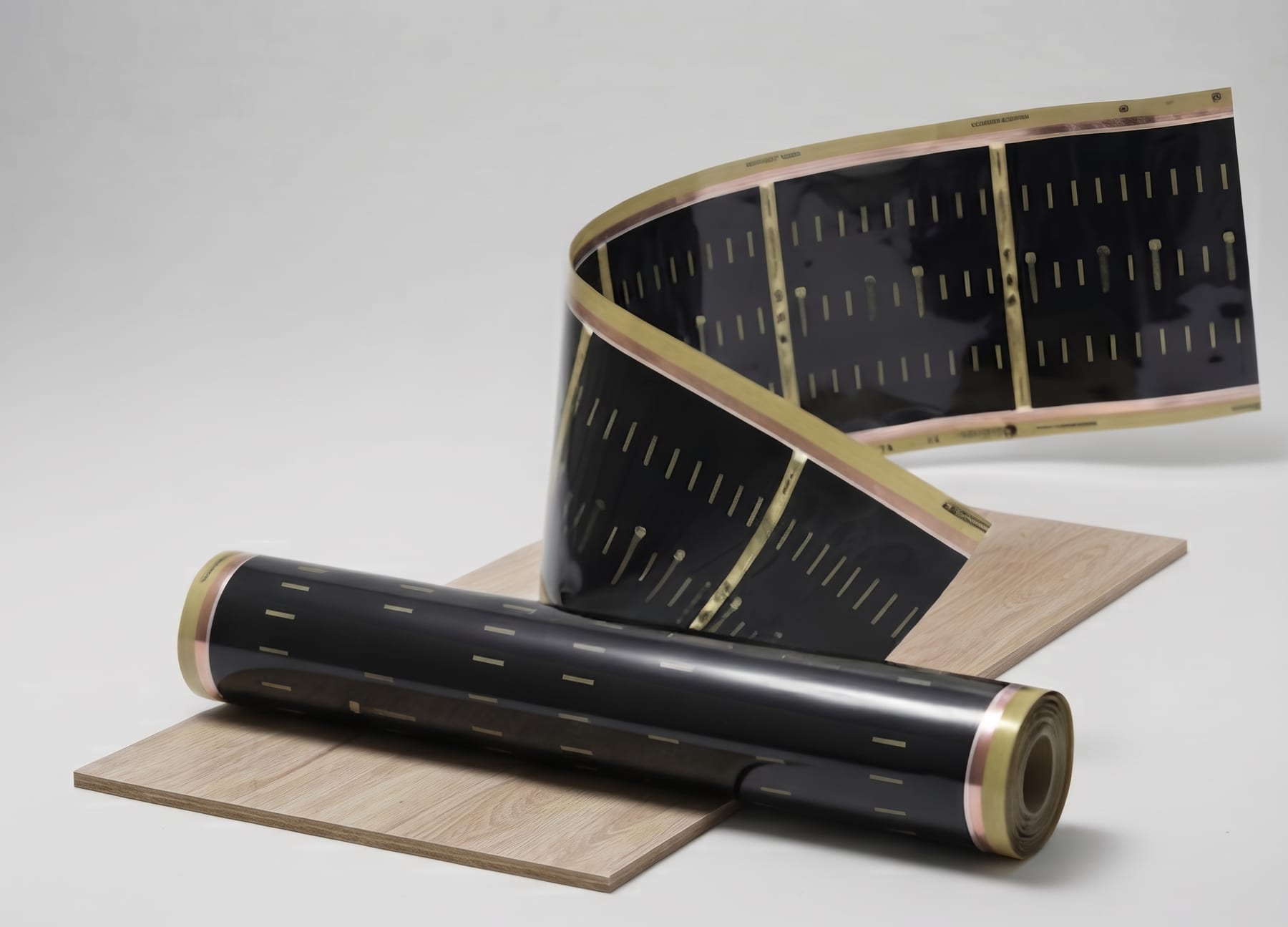
Heating film
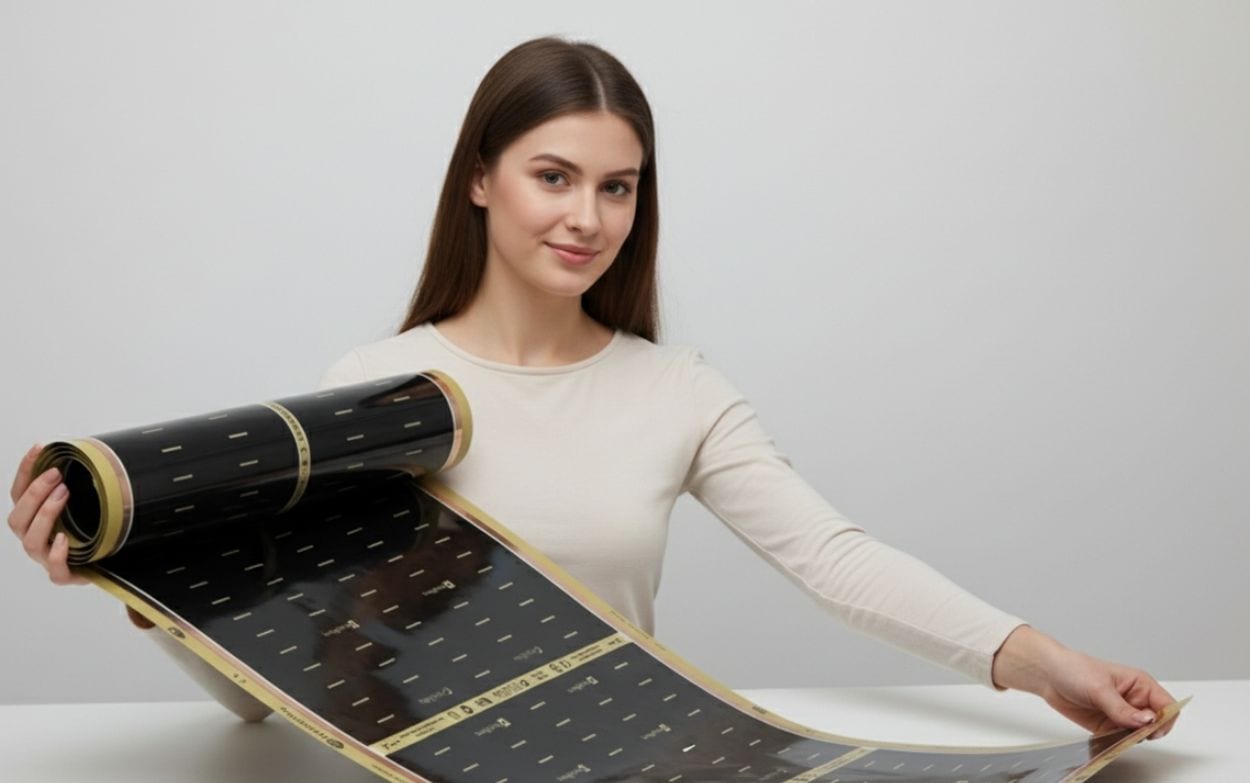
Black, flexible film on a roll. 0.4 mm thick, 50 cm wide, with a contact strip along both edges. It goes behind the floor covering, plasterboard ceiling or wall, and is not visible once installed.
Részletek →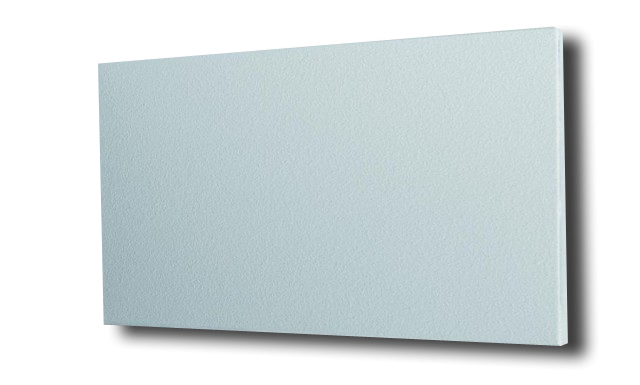
Infrared panel
A flat, frameless board on the wall or ceiling. Typically available in white, glass or mirror finish. It is visible, but it can be fitted retrospectively, without demolition.
Részletek →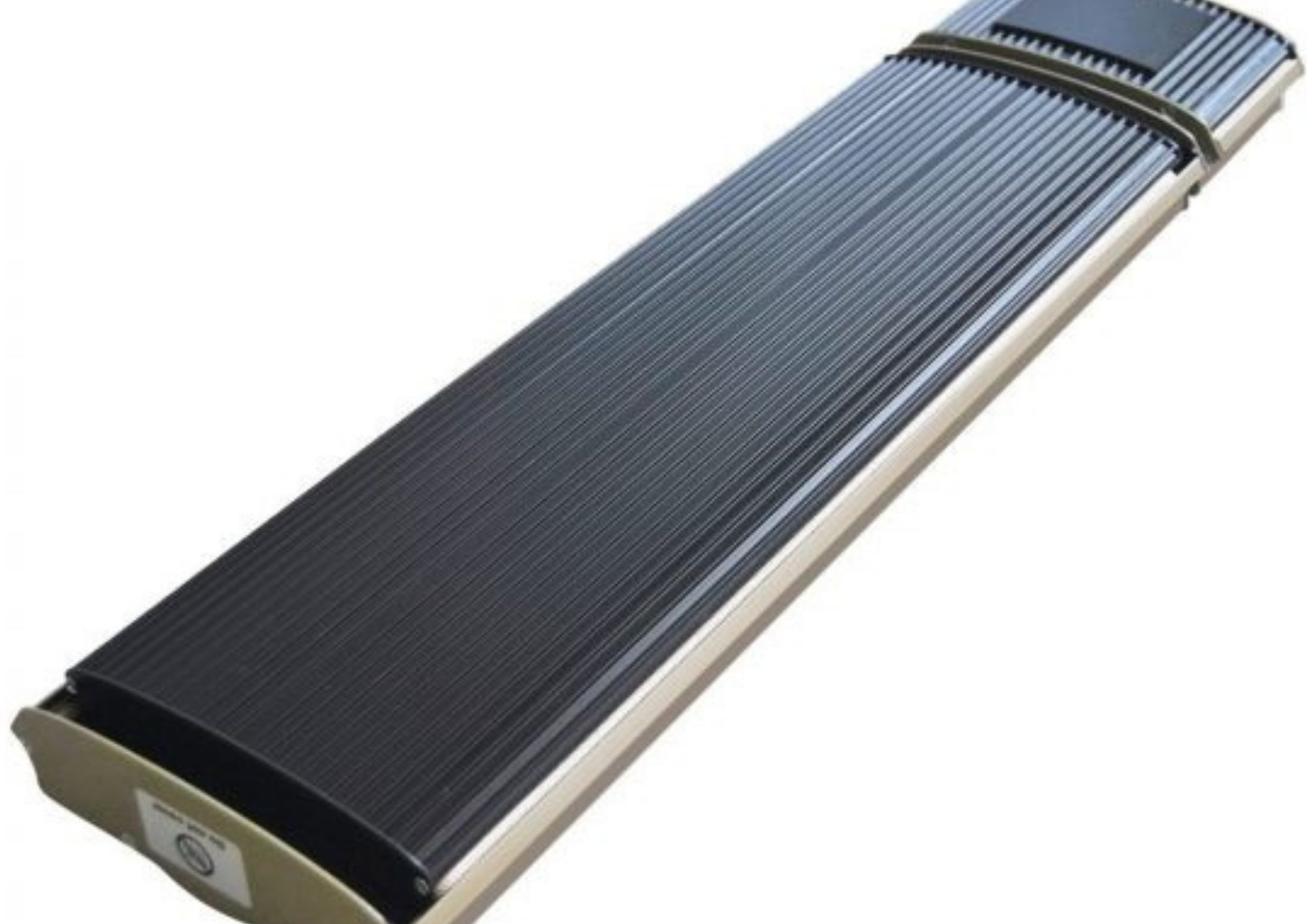
Dark radiator
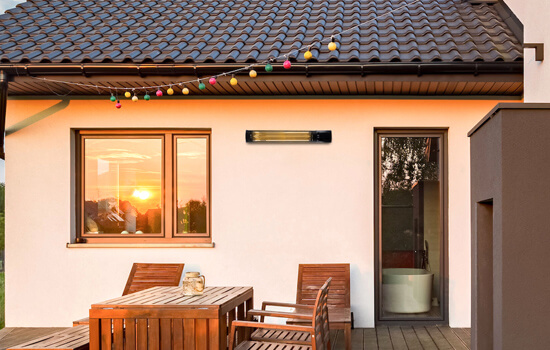
An elongated, ribbed metal housing. It is for terraces, the outdoor part of a restaurant and large-volume halls: instead of the air it heats directly those beneath it.
Részletek →What can each do? The three types side by side
The panel heater (electric radiator) does not belong here: it warms and circulates the air.
| Heating film | Infrared panel | Dark radiator | |
|---|---|---|---|
| Where is it? | Behind the floor covering, plasterboard ceiling or wall, invisible | A visible panel mounted on the wall or ceiling | A radiator mounted on the wall or ceiling, on a terrace or in a large-volume hall |
| Installation | Before tiling or plastering, with a layer build-up | Easy to fit retrospectively | Easy to fit, without special preparation |
| Typical role | Heating a whole home or house, with room-by-room control | Can be used as stand-alone heating, but recommended rather as supplementary heating (e.g. bathroom; a mirror version is also available) | Outdoor terrace heating, industrial premises |
| When to choose it? | As the invisible main heating of a whole home or house, in a renovation or a new build | To heat a single room, retrospectively, without demolition | Outdoors and in large-volume halls, where heating the air is pointless |
| Output | 110, 220 or 400 W/m² (4th-generation heating film) | Varies by model and size | Varies by model |
| More | Underfloor heating, ceiling heating, wall heating | Infrared panel | Terrace heating, dark radiator |
On two products that are often confused: panel heater or infrared panel? and what is the difference between an infrared panel and heating film? (in Hungarian)
Infrared panel: the visible solution that can be fitted retrospectively
An infrared panel is a visible radiant heater mounted on the wall or ceiling, the oldest and most widespread form of infrared heating. It can be fitted retrospectively, without demolition, so in an existing home it is the simplest solution.
It is available in different outputs, sizes and finishes; a mirror version also exists for bathrooms. The output must be chosen to suit the air volume and heat loss of the room. It can be used as stand-alone heating, but we typically recommend it as supplementary heating.
Where does it come in handy? In a bathroom, an office, a child's room, and in a large-volume communal space, a church for example, where warming the whole air volume would be wasteful.
Sizing with a calculator: infrared panel. The range: our web shop (Hungarian-language shop, delivery within Hungary).
Heating film: the invisible main heating
Heating film is a thin, flexible heating element that goes behind the floor covering, plasterboard ceiling or wall and stays invisible. It consists of carbon-paste stripes sealed in plastic film, supplied with current by copper strips running along its two edges.
Heating foil and heating film are the same product. The two words are only a distinction made by sellers; there is no technical difference between them.
Today's 4th-generation heating film is 50 cm wide, 0.4 mm thick, and available at three output levels: 110, 220 or 400 W/m². Together with the reflective foil and the vapour barrier the complete heating system is just 6 mm. The output is always determined by the heat loss of the building, not the floor area. It is also suitable for bathrooms: 4th-generation heating film has IP67 protection.
Details: 4th-generation heating film, electric underfloor heating, installation across the country.
Dark radiator: outdoor and industrial infrared heating
For outdoors and large-volume halls, the dark radiator is the right choice. It can be mounted on the wall or ceiling without special preparation, and instead of the air it heats directly those beneath it, which is why it works in the open air too, where warmed air would blow away at once.
It can be used on terraces, the outdoor part of restaurants, in industrial halls and in polytunnels alike, in many outputs. In a large-volume hall it is often more economical to heat only the people working there than to warm the whole air volume.
More: terrace heating, dark radiator, heating a polytunnel, web shop (Hungarian-language shop, delivery within Hungary).
A panel heater is not infrared heating
A panel heater (electric convector) is not infrared heating: it warms the air and circulates it in the room. Because of the similar prices and outputs it is often confused with the infrared panel, but the two give off heat differently and also have to be planned differently: the position of an infrared panel can be chosen freely, while a panel heater has fewer options.
More: panel heaters, panel heater or infrared panel?, what is the difference between an infrared panel and heating film?, electric heating.
The generations of heating film: what was wrong with the older ones?
The generations of heating film differ in how the contact between carbon paste and copper strip was solved, and in whether the film regulates itself. In heating films made before 2015 both were weak points.
The shortcomings of the 1st and 2nd generations
- An air gap under furniture. 4–5 cm had to be left between the underside of furniture and the floor, otherwise the heat generated was trapped and the floor covering could overheat. The lifespan of parquet fell drastically as a result, and adjusting the thermostat did not help.
- The positions of furniture had to be planned in advance, so that the unheated area could be taken into account. Rearranging later was practically impossible.
- An electric arc between the strips. In first-generation heating film the strips were not connected to each other; the fixing of the copper and silver strips carrying the current was less than optimal, so discharge could occur, which destroyed that section of the film.
- Weaker PET film. The quality of the carrier did not come close to today's: the heating film could be damaged even during installation.
The 3rd generation brought self-regulation (PTC) and a mesh contact; in the 4th generation the carbon-paste surface is larger, and a full-width contact strip at the edge joins the carbon paste to the copper strip. Both the 3rd and the 4th generation are self-regulating.
4th-generation heating film is printed with: 4th GENERATION PTC PREMIUM HEATING FILM, SwissWarm, Fűtőfólia. Details: 4th-generation heating film, 3rd-generation heating film.
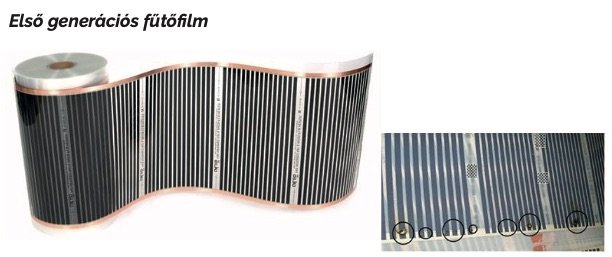
What it looks like when old heating film fails
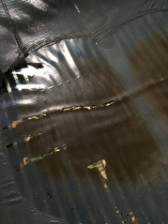
The pictures were taken during our own on-site inspections, of heating films made before 2015 or of poor quality. That is why it is worth asking exactly what product the installer is building in.
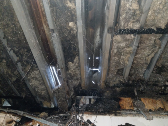
A burnt section of the film
Discharge at the contact between the copper strip and the carbon paste destroyed that section of the film.
Exposed from underfloor heating
The fault arose under the floor covering: the floor had to be broken up to repair it.
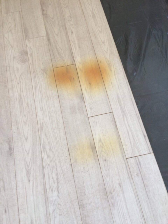
Damage under parquet
With film that was covered by furniture and not self-regulating, the heat could not escape.
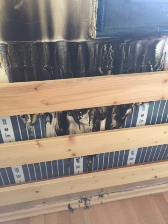
Exposed from wall heating
The same fault in wall heating: exposing it means breaking up the covering.
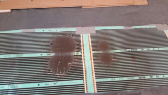
Another case under parquet
Because of the weaker quality of the PET carrier, the film could be damaged already during installation.
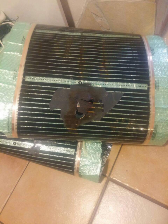
An old type of heating film
From the outside it hardly differs from today's. The difference is in the contact and in the self-regulation.
What does self-regulating mean?
Self-regulation means that the heating film reduces its own output where heat cannot escape. The resistance of the carbon paste rises with temperature (PTC, positive temperature coefficient), and a higher resistance means a lower output.
When the thermostat switches on, the heating film starts at maximum output. As it warms, the resistance of the carbon paste rises and its output falls, until the thermostat switches off. Under furniture or a rug the same happens locally: in the covered section the film carries on at an output about 25% lower, while the output of the surfaces left free does not change.
Compared with the older, non-self-regulating types this means an average energy saving of 25%.
The other, rarely mentioned advantage is safety. Self-regulation not only saves: it prevents local overheating, and with it most of the damage seen in the pictures above.
What should you ask the seller before buying heating film?
Four questions that reveal what product you are being offered. For the fourth, also ask for a photograph.
Is the heating film self-regulating (PTC)?
If not, the positions of furniture must be planned in advance, and an air gap must be left under it.
How do the carbon paste and the copper strip make contact?
It is the full-width contact strip that rules out discharge.
What is the warranty, and what is its condition?
With us, a 15.5-year warranty on 4th-generation heating film when we do the installation.
Is it 4th-generation film? Can I have a photo?
Ask for a photograph of the heating film itself, and see what is printed on it. On 4th-generation heating film it reads: 4th GENERATION PTC PREMIUM HEATING FILM, SwissWarm, Fűtőfólia. If the photo does not show the 4th-generation marking and the SwissWarm logo, this is not the product you are getting. Details: 4th-generation heating film.
The four generations side by side
The differences between the generations in brief.
| Aspect | 1st–2nd generation | 3rd generation | 4th generation |
|---|---|---|---|
| Contact (copper strip – carbon paste) | A weak, vulnerable point; discharge could occur | Mesh solution | Full-width contact strip |
| Self-regulation (PTC) | None | Yes: about 25% lower output in the covered area | Yes |
| Heating surface | Earlier design | Earlier design | Increased carbon-paste surface |
| Furniture on the heated floor | An air gap had to be left under it | The heating film reduces its output | The heating film reduces its output |
| Warranty | — | 10-year guarantee | 15.5 years when we do the installation |
The 3rd-generation product carries a 10-year guarantee; the 15.5-year warranty applies to 4th-generation heating film when we do the installation.
Why does self-regulating heating film use less electricity?
Self-regulating heating film uses less than an older heating film for three reasons. It does not heat where heat cannot escape; it gives the same sensation of warmth at a lower air temperature; and it can be controlled room by room and to the hour.
1. Self-regulation
In the covered area the heating film works at an output about 25% lower. With an older, non-self-regulating film this energy was lost: it only heated the floor covering there, and in the long run destroyed it.
2. Thermal sensation
With radiant heating, in our experience the thermostat can be set 2–3 °C lower for the same comfort. According to ista's guidance every 1 °C means at least 6% of heating cost. Why this is so: thermal sensation and operative temperature.
3. Zoning
Every room or heating circuit gets its own thermostat and a separate supply, so a rarely used room need not be heated, the bedroom can be cooler and the bathroom warmer. Thermostats and controls.
We deliberately do not state a specific saving compared with another heating method here: it depends on the building and on current energy prices. You will find the figures below, in the cost section and in the comparison table.
What does infrared heating cost, and how much does it use?
The investment
The price of a 4th-generation heating film system in 2026 is HUF 11,250–18,000 per m² gross, including installation, calculated on the floor area to be heated. The three packages (Lite, Standard, Premium) differ in the share covered by heating film and in the controls. For 100 m² of floor area to be heated this is HUF 1,125,000–1,800,000. We give the exact price after the on-site survey.
The price does not include forming the junction and thermostat boxes, the floor covering, the electrical safety inspection (mandatory, borne by the customer) and, if a connection above 32 A is needed, the grid capacity increase.
Monthly consumption
Infrared heating converts the electricity it draws entirely into heat, so 1 kWh of heat costs the same as 1 kWh of electricity. In September 2026 residential electricity in Hungary costs HUF 36.386/kWh up to 2,523 kWh a year (about 210 kWh a month) and HUF 70.104/kWh above that, and the household's whole consumption counts towards the allowance, not just the heating.
At full output one square metre of heating film draws 0.11 kWh per hour (110 W/m²) or 0.22 kWh (220 W/m²). The thermostat, however, switches off once the set temperature is reached, so the monthly bill is determined not by the installed watts but by the heat loss of the building and its use.
An example for the order of magnitude, with the assumption of our consumption calculator (medium insulation, 75 kWh/m²/year): a 100 m² house has an annual heating demand of 7,500 kWh. At the over-allowance price that is about HUF 525,800 a year, or about HUF 75,100 a month spread over a seven-month heating season. What falls to heating from the 2,523 kWh allowance, alongside the household's other consumption, costs roughly half as much. This is an example calculated from an assumption, not measured data.
For your own house you can calculate with the calculator; the consumption of real properties is shown in our article how much electricity does infrared heating use.
Solar panels
It can be combined with solar panels, but we do not promise zero-forint heating. Since 1 January 2024 new household solar systems in Hungary are on gross metering: the electricity fed into the grid and the electricity drawn are accounted for separately. Only systems applied for by September 2023 and commissioned by 1 January 2026 at the latest can remain on net metering, for 10 years at most. A solar system can therefore reduce the electricity cost of heating, but does not bring it to zero. In detail: solar heating: myth or real saving? (in Hungarian)
Compared with other heating
How infrared heating compares with other methods depends on the building, the existing system and current energy prices; we work this through on separate pages, assumption by assumption: heat pump or infrared heating, electric heating types, the disadvantages of infrared heating.
What does one hour at full output cost?
What does one square metre of heating film cost for one hour of continuous operation at full output?
| Heating film | Energy drawn | Within allowance (HUF 36.386/kWh) | Above allowance (HUF 70.104/kWh) |
|---|---|---|---|
| 110 W/m² | 0.11 kWh | about HUF 4.0 | about HUF 7.7 |
| 220 W/m² | 0.22 kWh | about HUF 8.0 | about HUF 15.4 |
The thermostat switches on and off in cycles, so averaged over an hour the real consumption is lower.
Infrared heating, gas boiler, heat pump, electric radiator
The same six aspects we go through at the survey, plus three that are worth knowing before you decide. We do not compare the running cost here: it depends on the building and on current energy prices, so we work it out on a separate page.
| Aspect | Infrared heating (heating film) | Gas boiler + radiators | Heat pump | Electric radiator |
|---|---|---|---|---|
| Installation complexity | Simple, no pipework | Complex, pipework needed | Medium to complex, with mechanical design | Simple |
| Maintenance | No moving parts, no annual service | Annual maintenance, chimney sweeping | Periodic specialist service | None |
| Dust circulation | None: it heats by radiation | High: it warms and circulates the air | Depends on the emitter; low with underfloor heating | High |
| Room-by-room control | Easy, with a separate thermostat in each room | Harder and more expensive | Possible | Easy |
| Investment cost | Low to medium | Medium to high | High | Low |
| Running cost | Depends on the electricity price | Depends on the gas price | The lowest, if the SCOP is high | Depends on the electricity price |
| Space required | None: it is under the floor covering | Boiler room, chimney, pipework | Outdoor unit and buffer tank | The heater is on the wall |
| Cooling, domestic hot water | Provides neither | Hot water yes, cooling no | Many models provide both | Neither |
The table compares how the systems work and what they require; it is not a quote. On costs, assumption by assumption: heat pump or infrared heating: 2026 cost comparison, electric heating, infrared heating and air-conditioner air heating (in Hungarian). For your own house you can calculate with the consumption calculator.
How real houses consume
According to the data planned in the technical proposals for ten houses of our customers, 26–75 kWh of electricity per square metre per year is needed. The difference comes from the insulation and the use, not from the name of the heating. The data of all ten houses is on the consumption page.
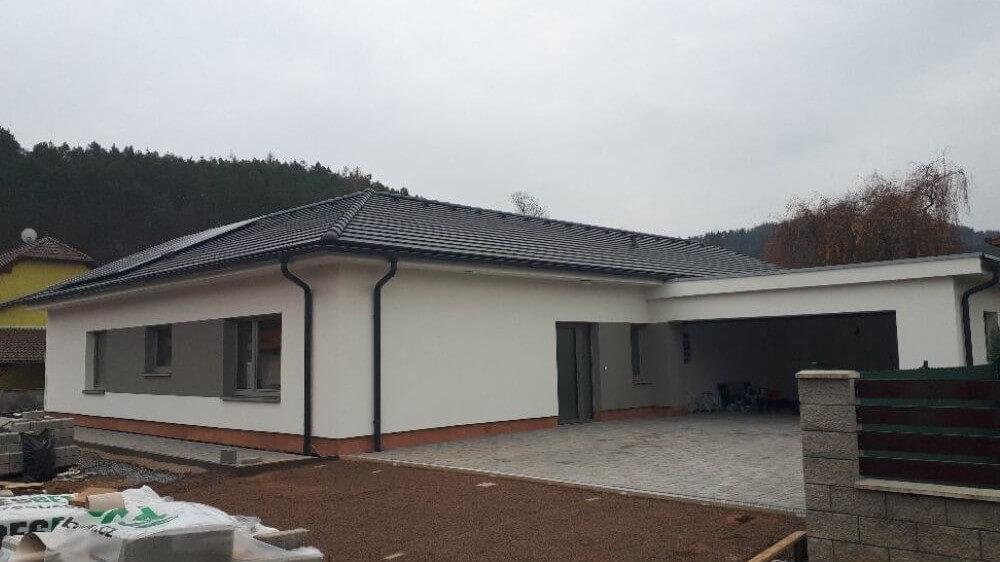
New family house, 218 m²
Heat loss 41 W/m², 11.6 kW installed output, 5,700 kWh/year, which is 26 kWh/m²/year. The best value of the ten: the insulation decides.
Részletek →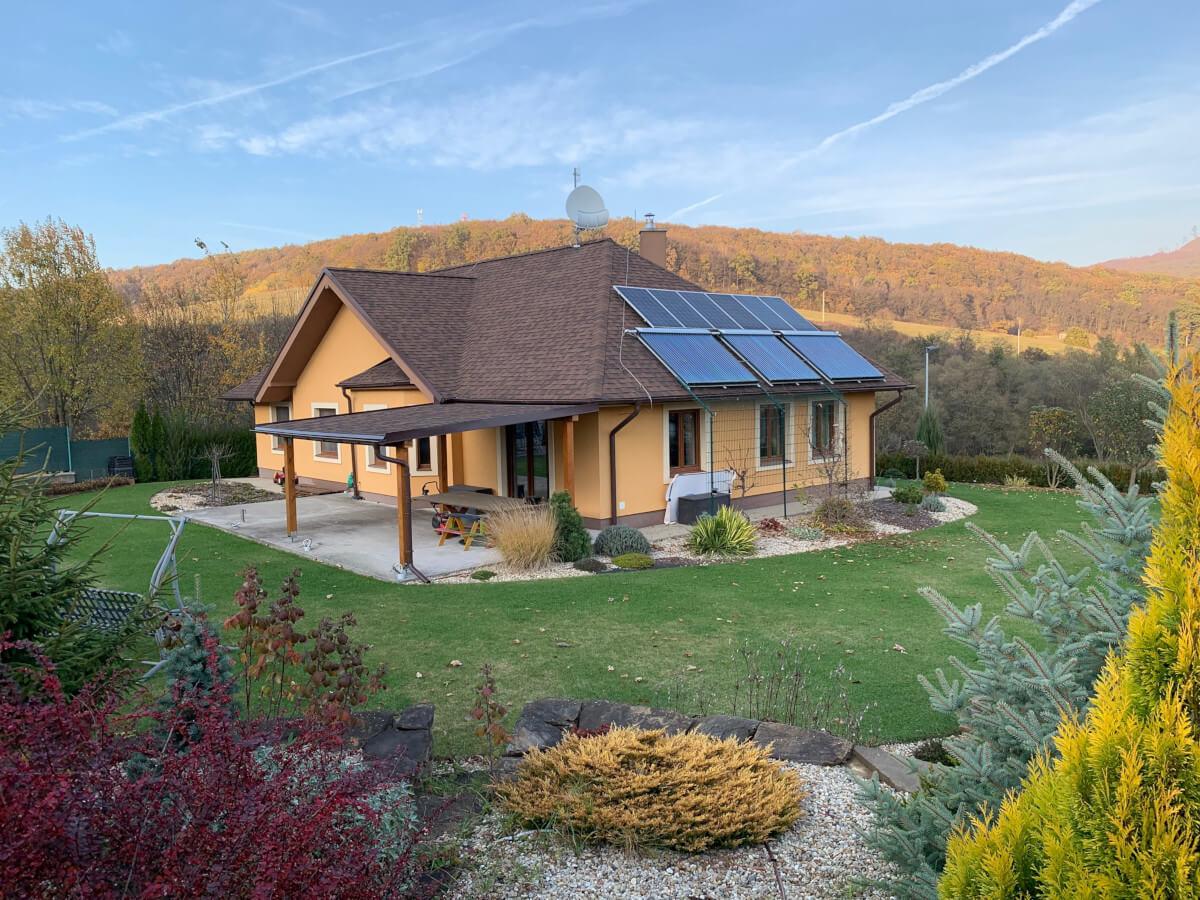
Holiday home, 158 m²
35 W/m², 7.8 kW, 5,200–5,700 kWh/year, 33–36 kWh/m²/year. With occasional use, room-by-room control matters a lot.
Részletek →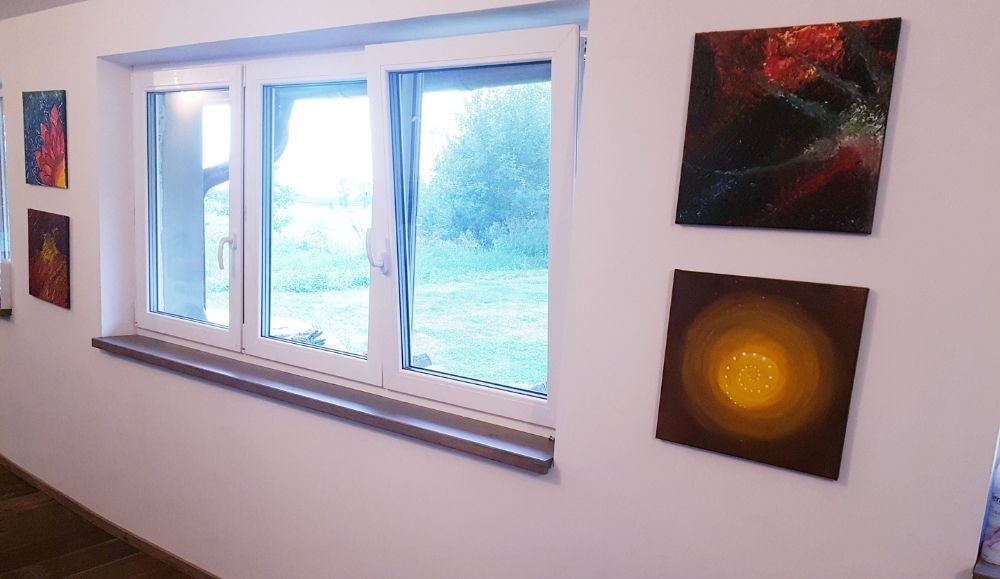
Family house renovation, 141 m²
80 W/m², 16.3 kW, 10,560 kWh/year, 75 kWh/m²/year. In a less well insulated house every heating is dearer; here the first step is insulation.
Részletek →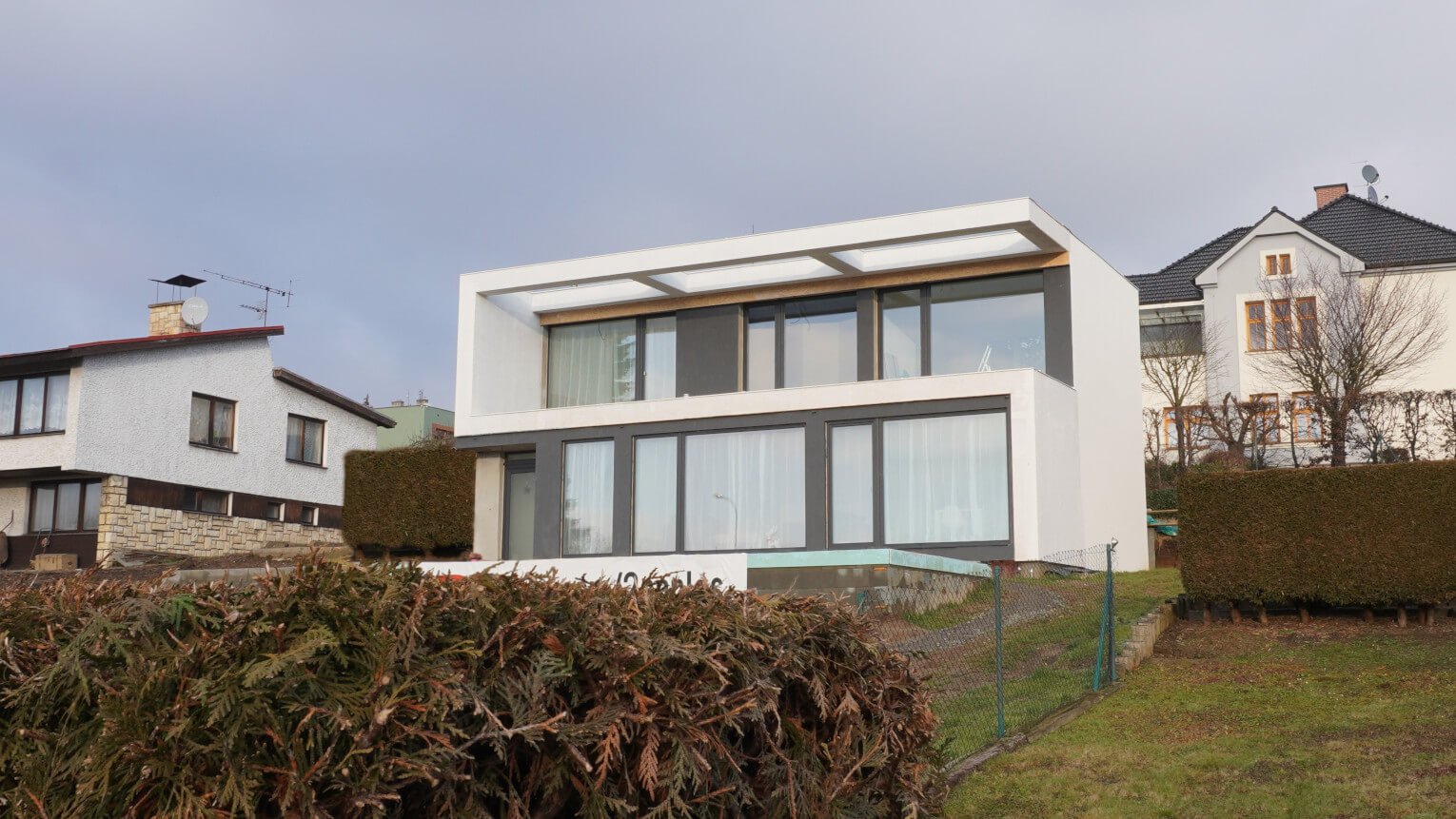
Container house, 130 m²
55 W/m², 9.9 kW, 7,057 kWh/year, 54 kWh/m²/year, with smart-home control.
Részletek →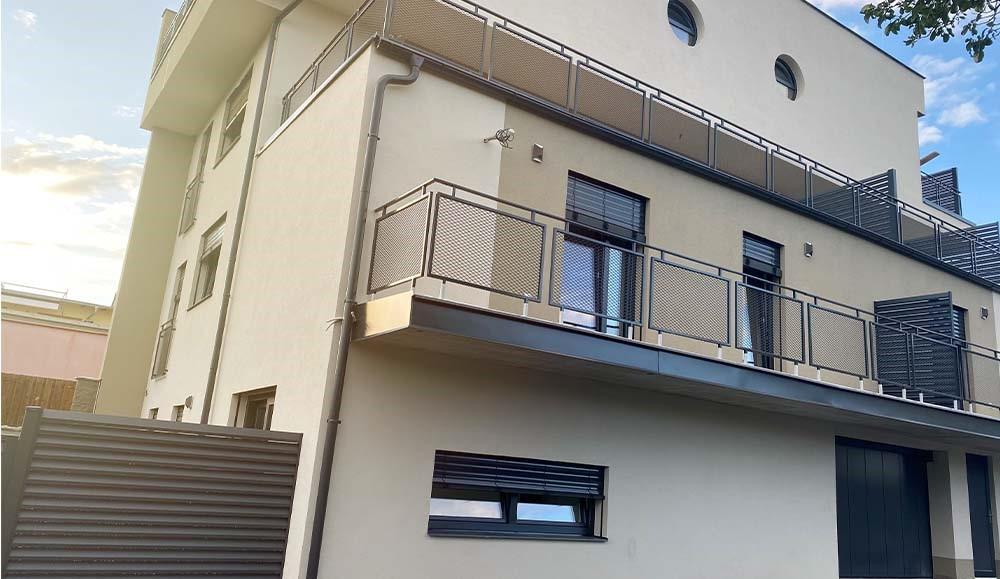
New apartment block, 385 m²
50 W/m², 32 kW, 18,018 kWh/year, 47 kWh/m²/year. Several flats, with separate metering for each flat.
Részletek →
Erzsébet, after one year
Before the installation the electrical network had to be extended, and the usual fears were there too. A year later she was completely satisfied with the heating. The conversation is in the video (in Hungarian).
Részletek →How does heat get through concrete or the floor covering?
The heat of heating film does not "pass through" the concrete. The radiation of the heating film is absorbed in the lowest few micrometres of the floor covering, the structure warms up, and the surface of the floor itself becomes the radiating surface.
1. The radiation of the heating film does not go through the concrete
Long-wave infrared radiation is absorbed a few micrometres deep. The layer above it warms up, and from there the heat travels on upwards by conduction.
2. The floor surface becomes the radiating surface
According to Wien's displacement law a heated floor radiates at about 9.6–9.8 µm, that is, in the same long-wave range as the heating film itself. A large surface with a small temperature difference: exactly what good radiant heating is. That is why what is under the floor covering is also infrared heating.
3. The question is what goes over the heating film
Emissivity tells you how good a radiator and absorber a surface is. It is high for concrete, tile and wood, and very low for aluminium. That is why an impact-sound underlay faced with aluminium does not belong over the heating film, and why a reflective foil goes under the film, bouncing the heat back towards the living space.
The heat of the heating film does not pass through the concrete: the concrete warms up, and the floor surface itself becomes the radiating surface.
More: myths about infrared heating under floor coverings (in Hungarian), electric underfloor heating.
Emissivity table: how good a radiator is each surface?
Emissivity (ε) tells you how much heat a surface radiates at its own temperature compared with what a perfect radiator (the "black body", ε = 1) would radiate. The same number is the surface's ability to absorb.
This is why it matters: concrete, screed, tile, brick and wood are matt, non-metallic surfaces with ε of about 0.9 or more: they absorb heat well and radiate it on well. Shiny metal is the opposite (polished aluminium ε ≈ 0.02–0.04): it hardly radiates, but reflects all the better.
That is why a reflective foil goes under the heating film, and why an aluminium-faced underlay does not belong over it. The order of the table: first building materials and floor coverings, then metals, finally other materials.
| Material | Surface, condition | Emissivity (ε) |
|---|---|---|
| Concrete | 0.95 | |
| Cement | 0.96 | |
| Brick | 0.93–0.96 | |
| Plasterboard | 0.89–0.91 | |
| Marble | 0.94 | |
| Ceramic | 0.95 | |
| Glass | 0.85–0.92 | |
| Wood | 0.90–0.95 | |
| Asphalt | 0.95 | |
| Clay | 0.92–0.96 | |
| Sand | 0.90 | |
| Gravel | 0.95 | |
| Soil | 0.90–0.98 | |
| Asbestos | 0.95 | |
| Lacquer | matt | 0.97 |
| Lacquer | glossy | 0.80–0.95 |
| Plastic | 0.85–0.95 | |
| Rubber | 0.95 | |
| Aluminium | oxidised | 0.20–0.40 |
| Aluminium | polished | 0.02–0.04 |
| Copper | oxidised | 0.40–0.80 |
| Copper | polished | 0.02–0.05 |
| Gold | 0.01–0.10 | |
| Iron | oxidised | 0.60–0.90 |
| Steel | oxidised | 0.70–0.90 |
| Graphite | oxidised | 0.20–0.60 |
| Human skin | 0.98 | |
| Textile | 0.90–0.95 | |
| Paper | in various colours | 0.94 |
| Leather | 0.75–0.80 | |
| Charcoal | powder | 0.96 |
| Water | 0.93 | |
| Snow | 0.83–0.90 | |
| Ice | 0.96–0.98 |
Indicative values, from the emissivity table of our earlier /infrafutes/ page, converted to text. Emissivity is not a single exact number: it depends on the roughness, colour and contamination of the surface and on temperature, so the tables of different handbooks and thermal camera manufacturers may differ by a few hundredths; for measurement always use the instrument manufacturer's figure. For comparison, a public, citable table: Table of Emissivity of Various Surfaces (Transmetra, from data in the Handbook of Chemistry and Physics). In the old table "Textile" appeared twice, with two values (0.90 and 0.95); here it is one row, as a range.
Is all heating foil infrared heating?
Not every foil-shaped heating system gives radiant heat. Some work predominantly by heat transfer. The difference shows in reliability, lifespan and consumption, and it only comes to light after installation.
Zoltán's case
We prepared our technical proposal for Zoltán. After that the interior designer found a cheaper product on the internet, and it was installed as ceiling heating in the loft. Two weeks later Zoltán contacted us: the flat would not warm up beyond 15 °C, and he asked whether infrared heating is really that bad.
We went out to check, because we had never seen this with our own system. The survey showed that the product installed was not radiant heating. We revised the technical proposal: instead of ceiling heating we built underfloor heating under laminate flooring. The installation, with the floor covering, took a few days, and Zoltán called us contentedly on the day of installation: the two systems give a completely different warmth and comfort.
The lesson: with heating, it is risky to look only at the price. Ask for an exact technical description, an installation layer build-up and a reference, and see what the seller commits to.
Whether a heating film works as infrared heating also depends on what goes over it. This is how we build it in:
Layer build-up of infrared floor, ceiling and wall heating: what goes over the heating film?
The installer fits three layers: a reflective foil underneath with full coverage, on it the heating film over 60–70% of the floor area, and a vapour barrier film on top; together these three are 6 mm. The other layers depend on the floor covering. Nearly 60% of our installations are underfloor heating, but all four installation methods have proved themselves, and with each the warmth can be felt within 5–15 minutes, depending on the floor covering. Choose what kind of surface it is:
Infrared heating under laminate flooring
The simplest layer build-up, usable with laminate flooring and ship's deck flooring. Under laminate flooring the heating film is covered by a vapour barrier film and an earthing mesh, and over that go the underlay paper and the floor covering. A solid layer (1.5–2 cm of Rigidur or 4–5 cm of concrete) is not mandatory, so the floor level rises hardly at all, and the warmth arrives towards the lower end of the 5–15 minute range.
Attention: an impact-sound underlay faced with aluminium must not go over the heating film: aluminium reflects the radiation, so the heat can only travel on by conduction. Why: the path of heat through the floor covering.
Under ship's deck flooring and solid wood the simple layer build-up is also enough: the solid layer (1.5–2 cm of Rigidur or 4–5 cm of concrete) is not mandatory here either, but it is possible. Wood has a higher thermal resistance, so the same heat output needs a warmer heated surface, and the warmth arrives towards the upper end of the range. Here it is especially important to keep to the highest surface temperature permitted by the floor covering manufacturer; we agree this at the survey.
Vinyl and PVC flooring must not go directly onto the heating film: it can also be installed over it, but only with a proper layer build-up, on a layer of 4–5 cm of concrete or 1.5–2 cm of dry screed over the heating film.
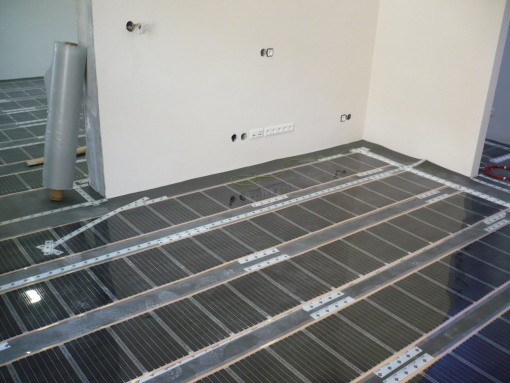
More: electric underfloor heating, insulating underfloor heating, heating film, mat or cable? (in Hungarian)
Layers under laminate flooring
- Laminate flooringThe visible floor covering.
- Underlay paperUnderlay beneath the flooring.
- Rigidur dry floor board or concreteA solid layer that is not mandatory under laminate. 1.5–2 cm / 4–5 cm
- Earthing meshElectrical protection: we fit heating film with an earthing mesh in every case.
- Vapour barrier film (PE)Covers and protects the heating system.
- 4th-generation heating filmThe radiant heating element, over 60–70% of the floor area. 0.4 mm
- Heat-reflecting foil (reflective foil)Reflects the heat towards the living space; full coverage. 5 mm
- Thermal insulationFor example walkable polystyrene.
- Base / concreteThe load-bearing substrate.
Under floor tiles, wall tiles, vinyl, carpet flooring and PVC
Floor tiles and wall tiles must not be glued directly onto the heating film: 4–5 cm of concrete or 1.5–2 cm of dry screed (for example Rigidur) goes over it, and the flexible adhesive sets on that. The tile adhesive therefore never touches the heating film. The vapour barrier film protects the heating in two layers here.
Under carpet flooring or PVC a solid layer is likewise needed over the heating film; the carpet or PVC takes the place of the adhesive and the tile. The thermal resistance of the carpet matters: it is not worth planning underfloor heating under a thick, long-pile carpet.
This layer build-up is also right for bathrooms: 4th-generation heating film has IP67 protection.
With concrete two visits are needed: the second 3–4 weeks after the concrete is poured, for commissioning.
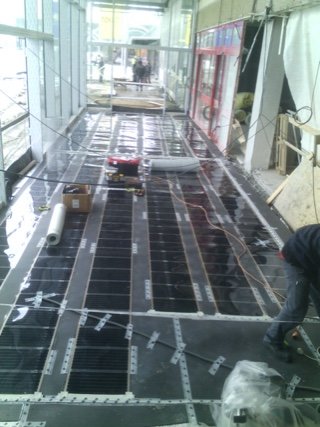
Layers under tile, vinyl, carpet and PVC
- Floor tile / wall tileThe visible hard floor covering.
- Flexible adhesiveTile adhesive on the solid layer.
- Rigidur dry floor board or concreteA mandatory solid layer, on which the adhesive sets. 1.5–2 cm / 4–5 cm
- Earthing meshElectrical protection: we fit heating film with an earthing mesh in every case.
- Vapour barrier film, double (PE)In two layers, mechanical protection over the heating film.
- 4th-generation heating filmThe radiant heating element, over 60–70% of the floor area. 0.4 mm
- Heat-reflecting foil (reflective foil)Reflects the heat towards the living space; full coverage. 5 mm
- Thermal insulationFor example walkable polystyrene.
- Base / concreteThe load-bearing substrate.
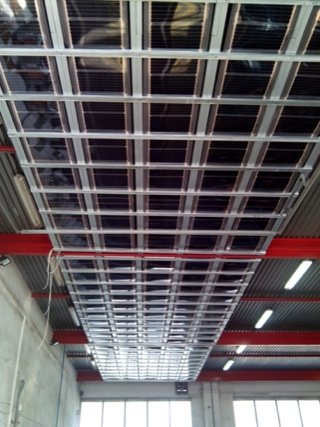
Infrared ceiling heating behind plasterboard
The heating film goes on the reflective foil, above the plasterboard supporting structure, and radiates downwards. The heating film is 50 cm wide, so there should be at least 55 cm between the upper hanger profiles.
Advantages of ceiling heating: it takes nothing from the ceiling height; the ceiling is not covered by furniture, so the whole surface can be heating surface; it can be built retrospectively, without breaking up the floor covering; it can be hidden behind a suspended ceiling. It is also a good choice for offices, hotel rooms and holiday homes, where heating does not have to be continuous but warmth is needed quickly. The reflective foil and the insulation of the slab are especially important here, so that the heat does not escape upwards.
More: ceiling heating.
Layers of ceiling heating
- PlasterboardThe visible ceiling.
- Plasterboard supporting structureA suspended profile frame.
- 4th-generation heating filmThe radiant heating element, radiating downwards. 0.4 mm
- Heat-reflecting foil (reflective foil)Reflects the heat towards the room.
- InsulationThermal insulation under the slab.
- SlabThe load-bearing structure.
Infrared wall heating
Wall heating is a good solution if you do not want to break up a covering during a renovation, or if there is not enough height under the floor. It is typically supplementary heating, because it can only be installed on free wall surface.
What is forbidden: covering the heated wall surface with furniture, and driving nails or screws into it afterwards. The heated wall can be covered with plasterboard or a wall rug.
More: wall heating. Step-by-step installation: how we install heating film (in Hungarian). Downloadable drawings: Layer build-ups (PDF, 2.3 MB, in Hungarian): the layer sequence of six installation methods in drawings: laminate flooring, carpet/linoleum, floor tile/wall tile, wooden parquet laid on cross battens, wall heating and ceiling heating. The sheet is a 2020 edition and calls the heating film "Intelligent Heating Foil"; the layer sequences have not changed since.
Layers of wall heating
- PlasterboardThe visible wall surface.
- 4th-generation heating filmThe radiant heating element, radiating towards the room. 0.4 mm
- Heat-reflecting foil (reflective foil)Reflects the heat from the wall side towards the room.
- Side wallThe existing wall.
What is needed under which floor covering?
Heating film can go under any of them; the difference is in the layers that go over it. Without a solid layer, with a simple layer build-up, laminate flooring and ship's deck flooring (solid wood) can go over the heating film. With every floor covering the warmth can be felt within 5–15 minutes, depending on the covering; a thicker covering with higher thermal resistance falls towards the upper end of the range.
| Floor covering | Is a solid layer needed over the heating film? | Typical output | What to watch for |
|---|---|---|---|
| Laminate flooring | Not mandatory | 110–220 W/m² | No aluminium-faced underlay; the limit is the surface temperature permitted by the manufacturer |
| Vinyl | Yes: it must not go directly onto the heating film | 110–220 W/m² | The temperature limit of the floor covering manufacturer must be kept |
| Parquet, ship's deck flooring | Not mandatory (possible) | 110–220 W/m² | Wood has a higher thermal resistance, so count on the upper end of the range |
| Tile, floor tile | Yes: 4–5 cm of concrete or 1.5–2 cm of dry screed | 220 W/m² | The adhesive sets on the solid layer, never on the heating film |
| Carpet flooring | Yes | 220 W/m² | Underfloor heating is not worth planning under a thick carpet |
| PVC | Yes | 220 W/m² | The heat resistance of the covering must be agreed in advance |
| Plasterboard ceiling | No | 220–400 W/m² | 50 cm heating film → at least 55 cm between profiles |
| Plasterboard wall | No | 220 W/m² | Covering it with furniture and drilling into it afterwards is forbidden |
The output is in every case given by the heat loss of the building; the table shows only typical values. We give the exact layer build-up and output after the on-site survey.
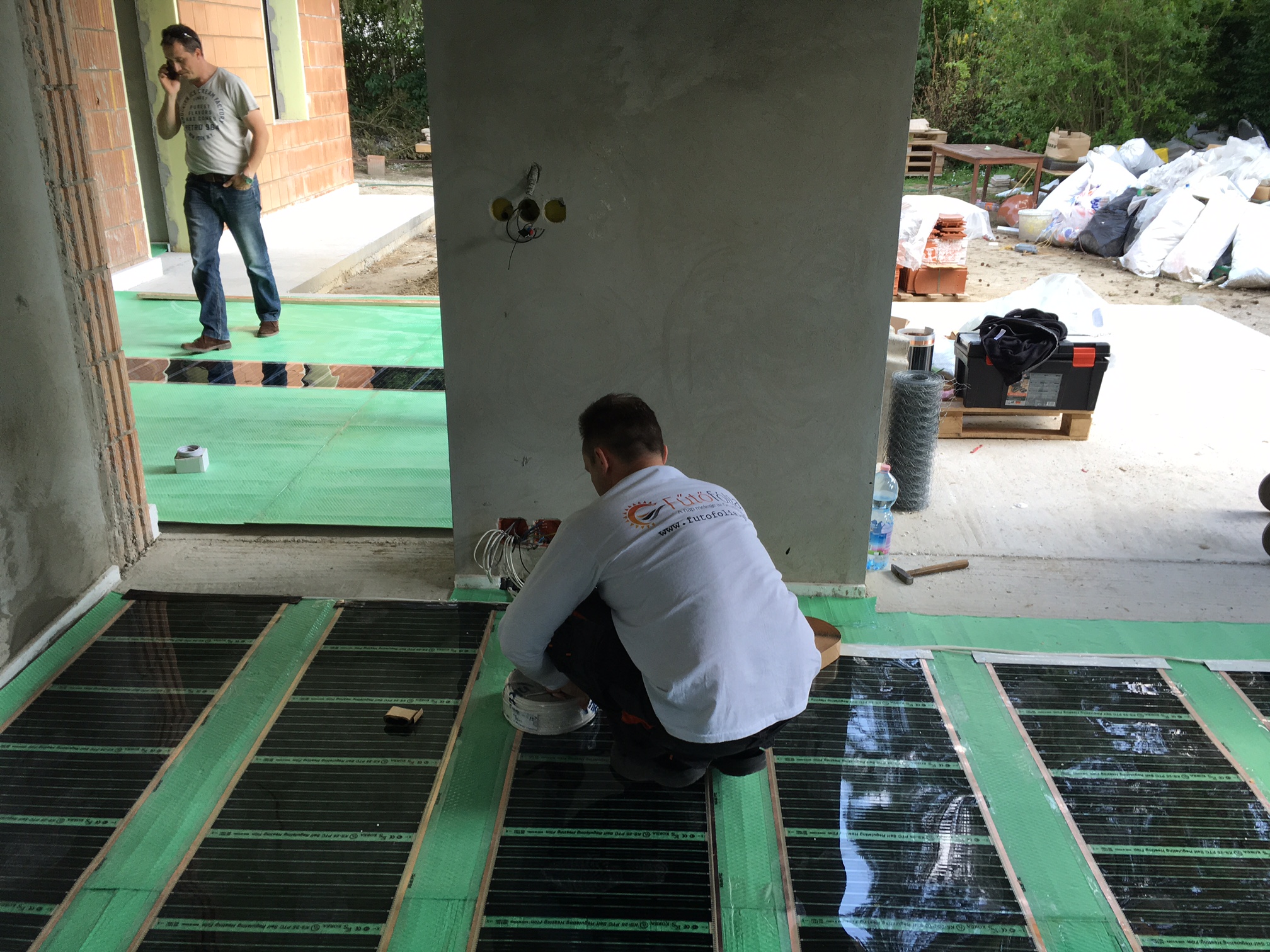
The installation process, step by step
Installing an average 150 m² family house usually takes a day. With plasterboard or a warm floor covering one visit is enough; with concrete two, the second 3–4 weeks after the concrete is poured, for commissioning. Installation is available in Hungary.
- 1
Preliminary discussion
By phone or in person we go through your needs and the characteristics of the property. If you have a floor plan, please send it.
- 2
On-site survey
We look at the building, the insulation, the floor coverings and the electrical network.
- 3
Technical proposal and quote
For each room we give the type and quantity of heating film and the control, with an exact sum, and we agree the date.
- 4
Preparation
We hand over what must be prepared: a flat, dry, dust-free substrate, an empty room, the positions of the junction and thermostat boxes.
- 5
Installation
We measure again, cut the heating film to size and connect it, and build up the layers to suit the floor covering.
- 6
Floor covering
Under laminate it is simple; under tiles, concrete or dry screed goes in first, and gluing directly onto the heating film is forbidden.
- 7
Commissioning and handover
We connect the thermostats and commission the system, and the electrician issues the electrical safety report. The warranty starts on the day of commissioning.
Sizing, thermostat, zones, electrical preparation

Sizing: we start from the heat loss
The output you need is determined not by the floor area but by the heat loss of the building. As a starting point, 110 W/m² is typical for a new, well-insulated house and 220 W/m² for a renovation; the third output level is 400 W/m². Heating film covers 60–70% of the floor area. If you have a floor plan, we can calculate from it, room by room, where how much heating film goes.
Thermostat and zones
Every room or heating circuit gets its own thermostat and a separate supply, so the bedroom can be cooler and the bathroom warmer. Connecting a suitable thermostat is mandatory. The heating film has a sensor, and the highest surface temperature can be regulated with the thermostat: 40–45 °C for 220 W/m² film, 35 °C for 110 W/m². Thermostats: thermostat for infrared heating.
Can infrared heating be the only heating of a house?
Yes, if the system is sized according to the heat loss of the building. In our own 2025 case study, a new 97 m² house with a 5 kW solar system would have met the energy requirement for the occupancy permit with heating film alone. In a poorly insulated house, however, the first step is insulation; without it every heating is expensive. Wall heating and infrared panels are typically supplementary heating.
How long does it take to warm up?
The warmth can be felt within 5–15 minutes with every installation method, depending on the floor covering: in the floor, wall, ceiling and built into concrete alike. People and objects feel the heating effect of radiation first; the difference lies not in the time of the sensation but in the thermal inertia of the structure: heating film embedded in concrete cools down more slowly and gives off heat for a long time after switch-off.
Electrical preparation
The connection is made by a qualified electrician, after which an electrical safety inspection and report are mandatory. The heating should preferably be a separate network, with each heating circuit on its own supply, leaving space in the distribution board for the residual-current devices. The basic connection is 1×32 A; how much is available to you can be read on the main fuse.
Electrosmog: what does the instrument measure?
Infrared thermal radiation is the same kind of radiation that every warm surface emits; we wrote about this above. The real question about electric heating is the electric and magnetic field, popularly known as electrosmog. We answer that not with opinion but with our own measurement (KMOON GM3120 instrument; this is not a laboratory test):
- on the surface of a 220 W/m² heating film, not installed: 345 V/m;
- under a 2 cm Rigidur board: 273 V/m;
- at a height of 20 cm: 0 V/m;
- covered with EMF foil: 0–1 V/m;
- the magnetic field: 0.16–0.93 µT.
The Hungarian regulation (ESzCsM Decree 63/2004 of 26 July) sets residential limits of 5,000 V/m for the 50 Hz electric field and 100 µT for the magnetic field. The 345 V/m measured on the uninstalled heating film is 6.9% of that. For comparison, with the same instrument we measured 525 V/m on a laptop adapter.
We fit heating film with an earthing mesh in every case, and commissioning is concluded with an electrical safety inspection: this is a mandatory part of the layer build-up and the installation, not an option.
Anyone who wants to avoid even the minimal field strength can ask for EMF foil over the heating film. The full measurement with frames and video: electrosmog: measurement results. On the common fears: is infrared heating harmful? (in Hungarian)
The advantages of infrared heating
The main advantage of infrared heating is that it heats by radiation: the warmth comes from the surfaces, not with circulating air. The rest follows from this: even heat distribution, room-by-room control, no boiler and no maintenance.
Comfort
Even heat distribution: a small temperature difference between floor and ceiling. No air movement, so it does not stir up dust. It does not dry the air, because it does not heat the air. No radiator on the wall, so the living space can be furnished freely.
Economy
1 kWh of electricity = 1 kWh of heat, without loss. Can be controlled room by room and to the hour. No maintenance cost, because there are no moving parts and no chimney sweeping. With every installation method the warmth can be felt within 5–15 minutes, depending on the floor covering.
Health and protection of the building
Non-ionising thermal radiation, in the same range in which human skin radiates. Less stirred-up dust, which is also favourable for allergy sufferers. Less moisture condenses on a warmer wall surface, which reduces the chance of mould.
Uses
The 0.4 mm heating film can be installed almost anywhere: in the floor, ceiling, wall, as main or supplementary heating. In flats, offices, shops, halls, holiday homes, polytunnels and churches alike: among our references there is an example of each.
The disadvantages of infrared heating: when is it not the right choice?
Infrared heating is not the best solution everywhere. We say so at the survey too; here it is in advance, in one place:
- It does not make hot water and does not cool. If you also want domestic hot water or summer cooling from your heating, you need another system alongside.
- With poor insulation every heating is expensive, this one too. In that case the first step is insulation, not changing the heating.
- The whole house's electricity consumption counts towards one allowance. The household's whole consumption counts towards the discounted residential electricity allowance, not just the heating; with a large heated floor area this must be counted on in advance.
- A larger electrical connection may be needed. 1 m² of 220 W/m² heating film draws about 1 A, and 110 W/m² about 0.5 A; above 20 m² of heating film a three-phase connection is probably needed, and the upgrade carries a fee.
- It goes behind the floor covering or plasterboard. Under tiles 4–5 cm of concrete or 1.5–2 cm of dry screed is also needed, which raises the floor level; with concrete two visits are needed, the second 3–4 weeks later.
- The limits of wall heating. The heated wall surface must not be covered by furniture, and nails or screws must not be driven into it afterwards.

It is worth a look if there is no existing, working heating system, or the building is just being built or renovated; if the house is well insulated with a low heat demand; if you want to control the heating room by room; or if you use the building only occasionally.
In detail: the disadvantages of infrared heating (in Hungarian).
Myths and misunderstandings about infrared heating
The eight most frequently recurring claims, and which of them is true. The short answer: heating film is infrared heating if the layer build-up allows the radiation; with solar panels it becomes cheaper, but not free; furniture can go on self-regulating heating film.
"All heating film is infrared heating."
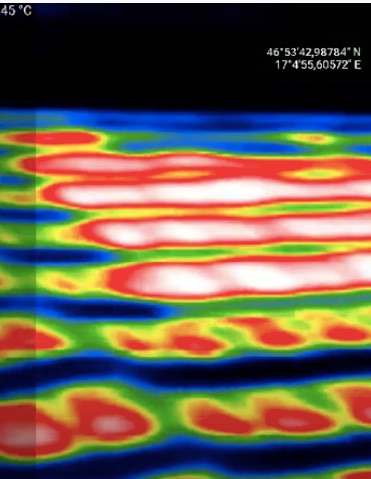
Not quite. Heating film radiates, but whether the radiation reaches the room depends on the layer build-up: an impact-sound underlay faced with aluminium, for example, reflects it, and then the heat gets through mainly by conduction. That is why what goes over the heating film matters.
"I can heat for free with solar panels."
Nobody can promise zero-forint heating: since 2024 new household solar systems in Hungary are on gross metering. A solar system can reduce the electricity cost of heating, but does not bring it to zero.
"I cannot put furniture on a heated floor."
With the 1st and 2nd generations an air gap really did have to be left. Self-regulating (3rd and 4th-generation) heating film reduces its output by about 25% where heat cannot escape.
"The radiation of infrared heating is dangerous."
Thermal radiation is the same kind that every warm surface emits. According to our own measurement the electric field is 6.9% of the limit even on the surface of the heating film, and 0 V/m at a height of 20 cm.
"It is only good as supplementary heating."
We size heating film as stand-alone heating from the heat loss of the building. In our 2025 case study a new 97 m² house with a 5 kW solar system would have met the energy requirement with heating film alone. Wall heating and infrared panels, however, are typically supplementary heating.
"Infrared heating dries out the air."
It does not heat the air, so it does not dry it the way high-temperature systems that heat the air do. It also creates no air movement, so it does not stir up dust.
"Heating under the floor covering is not infrared heating."
Quite the reverse: the floor covering warms up and itself becomes the radiating surface, in the same long-wave range in which the heating film radiates. This is how the heat gets through.
"Electric heating is always dearer."
1 kWh of electricity = 1 kWh of heat. Whether it is dearer overall is decided by the heat loss of the building and current prices: the comparison table shows this.
Three installations, three lessons
Three installations of our own, in three different situations: a parents' house instead of wood burning, a shop with a high ceiling and ceiling heating, and an installer's opinion on choosing between a heat pump and infrared heating.

Infrared heating instead of wood burning in the parents' house
Tamás Tóth replaced wood burning in his own parents' house, after ten years of persuasion.
Részletek →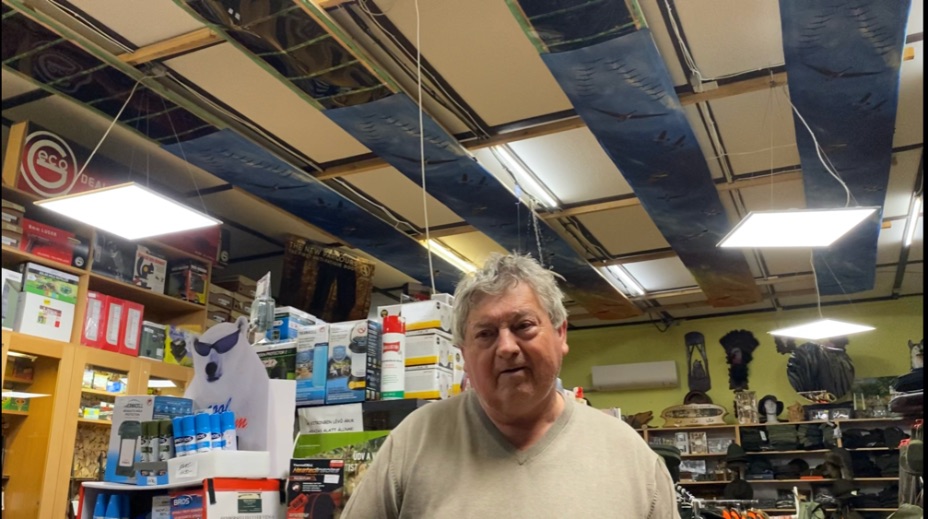
Hunting shop, ceiling heating
Csorna, 4 m ceiling height, glass shopfront, 400 W/m² in the ceiling: it works for retail premises too.
Részletek →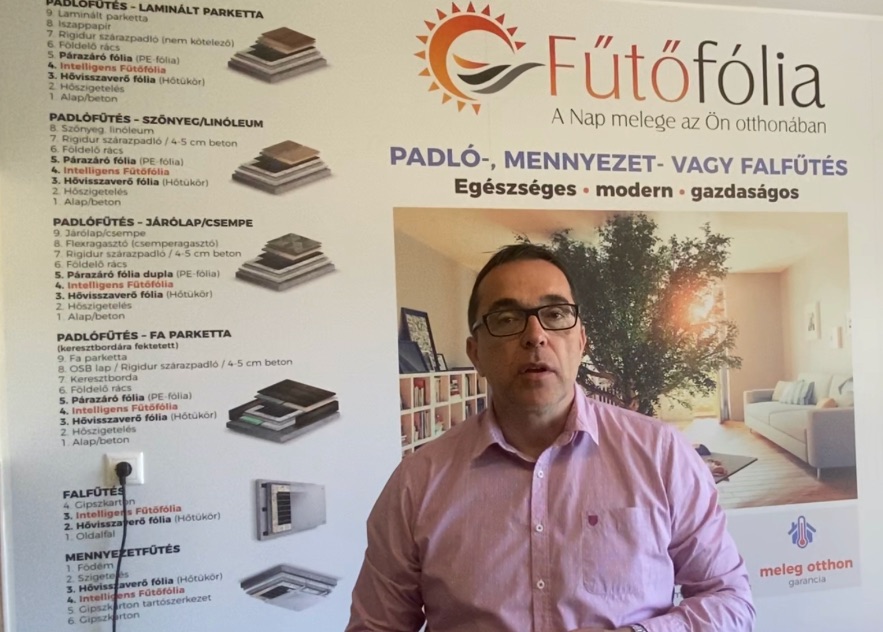
An installer's opinion
Zsolt Mánya, managing director of Mavit Building, on choosing between a heat pump and infrared heating.
Részletek →Tamás Tóth, founder of Fűtőfólia
Behind the claims on this page stand our own installations, our own measurements and our own technical proposals. The company has worked with infrared heating film since 2012 and has carried out more than 5,000 installations.
"I gladly recommend this heating system to anyone who wants warm, comfortable and economical heating. With Intelligent Heating Foil, the warmth of the Sun comes into your home."

Tamás Tóth is the founder and managing director of the company, and the president of the Hungarian National Electric Heating Association (MOEFSZ). He is the author of every article on our blog: Tamás Tóth's author page.
If you have a question this page does not answer: frequently asked questions, or call +36 20 400 7400.

Feel it yourself: a showroom in Budapest
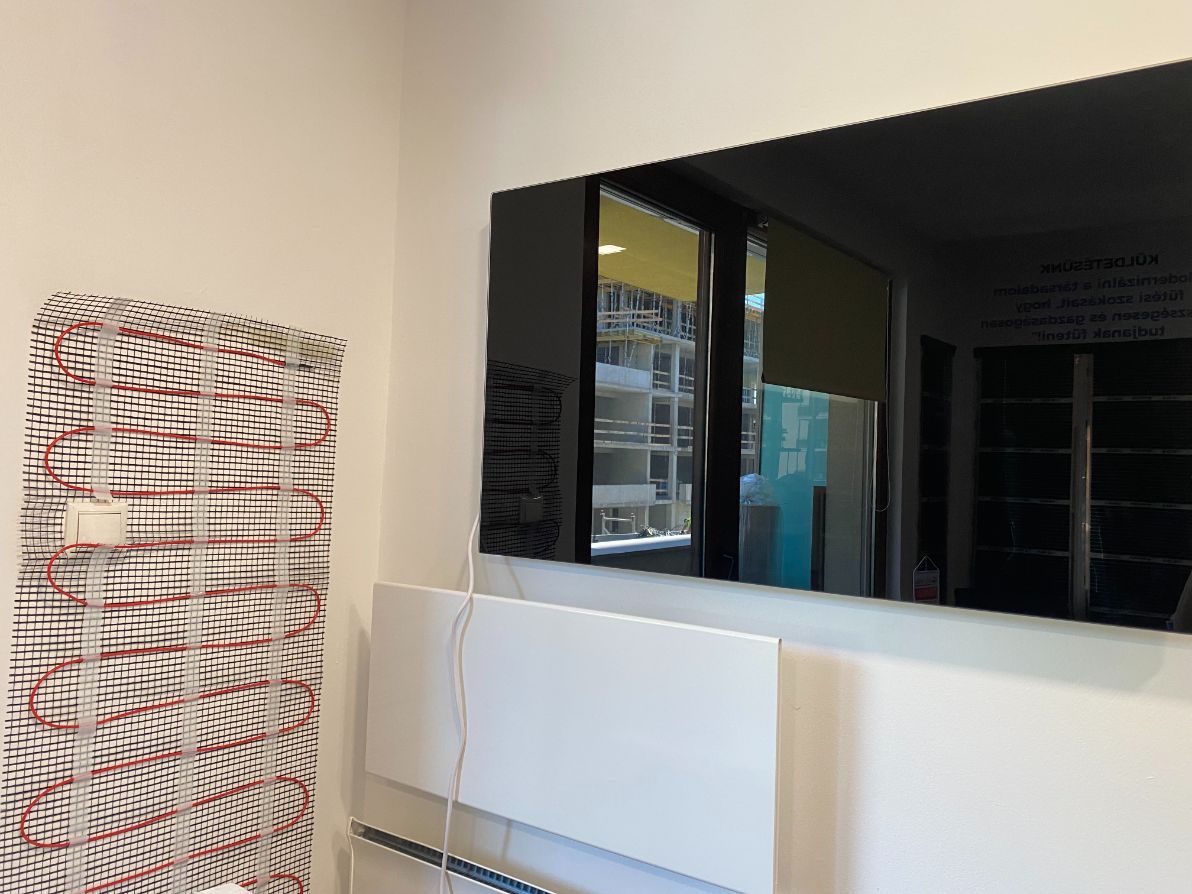
Infrared heating is best tried live. According to the company, our Budapest showroom is the largest infrared heating showroom in Hungary: you can handle 4th-generation heating film, and see it switched on with a thermal camera.
Address: Rákóczi u. 4, 1039 Budapest
Phone: +36 20 400 7400: it is worth arranging a visit in advance.
We have worked with infrared heating film since 2012 and have carried out more than 5,000 installations. The company's founder and managing director, Tamás Tóth, is the president of the Hungarian National Electric Heating Association (MOEFSZ).
A 15.5-year warranty on 4th-generation heating film when we do the installation. Installation across Hungary: heating film across Hungary.
Frequently asked questions about infrared heating
What is infrared heating?
Infrared heating is electric, radiant heating: the heating element (heating film, infrared panel or dark radiator) warms the floor, walls, furniture and people directly with long-wave infrared radiation, and the air warms only from them. It has no boiler, chimney, pipework or moving part, it converts the electricity it draws entirely into heat, and it can be controlled room by room. Types: types of electric heating.
How does infrared heating work?
The heating element of infrared heating warms up and gives off the larger part of its heat by radiation: according to Wien's law the radiation of heating film at 40–45 °C peaks at about 9.1–9.3 µm, in the long-wave infrared range. The floor, walls, furniture and people absorb the radiation, and because the surfaces are warm, the same sensation of warmth arises at a lower air temperature, in our experience 2–3 °C lower. In detail: why infrared heating can use less (in Hungarian).
How much electricity does infrared heating use?
The consumption of infrared heating is determined by the heat loss of the building: according to the planned data of ten houses of our customers, 26–75 kWh of electricity per square metre per year is needed. At full output 1 m² of 110 W/m² heating film draws 0.11 kWh per hour and 220 W/m² film 0.22 kWh, but the thermostat switches off once the set temperature is reached. Ten examples and a calculator: How much electricity does infrared heating use?
How much does it cost to install infrared heating?
Installing infrared heating with 4th-generation heating film costs HUF 11,250–18,000 per m² gross in 2026, including installation, calculated on the floor area to be heated, so HUF 1,125,000–1,800,000 for 100 m². The price does not include forming the junction and thermostat boxes, the floor covering, the mandatory electrical safety inspection and any grid capacity increase. We give the exact price after the on-site survey. Price and installation: heating film across Hungary.
What are the disadvantages of infrared heating?
The main disadvantages of infrared heating: it does not make hot water and does not cool, with poor insulation, like any heating, it is expensive, and a larger electrical connection may be needed (typically three-phase above 20 m² of heating film). The household's whole consumption counts towards the discounted residential electricity allowance, not just the heating. The heated wall surface must not be covered by furniture, and nails must not be driven into it afterwards.
Is infrared heating harmful to health?
The thermal radiation of infrared heating is the same kind of non-ionising infrared radiation that every warm surface emits, and we know of no harmful health effect from it in normal heating use. We examined the electric field with our own measurement: 345 V/m on the surface of a 220 W/m² heating film, 0 V/m at a height of 20 cm, 0–1 V/m when covered with EMF foil; the residential limit is 5,000 V/m. Measurement: electrosmog: measured values.
How long does an infrared heating installation take?
Installing heating film in an average 150 m² family house usually takes a day. With a plasterboard ceiling or a warm floor covering one visit is enough; with concrete two, the second 3–4 weeks after the concrete is poured, for commissioning. The floor covering comes on top of this, and commissioning is concluded with an electrical safety inspection.
Is it worth combining infrared heating with solar panels?
Infrared heating can be combined with solar panels, and a solar system can reduce the electricity cost of heating, but does not make it free. Since 1 January 2024 new household solar systems in Hungary are on gross metering; only systems applied for by September 2023 and commissioned by 1 January 2026 at the latest can remain on net metering, for 10 years at most. More: Solar heating: myth or real saving? (in Hungarian)
Can infrared heating be the only heating of a house?
Infrared heating can be the only heating of a house if the system is sized according to the heat loss of the building. In our own 2025 case study, a new 97 m² house with a 5 kW solar system would have met the energy requirement for the occupancy permit with heating film alone; in a poorly insulated house we recommend improving the insulation first. Wall heating and infrared panels, however, are typically supplementary heating. Sizing: on-site survey.
Does infrared heating need a permit to install?
For infrared heating in an existing house the mandatory step is the electrical safety inspection and report, which the electrician issues. If a connection above 32 A is needed, the capacity increase must be arranged with the electricity supplier; for a new house the energy certificate must satisfy the Hungarian energy performance decree (9/2023 ÉKM) for the occupancy permit. Preparation: before installing infrared heating (in Hungarian).
How quickly does infrared heating warm up a room?
The warmth can be felt within 5–15 minutes with every installation method, depending on the floor covering: in the floor, wall, ceiling and built into concrete alike. People and objects feel the heating effect of radiation first; the thickness and material of the floor covering determine where you are within the range. Heating film embedded in concrete cools down most slowly and gives off heat for a long time after switch-off.
Is infrared heating safe for children and the elderly?
Infrared heating runs at a comfortable surface temperature: the surface temperature of 220 W/m² heating film can be limited by the thermostat to 40–45 °C, and that of 110 W/m² film to 35 °C, and the surface of the floor covering is cooler still. The heating film is under the floor covering, there is no hot surface or sharp corner in the room, and no open flame, combustion products or carbon monoxide. The connection is made by a qualified electrician, and commissioning is concluded with a mandatory electrical safety inspection.
What is the difference between heating foil and heating film?
None: heating foil and heating film are the same product. The two words are only a distinction made by sellers; there is no technical difference between them. The real difference lies in the generations: whether the heating foil is self-regulating (PTC), and how the carbon paste makes contact with the copper strip.
Is all heating film infrared heating?
Not every foil-shaped heating system gives radiant heat: some work predominantly by heat transfer. What goes over the heating film also matters: an impact-sound underlay faced with aluminium, for example, reflects the radiation. So ask the seller for an exact technical description, an installation layer build-up and a reference.
How does heat get through concrete or the floor covering?
The radiation of the heating film does not go through the concrete: long-wave infrared is absorbed a few micrometres deep, the layer above it warms up, and from there the heat travels on by conduction. The warmed floor surface itself becomes the radiating surface: according to Wien's displacement law a surface at 24–29 °C radiates at about 9.6–9.8 µm, in the same long-wave range as the heating film itself.
Under which floor coverings can heating film be installed?
With a simple layer build-up, without a solid layer, laminate flooring and ship's deck flooring (solid wood) can go over the heating film. Under vinyl, PVC, carpet flooring, tile and floor tile, 4–5 cm of concrete or 1.5–2 cm of dry screed is needed over the heating film: these floor coverings must not go directly onto the heating film, and the adhesive never sets on the heating film. An impact-sound underlay faced with aluminium is not suitable under any floor covering, because it reflects the radiation.
Can I put furniture on a heated floor?
With self-regulating (3rd and 4th-generation) heating film, yes: where heat cannot escape, the heating film reduces its own output by about 25%, while that of the surfaces left free does not change. With the non-self-regulating heating films made before 2015 a 4–5 cm air gap had to be left between the underside of furniture and the floor, and the positions of furniture had to be planned in advance.
What output of heating film do I need?
The output is determined by the heat loss of the building, not the floor area. As a starting point, 110 W/m² is typical for a new, well-insulated house and 220 W/m² for a renovation, and the third level is 400 W/m². Heating film covers 60–70% of the floor area. The exact value comes from the on-site survey and the heat-loss calculation.
Infrared heating in detail
4th-generation heating film
Construction, contact strip, self-regulation.
Electric underfloor heating
Layer build-ups under laminate, tile and concrete.
Ceiling heating
If you do not want to touch the floor.
Wall heating
Supplementary heating behind plasterboard.
Consumption calculator
Estimate the heating cost of your own house.
How much electricity does infrared heating use?
Consumption data of real properties.
Electrosmog
The full measurement, with pictures and video.
Infrared panel
A visible radiant heater on the wall or ceiling.
Panel heater
An electric heater that warms the air.
Thermostat
Room-by-room control, WiFi control.
Infrared heating reviews
Our customers' experiences.
The disadvantages of infrared heating
What you need to know before you decide.
Heating film across Hungary
Price, installation and travel across the country.
Frequently asked questions
All the questions and answers in one place.
The history of infrared heating
From Herschel's discovery to today's heating film.
Terrace heating, dark radiator
Outdoor and industrial infrared heating.
Heat pump or infrared heating?
2026 cost comparison, assumption by assumption.
Web shop
Infrared panels, thermostats, heating film and accessories (Hungarian-language shop, delivery within Hungary).
Our references
Flat, office, shop, hall, church.
Request a quote — installation anywhere in Hungary
We survey, design and install heating film and infrared heating throughout Hungary. Tell us about your home and we will get back to you.
Sources
- Fűtőfólia — own data: since 2012, more than 5,000 installations; 15.5-year warranty on 4th-generation heating film when we do the installation (the client's decision); showroom: Rákóczi u. 4, 1039 Budapest (2026-09)
- Fűtőfólia — the earlier /infrafutes/ page: heat transfer, types, generations, layer build-ups, limits of wall heating (2022-07)
- Fűtőfólia — 4th-generation heating film (construction, contact strip) (2025-09)
- Fűtőfólia — Layer build-ups (Retegrendek-2020.pdf) and pre-installation checklist (2020-07)
- Fűtőfólia — own electrosmog measurement with a KMOON GM3120 instrument (video) (2020-04)
- Fűtőfólia — case study: occupancy permit with electric heating, a new 97 m² house (2025-06)
- Investment calculator: Lite 11,250, Standard 14,625, Premium 18,000 HUF/m² gross, including installation (2026-09)
- Fűtőfólia — assumptions of the consumption calculator (medium insulation: 75 kWh/m²/year, 7-month heating season) (2026-09)
- Wikipedia (Hungarian) — Heat transfer (conduction, convection, thermal radiation) (2026-09-14)
- Wikipedia (Hungarian) — Infrared radiation (780 nm – 1 mm; LWIR 8–15 µm) (2026-09-14)
- Wikipedia (Hungarian) — Wien's displacement law (2026-09-14)
- Wikipedia — Operative temperature (ANSI/ASHRAE 55, ISO 7730) (2026-09-14)
- ista — Energy saving tips (1 °C = at least 6% of heating cost) (2026-09-14)
- officina.hu — What does 1 kWh of electricity cost in 2026 (2026-09)
- officina.hu — The price of electricity above 210 kWh a month (2026-09)
- MVM Optimum — On the introduction of gross metering (2024-01-26)
- MNNSZ — Changes in the regulation of net and gross metering (2025-06-20)
- ESzCsM Decree 63/2004 (26 July) on the residential limit values of electric, magnetic and electromagnetic fields between 0 Hz and 300 GHz (Hungary) (2026-09-14)
- ÉKM Decree 9/2023 (25 May) on determining the energy performance of buildings (Hungary) (2026-09)
- Fűtőfólia — consumption case studies: planned data of ten properties (26–75 kWh/m²/year) (2022)
- Fűtőfólia — heat pump or infrared heating: 2026 cost comparison, assumption by assumption (2026-07)
- Google reviews: 436 reviews, average 5.0 (src/data/velemenyek.json, updated: September 18, 2026)
- Fűtőfólia — the emissivity table of the earlier /infrafutes/ page (emisszio.jpg); indicative values, rebuilt as an HTML table (2020-04)
- Transmetra — Table of Emissivity of Various Surfaces (for comparison; from data in the Handbook of Chemistry and Physics) (2026-09)
- CIE e-ILV — the range boundaries of infrared, ultraviolet and visible radiation (CIE S 017 / ISO 20473 division: IR-A 780–1400 nm, IR-B 1.4–3 µm, IR-C 3 µm – 1 mm; UV 100–400 nm) (2026-09-18)
- NIST/CODATA — the constant of Wien's displacement law (b = 2.897 771 955 × 10⁻³ m·K); the radiation peaks were calculated from it (2026-09-18)
- NASA Sun Fact Sheet — the effective temperature of the Sun, 5,772 K (2026-09-18)
- Fűtőfólia — own technical experience: the surface temperature of an infrared panel in operation can be as high as 80–90 °C, compared with 20–28 °C for a heated floor covering (2026-09)
- Fűtőfólia — own article material: the heating film warms the screed and floor covering above it, and the surface of the floor covering becomes the radiating surface (typically 20–28 °C, within the limit permitted by the floor covering manufacturer); the reflective foil goes under the heating film (2026-09)
- Fűtőfólia — own technical material: 4th-generation heating film is self-regulating (on the product "4th GENERATION PTC PREMIUM HEATING FILM"); with non-self-regulating types a 4–5 cm air gap was needed under furniture; it can be tried switched on in the showroom (2026-09)
- Fűtőfólia — warranty terms: a 10-year guarantee on the 3rd-generation product, a 15.5-year warranty on 4th-generation heating film when we do the installation (the earlier /infrafutes/ and the /negyedik-generacios-futofilm/ page, 2020–2026) (2026-09)
- Fűtőfólia — the layer build-ups layer by layer are sourced on the /padlofutes/, /mennyezetfutes/ and /falfutes/ pages; the installation process on the /igy-telepitjuk-a-futofoliat/ page (2026-09)