

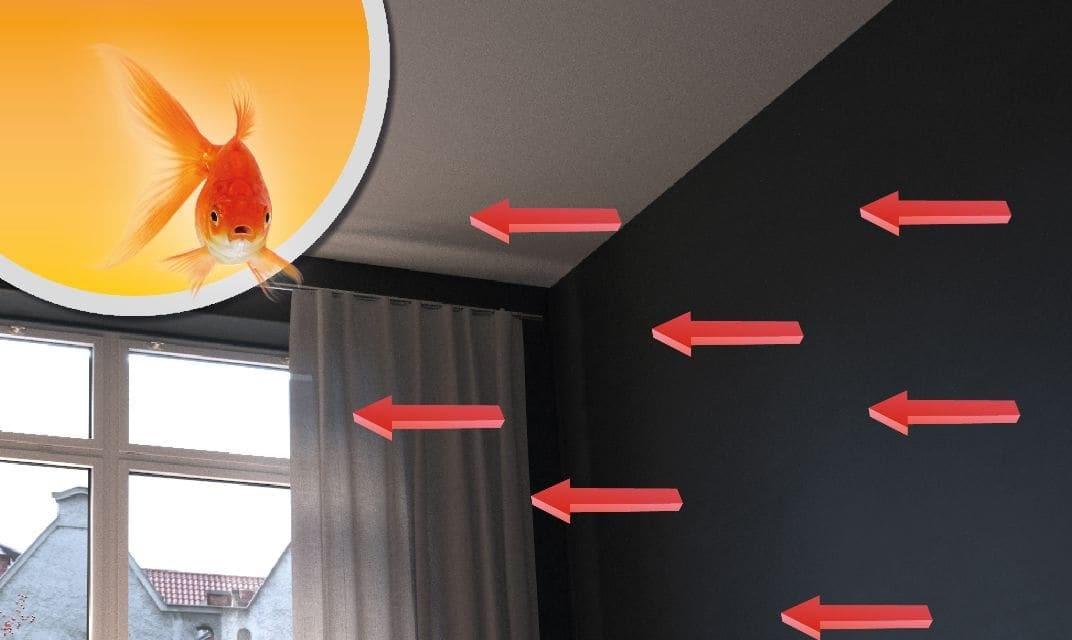
Infrared wall heating with heating film
In wall heating, heating film with a reflective foil goes on the wall and is covered with plasterboard or a wall rug. It is a good choice if you do not want to break up the floor covering during a renovation, or if there is no build-up height under the floor, and it also helps with damp, mouldy walls. It can only be placed on free wall surface, so it is mostly supplementary heating.
When is wall heating worth choosing?
Wall heating is infrared heating just like floor or ceiling heating: the surface of the wall radiates heat into the room, while the reflective foil bounces back the heat heading towards the wall. The layer build-up is thin and simple.
There are two situations in which it is usually the best solution. In a renovation, if you do not want to break up the floor covering, or there is not enough height under the floor. And for damp, mouldy walls, because a wall surface kept warm dries out.
Its limitation also comes from the wall: heating film can only go on free wall surface. If a wardrobe or sofa is placed in front of the heated section of wall, it reduces the output. That is why wall heating is rather a supplementary heating; for complete heating, floor or ceiling heating is the more obvious choice.
What wall heating can do, and what it cannot
No floor demolition
The film goes on the existing wall; the floor covering does not need to be touched.
Drier wall
The heating raises the wall temperature, the dew point moves outwards and the breeding ground for mould disappears.
Részletek →Free wall surface needed
No wardrobe or sofa may be placed in front of the heated section of wall, because it reduces the output of the heating film.
Supplementary role
Since only free wall surface can heat, wall heating mostly supplements floor or ceiling heating.
Infrared wall heating layers
Wall heating has the thinnest layer build-up: from the room side, plasterboard, under it the heating film, then the reflective foil, directly on the wall.
- Plasterboardor a wall rug: the covering on the room side
- Intelligent heating film
- Reflective foilreflects the heat towards the room
- Side wall
A real case: the mould in the flat disappeared
Tibor Kiss, an electrical engineer, was looking for a solution to recurring mould in his daughter's flat. He first tried the technology with a sample of heating film, and then intelligent heating film was installed in the flat too, facing the mouldy wall.
The mould disappeared completely and has not come back since. The explanation: the heating raised the temperature of the walls, the dew point moved outwards, and so the breeding ground for mould disappeared.
Tibor Kiss's full account (in Hungarian)
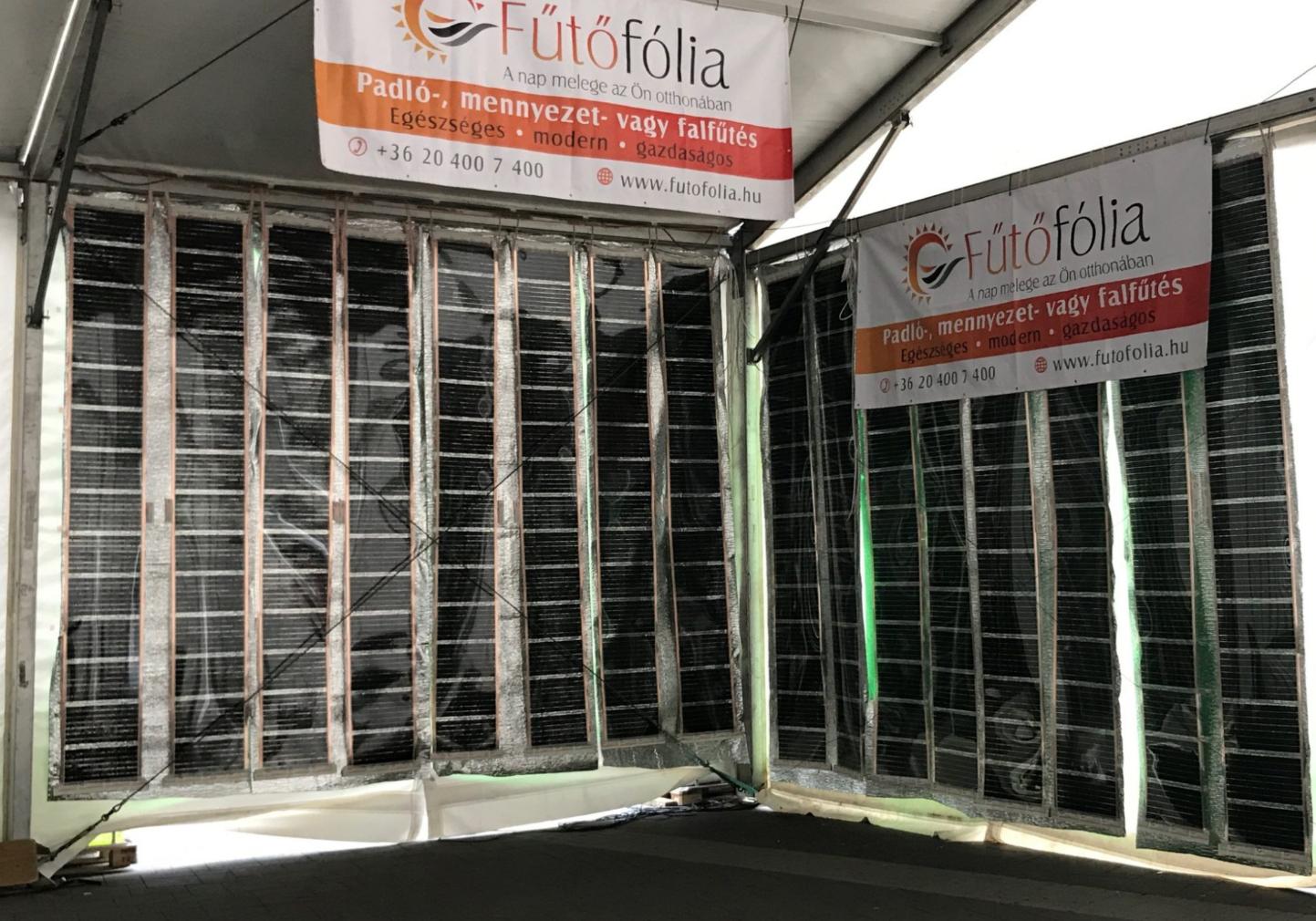
Wall-mounted heating film, without a covering
The picture shows the heating film on the wall without a covering, together with the strips of reflective foil. In a home the same layer build-up goes behind plasterboard or a wall rug, so nothing of the heating is visible on the finished wall.
Wall heating also works in temporary structures: we have used it to heat event tents.
Tent heating with heating film at a festival (in Hungarian)
Questions about wall heating
When is wall heating worth choosing?
Infrared wall heating is worth choosing if you do not want to break up the floor covering during a renovation, if there is not enough build-up height under the floor, or if a damp, mouldy wall needs to be dried out. Heating film can only go on free wall surface not covered by furniture, so wall heating mostly supplements floor or ceiling heating, and the solutions can be combined within one home. References: infrared wall heating: reviews (in Hungarian).
What are the layers of wall heating?
Seen from the room, the layers of wall heating are: plasterboard or a wall rug, under it the heating film, then the reflective foil, directly on the wall. This is the thinnest infrared heating layer build-up: the reflective foil bounces the heat heading towards the wall back into the room, and nothing of the heating is visible on the finished wall. Other layer build-ups: infrared heating: where it can be installed.
Can I put furniture in front of wall heating?
It is not recommended to put furniture in front of the heated section of the wall, because a wardrobe or sofa covers the radiating surface and reduces the output of the heating film. That is why we design wall heating for free wall surfaces, and nails or screws must not be driven into the heated wall afterwards. For a room full of furniture the ceiling is better: ceiling heating.
Does wall heating help against mould?
On damp, mouldy walls wall heating can also dry out the surface: the heating raises the surface temperature of the wall, the dew point moves outwards in the wall structure, moisture does not condense on the surface, and the breeding ground for mould disappears. Tibor Kiss, an electrical engineer, got rid of recurring mould in his daughter's flat this way: the full account (in Hungarian).
Can wall heating be installed retrospectively?
Wall heating can be installed retrospectively, because the heating film with the reflective foil goes on the existing wall and is covered with plasterboard or a wall rug, so the floor covering does not need to be touched. That makes it a good solution for renovations and where there is not enough build-up height under the floor; we have also used it in temporary structures such as event tents.
Which is better: wall, floor or ceiling heating?
Wall, floor and ceiling heating are the same radiant infrared heating; the difference is in the installation: wall heating is the obvious choice as supplementary heating and for damp walls, floor heating for new builds, tiled floors and cold feet, ceiling heating for bedrooms, offices and renovations. The solutions can be combined within one home. Comparison: ceiling, floor or wall heating?
How is wall heating controlled?
Wall heating is controlled room by room with a thermostat or a smart-home system, so a different temperature can be set in each room and the heating runs only where and when it is needed. Each room or heating circuit gets its own thermostat and a separate supply; connecting a suitable thermostat is mandatory. Controls: thermostat for electric heating.
Related pages
Infrared heating: the basics
How it works, and what to consider before you decide.
Ceiling heating
If you do not want to break up the floor.
Electric underfloor heating
Layers by floor covering, price and consumption.
Wall heating references
Completed wall heating installations.
4th-generation heating film
How it differs from earlier generations.
Electrosmog: measured values
V/m on the film, under the covering and at 20 cm.
Request a quote — installation anywhere in Hungary
We survey, design and install heating film and infrared heating throughout Hungary. Tell us about your home and we will get back to you.
Sources
- futofolia.hu — Wall heating (old page: when it is a good solution, furnishing, covering, layers) (2022-07)
- futofoliatervezoknek.hu — wall heating layers ("suitable for drying out the surface of damp, mouldy walls") (2026-09)
- futofolia.hu — Tibor Kiss, electrical engineer: his experience with intelligent heating film (article) (2020-01)