

Electric Underfloor Heating in 2025: Film, Mat or Cable?
Author: Tóth Tamás · 9 min read
Heating film, heating mat or heating cable? Which electric underfloor heating suits laminate, vinyl or tile, what drives consumption, what solar adds today, and what build-up each solution needs.
Which electric underfloor heating is the right choice is decided mainly by the floor covering and the layer thickness that can be built in. Heating film suits laminate or vinyl flooring, where there is little space and fast warm-up is needed; a heating mat suits bathrooms, kitchens and tiles; a heating cable suits a new house, as electric main heating embedded in screed. All three need proper thermal insulation underneath, and all three can be controlled room by room with a thermostat.
In this comparison we go through the three solutions by type, the factors that affect consumption, the combination with solar panels and the build-up of layers for each floor covering. We have written about the differences between water-based and electric underfloor heating in a separate article.
Heating film, heating mat or heating cable: which is for what?
There is no general answer to the question "which is best" – what matters is which one suits the given room, floor covering and usage habits. The table below summarises the differences briefly.
| Criterion | Heating film | Heating mat | Heating cable |
|---|---|---|---|
| Typical floor covering | floating laminate flooring, vinyl | tiles, ceramic floor tiles, stone | cold or warm floor covering on screed |
| Installation height | very small | thin, goes into the adhesive bed | needs a thicker substrate |
| Response time | fast: warmth can be felt within 5–15 minutes, depending on the floor covering | faster than a cable embedded in screed because of the thin bedding | slower, but cools down slowly |
| Typical use | renovation, living room, bedroom, main heating | bathroom, kitchen, hallway, comfort heating | new build, main heating for a whole house |
Heating film (infrared heating, heating film) – small layer thickness, fast response
Heating film is a thin, large-area heating element, generally graphite- or carbon-based, which passes heat to the floor covering and the objects in the room by infrared radiation. The 4th-generation heating film we install is made with an increased carbon-paste surface and a full-width contact strip.
Advantages:
- Its installation height is very small, so it is especially good under laminate or vinyl flooring.
- It heats up quickly: after switching on, warmth can be felt within 5–15 minutes, depending on the floor covering.
- Thanks to the large heating surface, the heat distribution is even.
- It can be fitted in a retrofit renovation, when there is no room for a thick build-up of layers.
- It works well with smart thermostats and zone-by-zone control.
What to watch out for:
- Glued cold floor covering must not go directly on the film: tiles must be glued onto a solid layer, so a separate build-up is needed in that case. We show an example by floor covering in the description of our installation in Sitke.
- Many people worry about electrosmog. With a professionally installed, earthed system this is a technically manageable issue; we discuss our own measurement on the electrosmog page, and the common misconceptions in our article on the myths about infrared heating under floor coverings.
- The durability of films and the warranty given on them differ by manufacturer. We give a 15.5-year warranty on 4th-generation heating film if we carry out the installation.
When is heating film ideal? If you are looking for a solution under floating laminate or vinyl flooring with minimal increase in height; if it matters that you feel the effect within 5–15 minutes of switching on in the morning, depending on the floor covering; and if you would combine it with solar panels, where well-timed heating is an advantage.
Electric heating mat – the classic solution under tiles
A heating mat is essentially a thin heating cable fixed to a fibreglass mesh. It is simple to lay out: the 3.8 mm thick T-Mat heating mesh can be embedded directly in the tile adhesive or the levelling compound; the 1.8 mm thick F-Mat ALU heating mat is meant for under warm floor coverings (laminate, parquet).
- Advantages: made for under cold floor coverings (bathroom, WC, kitchen); relatively easy to plan and lay; its thin build-up allows use in renovations; good for comfort and supplementary heating.
- Limitations: because of the fixed mat width it is less flexible than a freely routed cable, and it is harder to work around built-in furniture. For main heating it is suitable only in a well-insulated room and with adequate power density.
- When is it ideal? In a bathroom, kitchen or hallway, if you want "warm tiles" with a simple, proven solution.
Electric heating cable – the greatest freedom in layout
A heating cable is the most flexible solution, but also the one that demands the most expertise. It is generally laid in screed or a thicker substrate.
- Advantages: the cable can be routed wherever and however the room requires; it is also suitable for main heating of larger spaces; as a good-quality system it is a durable solution.
- Limitations: it needs a thicker build-up (subfloor concrete, screed), so it is often hard to use in a renovation; installation requires careful planning; because of the larger heat-storing mass it reacts more slowly, but in return the heat is more even.
- When is it ideal? In new construction, if electric underfloor heating is planned from the start and it is to provide main heating for a whole house or a larger flat.
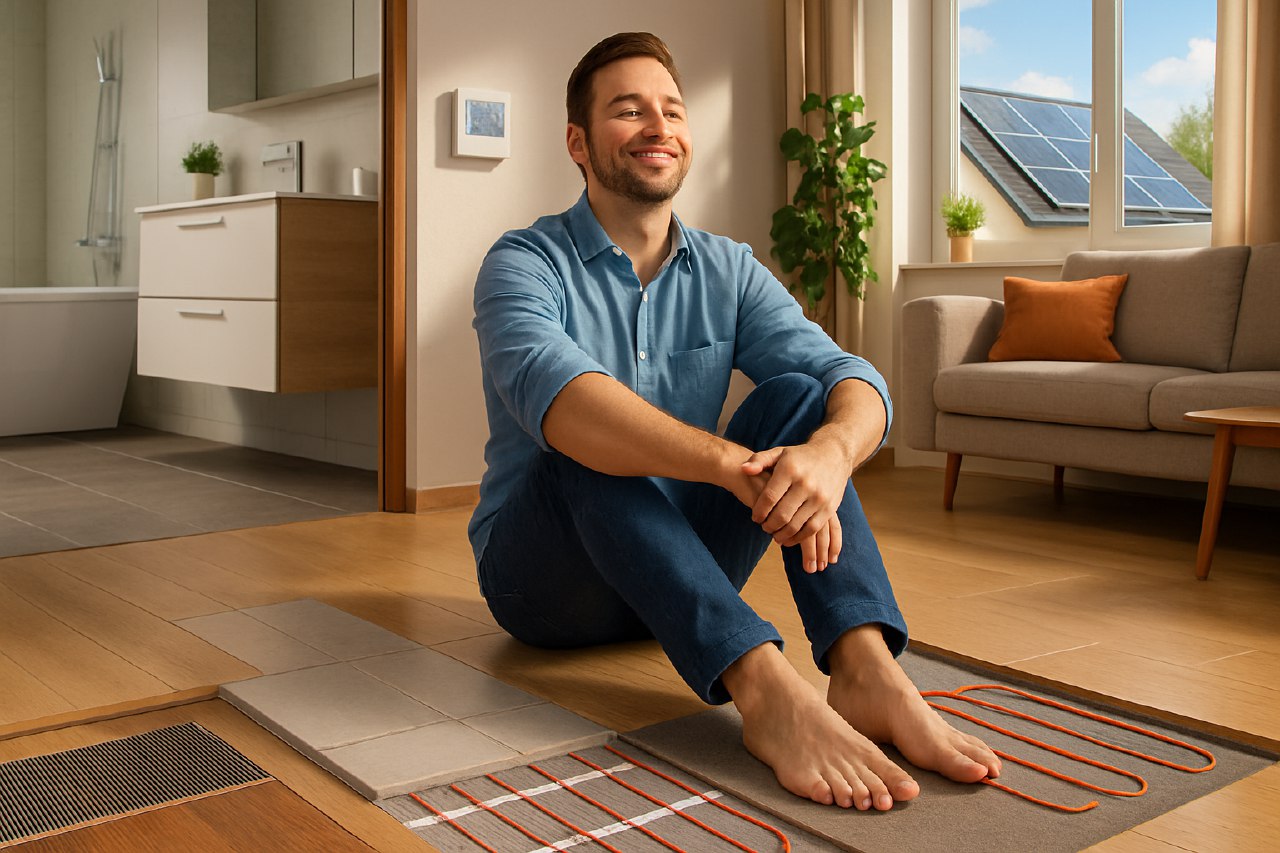
How much electricity does electric underfloor heating use?
Many people assume electric underfloor heating is expensive from the start. The reality is more nuanced: consumption depends largely on the building and the controls. The most important factors:
- the thermal insulation of the building,
- the heated floor area,
- the installed power (W/m²),
- usage habits: what temperature is kept and for how long.
As supplementary heating – for example for bathroom underfloor heating – in a well-insulated building and controlled by a thermostat, the extra monthly cost in our experience is often only a few thousand forints. For main heating, the exact consumption can be estimated from the building's heat loss; what this means in practice can be seen in two of our references measured with a separate electricity meter: a newly built family house and a holiday home. You can read more about the factors affecting consumption on our consumption page.
Combined with solar panels
With solar-powered underfloor heating, part of the heating's electricity is produced by your own solar system. The advantage is that there is no gas connection, boiler or chimney, so there is less maintenance, and the system is a simple electrical installation with hardly any moving parts.
The size of the saving today is also affected by the way electricity is accounted for. Since 1 January 2024, new household solar systems in Hungary operate on gross metering, meaning that the electricity fed into the grid and the electricity drawn from it are accounted for separately. Net metering can only be kept by systems applied for by September 2023 and commissioned by 1 January 2026 at the latest, for a maximum of 10 years. Solar panels can therefore reduce the electricity cost of heating, but the extent depends on the size of the system and on how much electricity is used while the panels are producing.
- The solar system must be sized for the total electricity consumption, including the heating.
- With smart control (timing, zones) the heating can be better matched to when the sun is shining.
The topic is discussed in more detail in our article on the real savings of solar heating and on our solar panel page.
Thermostat and zones: this is where your running costs are decided
A great advantage of electric underfloor heating is that it can be controlled room by room, zone by zone. With a programmable thermostat you can set when and where it should be warmer; with a Wi-Fi thermostat controlled by an app, consumption can be fine-tuned further. A well-set system heats only where and when people are actually present.
Build-up by floor covering: it matters what goes where
The choice is determined by the floor covering and the available layer thickness at least as much as by the type of heating element. The build-ups below are simplified and run from bottom to top; the exact design is always set by the manufacturer's instructions and the conditions on site.
Heating film under laminate and vinyl flooring
- Load-bearing substrate (concrete, screed)
- Walkable thermal insulation
- Reflective foil
- Heating film
- Vapour barrier film
- Earthing mesh and the underlay required by the manufacturer
- Laminate or vinyl floor covering
Proper thermal insulation must always go under the heating film, otherwise a significant part of the heat escapes downwards – we wrote about this in detail in our article on underfloor heating insulation. With laminate flooring, also pay attention to the highest surface temperature permitted by the flooring manufacturer.
Heating mat under tiles, ceramic floor tiles and stone
- Load-bearing substrate
- Thermal insulation, if the layer thickness allows
- Levelling compound, fixing layer
- Electric T-Mat heating mesh (embedded in the tile adhesive or the levelling compound)
- Flexible tile adhesive
- Cold floor covering (tiles, ceramic floor tiles)
This solution is meant specifically for the experience of warm floor tiles, for bathrooms and wet rooms.
Heating cable embedded in thicker subfloor concrete
- Load-bearing slab
- Thermal insulation
- Heating cable fixed with spacers or rails
- Thicker screed, subfloor concrete
- Floor covering adhesive
- The chosen cold or warm floor covering
The high-mass substrate cools down slowly, so it gives a stable temperature. For choosing the floor covering, our article on choosing a floor covering and, for parquet, the one on parquet and underfloor heating give further considerations.
Typical situations and what customers highlight
- Bathroom with a heating mat: the most common feedback is that warm floor tiles in winter give a comfort people would not want to give up afterwards, and consumption as supplementary heating stayed moderate.
- Living room with heating film under laminate flooring: they describe the warmth coming from the floor as natural and pleasant; controlled with a smart thermostat, the heating does not run unnecessarily.
- New house with full electric heating and solar panels: no gas, no boiler, hardly any maintenance, and the heating cost is predictable.
Which electric underfloor heating suits you?
- If you want warm tiles in the bathroom or kitchen: an electric heating mat.
- If you have laminate or vinyl flooring, little space, and want a fast response: heating film.
- If you are building a new house and are thinking of electric main heating: a heating cable embedded in screed, or heating film built under the concrete – this is best decided on the basis of the house's data.
What is the next step?
Online calculators and experiences read on forums help only in part, because every home, level of insulation and consumption habit is different. It is worth asking for a consumption and cost estimate with the data of the specific room – floor covering, floor area, the desired sense of warmth – including a version with solar panels and a smart thermostat.
You can ask for a technical recommendation on our request-a-quote page (installation is available in Hungary), so you can decide between heating film, a heating mat and a heating cable on the basis of a solution tailored to your own home rather than general advice.
Request a quote — installation anywhere in Hungary
We survey, design and install heating film and infrared heating throughout Hungary. Tell us about your home and we will get back to you.