

Heating Film and Infrared Heating Under Flooring: Myths, Electrosmog and Real Efficiency
Author: Tóth Tamás · 7 min read
Is heating film under the floor covering real infrared, does it produce dangerous electrosmog, is it slow and expensive? Four common myths with technical explanations: shielding, earthing, thermostat, laminate flooring, consumption and solar panels.
Heating film built under the floor covering is genuine infrared heating: its heat reaches the room through the covering, and the floor itself becomes a radiating surface. With a professionally installed, earthed and protected system, electrosmog is a technically manageable question, and "slow, pulsing, expensive" heating is mostly the result of poor sizing, weak insulation or poor control.
Anyone considering underfloor heating with heating film often runs into sentences like these on forums:
- "It's not real infrared if it's under the floor!"
- "It produces electrosmog in the home, it can't be healthy."
- "It heats slowly, the warmth pulses, and it bakes the laminate apart."
- "Electric underfloor heating will add up to an astronomical sum on the electricity bill."
Because of this, many people give up a comfortable, clean and easily controllable heating system. In this article we go through these four myths one by one and explain with technical background what is true in them and what is not.
Myth 1: "it's not real infrared if it's under the floor covering"
The misunderstanding comes from many people associating infrared heating with showy infrared panels or radiant heaters. The essence of infrared heating, however, is not whether the emitter is visible, but at what wavelength and in what way it transfers heat.
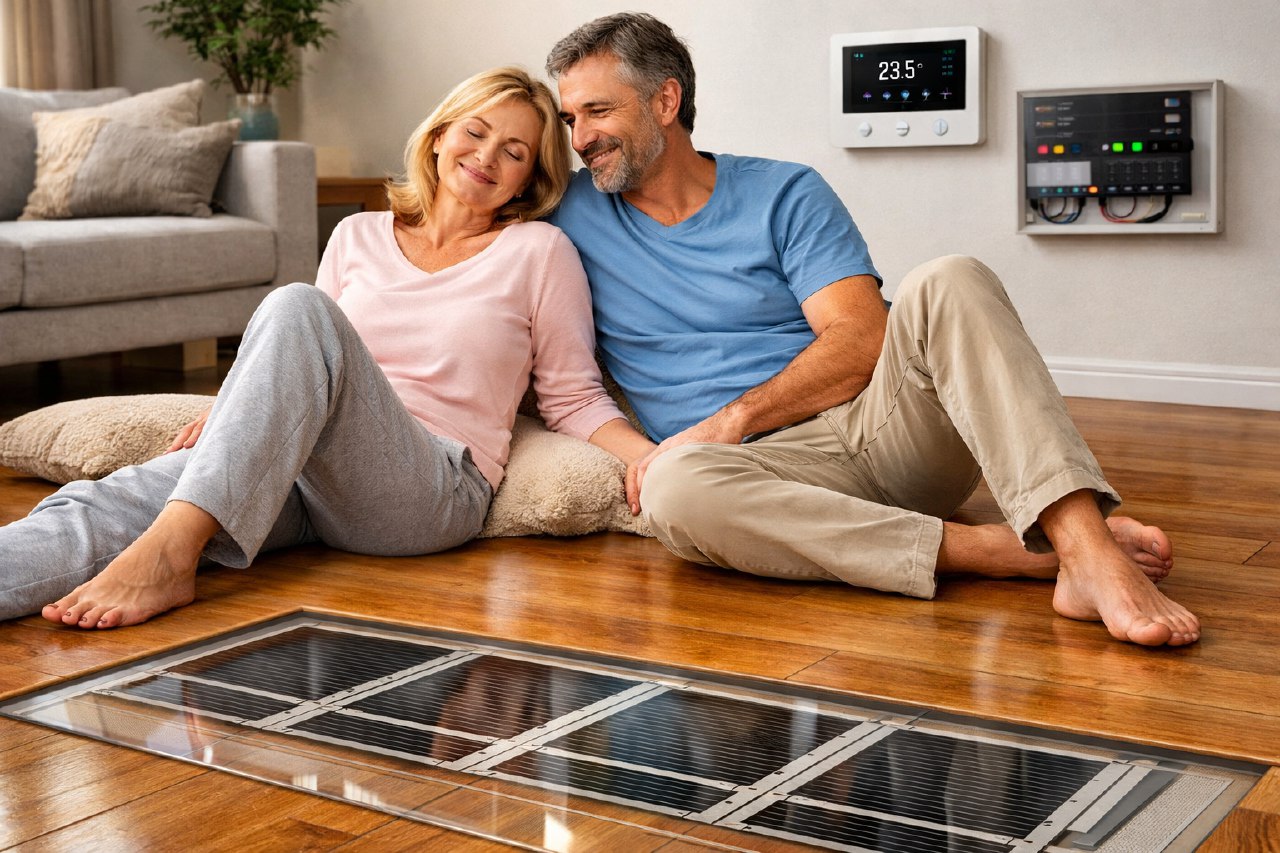
Most modern heating films radiate in the long-wave infrared range, and give part of the heat directly to the covering and part to the air and objects of the room. The covering – whether laminate, vinyl or another layer – itself starts to work as a radiating surface. So the question is not whether "infrared disappears under the covering", but how the heat reaches the people in the room.
- The heat of the heating film is not lost under the covering but reaches the room through it.
- Properly sized infrared heating gives an even, pleasant feeling of warmth in practice.
- The argument "I can't see it, so it isn't infrared" is physically wrong: infrared radiation is invisible, and visible glow is a property only of very hot materials.
Well-designed infrared heating is therefore infrared heating even under the covering – just invisible and silent. You can also read about how infrared heating works on our underfloor heating page.
Myth 2: "the family lives in toxic electrosmog"
The word "electrosmog" has acquired a strong emotional charge, partly because of legitimate questions and partly because of half-information. It is worth separating what happens with a professionally installed electric underfloor heating system.
What is called electrosmog in this context?
- the electric field, which comes from the presence of voltage;
- the magnetic field, which arises when current flows;
- and the resulting time-varying electromagnetic (EMF) effects.
Old, unshielded, single-conductor cables or badly designed systems could indeed cause stronger electric or magnetic fields in their surroundings. Today's quality heating film and heating cable systems, however, work with several protective solutions.
How do modern systems protect?
- Symmetrical conductor arrangement: the conductors carrying current run close together in pairs, so their magnetic fields largely cancel each other out.
- Earthed shielding: some films have a metallic shielding layer, which is earthed and carries the electric field away.
- Protective earth and residual current device: the system is connected to protective earth, and in the event of a fault the RCD (residual current device) switches off.
What makes electric underfloor heating safe?
- a product with the right certification, with certificates and manufacturer documentation;
- a shielded or symmetrical heating element;
- proper earthing and professional electrical connection;
- suitable protection: an RCD and overcurrent protection.
The claim that "all electric underfloor heating emits dangerous electrosmog" is not true as a generalisation: the measurable field depends on the design of the product and the quality of installation. This can be checked with an instrument – if you are unsure, ask an expert who can also measure and who cites data. We present our own measurement on installed heating film and the applicable limits on our electrosmog page.
Myth 3: "it heats slowly, the warmth pulses, it ruins the laminate"
This myth has several layers, and it is worth looking at them separately.
Is heating film really slow?
Heating film sits directly under the covering and has little thermal inertia. In practice this means the temperature of the covering starts to rise within minutes, the system follows the thermostat signal quickly, and with proper sizing it can be well controlled both as comfort heating and as main heating.
Behind the "heats slowly" experience there are usually two faults:
- undersized output (too few W/m²);
- neglected thermal insulation, with a significant part of the heat escaping downwards.
Pulsing warmth or a badly set thermostat?
In modern systems the thermostat uses a floor sensor, the minimum and maximum floor temperature can be set, and the controller switches spread over time to hold an even average temperature. If someone still feels the warmth "pulsing", the cause is typically a wrong PID setting, too large an allowed temperature swing, or a very simple, cheap thermostat.
With a suitable thermostat the floor temperature fluctuates only slightly, the feeling of warmth stays even, and there are no noticeable "warm–cold" cycles.
Does it ruin laminate flooring?
Laminate floor manufacturers specify the maximum permitted surface temperature (usually around 27–29 °C). If the system works with a proper floor sensor, a good thermostat and correctly chosen output, the floor stays within the manufacturer's limit, so it does not ruin the laminate. The problem is caused not by infrared heating but by a system built irregularly, without sizing. Which covering suits underfloor heating how well is detailed in our article on choosing a floor covering.
Myth 4: "infrared heating is expensive" – or is it just used badly?
Any electric heating will be expensive if it is badly sized, built into a poorly insulated house and badly controlled – this is true of heating film, heating cable, convectors and infrared panels alike.
What influences consumption the most?
- the thermal insulation and airtightness of the building;
- the heated floor area and the installed output;
- the way it is used: constantly high temperature, or timed, zone-by-zone heating;
- the quality of control: a simple thermostat or a smart system;
- whether there are solar panels or other own electricity production.
We write more about calculating consumption on our consumption page. Among modern heating elements there are also self-regulating types with PTC technology: as the temperature rises, the power drawn falls. The 4th-generation heating film we install is also like this: where furniture or a rug covers it, it automatically reduces its output. This is not a miracle cure, but it shows well that the technology has developed a lot over the past 10–15 years.
Combined with solar panels
More and more houses choose a solar system. In that case the heating film can run partly on your own production, and part of the heating cost appears in the solar investment instead of the electricity bill. The size of the saving, however, also depends on the settlement method: since 1 January 2024, new household solar systems in Hungary are on gross metering, meaning that electricity fed into the grid and electricity drawn are settled separately. Solar panels can therefore reduce the cost of electric underfloor heating, and the exact proportion depends on the production and consumption of the house. You can read more on our solar page.
Overall, infrared heating is neither inherently expensive nor inherently cheap: in a well-insulated house, with good control, possibly combined with solar panels, it can be competitive with other heating methods.
What can well-designed infrared heating do in everyday life?
Behind the debates it is easy to forget why anyone would choose heating film:
- Invisible heating: no radiators, boiler or mechanical equipment in the living space.
- Even comfort: the floor is warm, there are no cold spots.
- Fast response: especially with heating film.
- Zoning: each room can be controlled separately.
- Little maintenance: no annual boiler service or chimney inspection.
- Can be used with solar panels: as an electrical system it is easily linked with your own production.
For many families this is the first heating that does not "dominate" the home: there is no large, noisy appliance in the middle of the house, only the warmth of the floor.
What is the next step?
If you are seriously thinking about heating film, after the forums the surest step is a consultation with an expert:
- tell them what covering you have or will have, how large the area to be heated is, and what feeling of warmth you expect;
- ask for a numerical estimate of the expected consumption, including a solar variant;
- ask about shielding, earthing and electrosmog measurement, and ask for a technical explanation.
This way you decide not on scare stories but on data and a plan tailored to your own house. If you would like our expert to look at your home and tell you whether heating film can work there safely and economically, request an on-site survey (available in Hungary), or send your quote request.
Request a quote — installation anywhere in Hungary
We survey, design and install heating film and infrared heating throughout Hungary. Tell us about your home and we will get back to you.