

Heat Pump vs Infrared Heating – 2026 Cost Comparison
Author: Tóth Tamás · 10 min read
A worked example for a well-insulated 120 m² house: investment, electricity price, H tariff, annual consumption and maintenance for a heat pump and infrared heating – every assumption marked so you can recalculate with your own data.
Infrared heating is typically cheaper in investment, and a heat pump is cheaper to run. In our worked example made in July 2026, for a 120 m² house with excellent insulation, we estimated the installation of infrared heating with heating film at HUF 1.2–2.5 million and that of an air-to-water heat pump with underfloor heating at HUF 3.5–6 million, while the annual heating cost came to about HUF 103,560 with a heat pump and about HUF 294,000 with infrared heating. These are estimates, not quotes: below we show every assumption so that you can recalculate for your own house.
Both technologies are electric heating: a heat pump uses the heat of the environment with the help of electricity, while infrared heating turns electricity directly into radiant heat. The decision therefore does not rest on a single number, but on the investment, the electricity price, the tariff, maintenance and comfort needs together.
The two systems in brief
Heat pump – using environmental heat
A heat pump extracts heat from the air, water or ground and brings it into the building using electrical energy; many types can also cool in summer. Its efficiency is indicated by the coefficient of performance (COP) or, over the heating season, the seasonal coefficient of performance (SCOP).
Advantages:
- High efficiency: from 1 kWh of consumption it typically produces 3–5 kWh of heat; the exact value depends on the outside temperature and the temperature of the heating water.
- Heating and cooling in one: air-to-air air conditioners and reversible air-to-water systems also cool in summer.
- Low running cost: thanks to the high COP, less electricity is needed for the same heat, and in the heating season the preferential H tariff can also be used (conditions detailed below). New contracts can no longer be signed for the previously popular Geo tariff.
- Less fossil energy use: a greater part of the heat comes from the environment.
Disadvantages:
- High investment cost: especially with ground-probe and water-to-water systems, where groundwork is also needed.
- Complex installation: it requires mechanical design and specialist installation.
- Emitter system: it works most efficiently at a low flow temperature, so it suits underfloor heating, ceiling heating or wall heating best; with an existing radiator system, larger sizing may be needed.
- Efficiency drops in the cold: the efficiency of an air-source heat pump falls significantly below freezing, so supplementary heating may be needed on the coldest days.
- Maintenance: it needs regular inspection by a professional.
- Outdoor unit: the outdoor unit of air-source systems is audible, and its position must be chosen with the neighbours in mind.
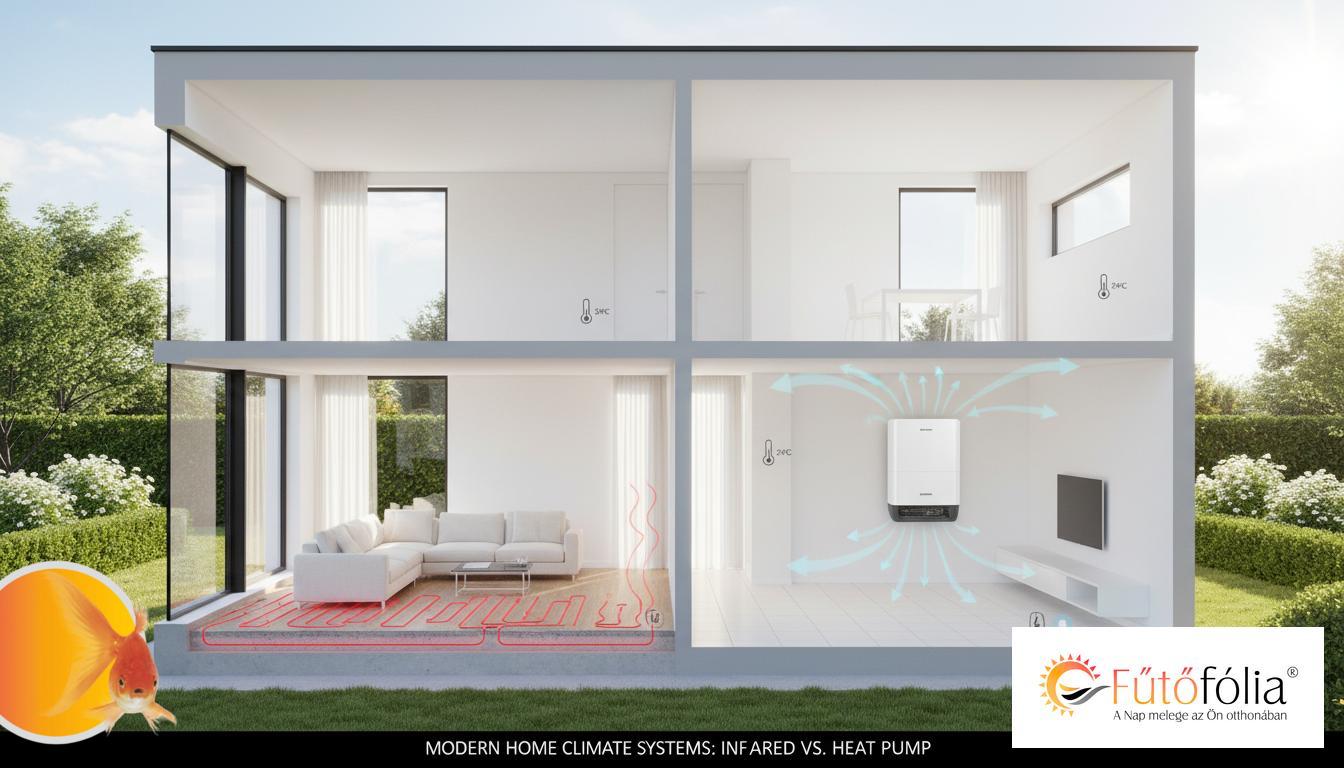
Infrared heating – radiant heat
Infrared heating gives off heat by infrared radiation: it warms not primarily the air but bodies, objects and the bounding surfaces, and the sense of warmth is similar to sunshine.
Advantages:
- Even sense of warmth: thanks to the warm surfaces, the space can be comfortable even at a lower air temperature – this saving is one of the assumptions of the calculation, see below.
- No fan-driven air movement: radiant heating stirs up less dust, which can also be good for allergy sufferers.
- Lower investment: its purchase and installation are typically considerably cheaper than a heat pump's.
- Simple installation: in plasterboard (heating film, heating foil), under floor coverings (heating mat, heating cable), on the wall or ceiling (infrared panel, heating panel).
- Low maintenance need: it has no moving parts and needs no regular annual service.
- Room-by-room control: every room can be controlled with its own thermostat, so it heats only where and when needed.
- Fast response: panels and ceiling film give noticeable warmth quickly; with an under-floor-covering system the floor covering also has to warm up.
On electrosmog: every electric heating creates an electromagnetic field, so the claim that it "emits no electrosmog" is inaccurate. We publish our own measured values for heating film on our electrosmog page.
Disadvantages:
- It does not cool: summer cooling needs a separate air conditioner.
- A more expensive unit of electricity: the electricity is converted entirely into heat (100% efficiency), but without a heat pump's COP it uses more electricity, and the H tariff cannot be used for it (see below).
Assumptions of the worked example
We made the calculation in July 2026. Energy prices and installation prices change, and the investment and maintenance amounts are our own estimates, not official data – so we mark every assumption separately.
- Building (assumption): a newly built, excellently insulated family house with a floor area of 120 m² and a specific heating demand of 50 kWh/m²/year. The annual heat demand is thus 120 m² × 50 kWh/m²/year = 6,000 kWh/year.
- General electricity price (A1/A2 tariff): HUF 70/kWh. This is the residential market price, rounded: according to MVM Next, above the preferential quantity of 2,523 kWh a year, consumption is priced at HUF 70.104/kWh under the A1 and A2 tariffs. The example calculates the whole electricity demand of heating at this price; if the house's other consumption does not use up the preferential allowance, part of the heating comes out cheaper.
- H tariff (heat pump): as a cautious assumption, HUF 40/kWh. MVM Optimum's information puts the price of the H tariff lower than this, at ~HUF 22–24/kWh, so the real electricity cost of a heat pump may be even lower than in the example. The H tariff can be used from 15 October to 15 April, with a separate two-tariff meter, for a heat pump system with an SCOP of at least 3.4; it cannot be used for electric boilers, infrared panels or electric radiators. Outside the heating season the heat pump runs on the general tariff.
- Solar panels: not taken into account in the calculation; their effect is discussed in a separate section.
- Maintenance (our estimate): HUF 35,000 a year for a heat pump; for infrared heating we do not count any maintenance cost.
Cost calculation – the numbers in the example
1. Heat pump (air-to-water, with underfloor heating)
- Average coefficient of performance (assumption): 3.5 – that is, 3.5 kWh of heat from 1 kWh of consumption.
- Annual electricity demand: 6,000 kWh ÷ 3.5 = ~1,714 kWh/year.
- Annual electricity cost (H tariff, at HUF 40/kWh): 1,714 kWh × HUF 40/kWh = ~HUF 68,560/year.
- Investment (our estimate, with installation and underfloor heating): HUF 3,500,000–6,000,000, at the midpoint HUF 4,750,000.
- Maintenance (our estimate): ~HUF 35,000/year.
- Total annual cost: HUF 68,560 + HUF 35,000 = HUF 103,560/year.
2. Infrared heating (heating film or infrared panels)
- Efficiency: 100% – 1 kWh of heat from 1 kWh of electricity.
- Comfort assumption: because of the radiant heat, the room can be comfortable even at an air temperature 2–3 °C lower, so we assume that for a heat demand of 6,000 kWh, 20–30% less electricity is enough. The example uses the upper value of the range, 30%: 4,200 kWh/year. This is the most sensitive point of the calculation: the size of the saving depends on the building, the controls and usage habits, and is not guaranteed; at the lower value of the range the cost of infrared heating is higher. If it does not materialise, the electricity demand is the full 6,000 kWh, and the cost rises in proportion.
- Annual electricity cost (general tariff): 4,200 kWh × HUF 70/kWh = ~HUF 294,000/year.
- Investment (our estimate, with installation, as underfloor heating with heating film): HUF 1,200,000–2,500,000, at the midpoint HUF 1,850,000.
- Maintenance: not counted.
- Total annual cost: ~HUF 294,000/year.
How the comfort assumption appears in measurement is shown by our article on the container measurement of air-conditioner and infrared heating: there too it appears as an assumed correction on top of the measured data.
The example in one table
| Item | Heat pump (air-to-water) | Infrared heating (heating film) |
|---|---|---|
| Investment (our estimate) | HUF 3.5–6 million | HUF 1.2–2.5 million |
| Annual electricity demand | ~1,714 kWh | ~4,200 kWh (with the comfort assumption) |
| Electricity price in the example | HUF 40/kWh (H tariff, cautious assumption) | HUF 70/kWh (A1/A2 market price) |
| Annual electricity cost | ~HUF 68,560 | ~HUF 294,000 |
| Maintenance (our estimate) | ~HUF 35,000/year | not counted |
| Total annual cost | ~HUF 103,560 | ~HUF 294,000 |
When does the heat pump earn back the extra investment?
The simple payback time is the heat pump's extra investment divided by the difference between the two systems' annual costs. With the midpoint values of the example, installing a heat pump costs nearly three million forints more, while its annual cost is considerably lower; the quotient of the two is roughly a decade and a half. The result depends strongly on the assumptions:
- The payback is shorter if the real price of the H tariff is below the HUF 40/kWh used in the example, if the comfort saving of infrared heating is smaller than assumed, or if the heat pump is installed in the lower part of the investment range.
- It is longer if the maintenance and repair of the heat pump cost more than estimated, if the investment is in the upper part of the range, or if part of the infrared heating's electricity is used at a preferential price.
- The calculation does not include the service life of the equipment, replacement, the value of cooling and subsidies – it is worth adding these on the basis of your own quotes.
Combined with solar panels
Since both systems run on electricity, your own solar production can reduce the amount of electricity bought from the grid in both.
- Heat pump + solar panels: for the example's annual heating electricity demand of ~1,714 kWh, even a smaller solar system can contribute meaningfully.
- Infrared heating + solar panels: ~4,200 kWh is a larger demand, which needs a larger system, though still a realistic size for a family house. Part of the money left over thanks to the lower investment can go to solar panels or home energy storage.
Two limits are worth knowing in advance. The heating demand is greatest in winter, when solar panels produce the least, so the electricity cost of heating does not disappear even with solar panels. In addition, since 1 January 2024, gross metering has applied to new household systems in Hungary: electricity fed in and electricity drawn are accounted for separately, so the summer surplus cannot be carried over to winter heating. The details are discussed in our article on heating with solar panels.
Summary: which one, and when?
- Investment: in the example, infrared heating (HUF 1.2–2.5 million) is considerably cheaper than a heat pump with underfloor heating (HUF 3.5–6 million).
- Annual cost with grid electricity: ~HUF 103,560 with a heat pump, ~HUF 294,000 with infrared heating – the heat pump is cheaper to run thanks to the higher coefficient of performance and the H tariff.
- With solar panels: the purchased electricity demand of both can be reduced, but winter production and gross metering set a limit.
- Comfort and function: a heat pump can also cool; infrared heating only heats, but it gives radiant warmth without fan-driven air movement.
A heat pump is a good choice if the higher initial cost is no obstacle, you aim for the lowest possible running cost in the long term, you also want cooling, and you plan with surface heating and the H tariff.
Infrared heating is a good choice if the investment budget is tighter, you need quick and simple installation, you are renovating a well-insulated house, or you would heat room by room and intermittently. It also fits smaller, targeted heating jobs well – for example seedling heating or terrace heating.
The final decision depends on the characteristics of the house, the budget and usage habits. It is worth recalculating the figures above with your own floor area, heat demand and the quotes you receive before deciding.
Request a quote — installation anywhere in Hungary
We survey, design and install heating film and infrared heating throughout Hungary. Tell us about your home and we will get back to you.