

Solar-Powered Heating: Myth or Real Savings?
Author: Tóth Tamás · 7 min read
Can you heat economically with solar panels? The limit of winter production, gross metering, payback and the real role of the battery – and the five conditions on which the savings from solar-powered heating depend.
Solar-powered heating can bring real savings, but not everywhere and not unconditionally. The electricity produced by solar panels can run electric heating – for example infrared heating, heating film or a heat pump – and so reduces the amount of electricity bought from the grid. The size of the saving depends on the house's thermal insulation, the type of heating, the sizing and the way electricity is accounted for, and because of the limit on winter production it needs careful planning.
Because of fluctuating energy prices and environmental awareness, more and more people are rethinking their home's energy use, and solar energy plays a growing role in this. In this article we go through the possibilities of solar-powered heating, its common myths, and the conditions under which it can become an economical and environmentally friendly solution.
What is solar-powered heating, exactly?
By solar-powered heating we do not mean water heating with solar collectors. A solar collector uses the sun's heat energy directly to produce hot water, whereas solar-powered heating is based on a photovoltaic (PV) system that produces electricity from sunlight. This electricity can run the house's electric heating systems, for example:
- infrared heating (e.g. infrared panels);
- underfloor heating (e.g. heating mats, heating cables, heating film, heating foil);
- ceiling heating;
- wall heating;
- heat pump systems (air-to-air air conditioners, air-to-water heat pumps);
- heating panels.
The electricity demand of these systems can be covered in part by the solar panels, so less electricity has to be bought from the grid.
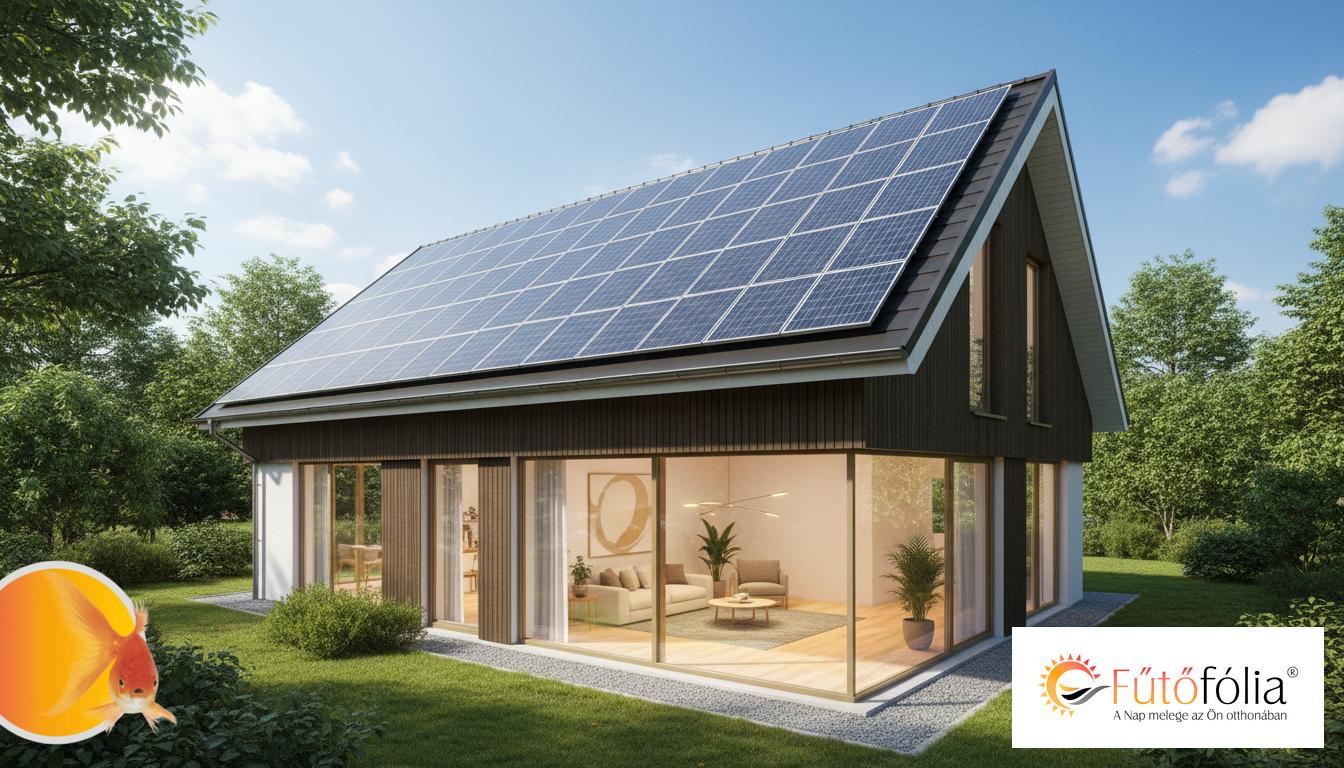
Myths and real challenges
The prospect of solar-powered heating is tempting, but it is important to get a realistic picture of how it works and what its limits are. Three common claims are worth clarifying:
"Solar panels do not produce enough electricity for heating in winter."
This is the most common and a justified concern, because production depends on the strength of solar radiation and on the position of the sun. In Hungary about 70–80% of a solar system's annual production arises in the spring and summer months (March–September), while in the winter months (November–February) production is only 10–20% of the summer level. The heating demand, however, is greatest exactly in winter.
This asymmetry of production and consumption used to be bridged by net metering: the surplus fed into the grid in summer was deducted by the utility from winter consumption. With new systems this no longer works. Since 1 January 2024, household-scale power plants in Hungary have been on gross metering: the bidirectional meter keeps two counters, one for electricity fed in and one for electricity drawn, and the utility bills them independently of each other. Only someone who submitted their connection request by September 2023 and commissioned their system by 1 January 2026 can remain on net metering – and they too for a maximum of 10 years. You can read more about the weakness of winter production in our article on the winter benefits of solar panels.
"The initial investment is too expensive, it will never pay back."
Building a solar system and efficient electric heating is indeed a significant investment. The price of solar panels shows a falling trend over the longer term, and government support programmes may also help the investment from time to time – their conditions and deadlines change, however, so the current call must always be checked. By our estimate, the payback time of a well-designed and well-sized system is around 8–12 years, which may shorten as energy prices rise; under gross metering, however, it depends strongly on how much electricity the house uses while it is being produced. Over the solar panels' service life of up to 25–30 years, the saving can be significant.
"A house heated with solar panels is unhealthy."
Some people worry about electrosmog or other health effects in connection with electric heating. A solar panel changes nothing about this: the heating works the same way wherever the electricity comes from. We have measured the electromagnetic emission of heating film ourselves, and our electrosmog page presents the result. A further advantage of infrared heating is that it does not create strong air currents, so it stirs up less dust, which can also be good for allergy sufferers.
The conditions for real savings
The savings from solar-powered heating are no myth, but they can be achieved only if certain conditions are met and the system is deliberately designed.
1. Good thermal insulation and energy efficiency
This is the most important basic condition. In a poorly insulated house the heat loss is so great that even the largest solar system could not economically cover the heating demand. The insulation of the walls, ceiling slab, floor and windows is the key issue: the lower the building's heat requirement, the smaller the solar system that is enough, and the easier it is to achieve meaningful savings.
2. Efficient electric heating
It matters what electric heating the solar panels run:
- Heat pumps (e.g. air-to-air air conditioners): their COP is above 3–4, meaning they produce 3–4 kWh of heat from 1 kWh of electricity. According to MVM Optimum's information, the preferential H tariff can also be used for heat pump heating if the equipment meets the conditions; it cannot be used for infrared panels and other heating that produces heat directly from electricity.
- Infrared heating (infrared panels, heating film): by radiation it warms bodies and objects directly, not the air. It gives a sense of comfort quickly, and with room-by-room control (thermostat) consumption can be kept well in hand. Its efficiency – like that of all direct electric heating – is nearly complete; the saving comes from the better sense of warmth and zone control.
- Surface heating (underfloor, ceiling, wall heating): they give even heat distribution with a low flow temperature, which is especially efficient combined with a heat pump.
3. Energy storage with a battery
A home battery bridges the difference within the day: it stores the electricity produced during the day but not used, and gives it back in the evening or at night. It is not suited to carrying the summer surplus over to winter, so it does not solve the winter shortfall, but it can significantly raise the share of self-consumption – especially valuable under gross metering – and makes the house more independent of the grid. Its drawback is that batteries are still expensive, so their payback is long; their prices are falling, however, and the technology is developing.
4. Smart home and conscious energy use
With a smart thermostat system, the heating can be adjusted to the residents' presence, the weather and the needs of individual rooms. With zone-by-zone control, the system heats only where and when it is needed, so unnecessary consumption is avoided. Alongside solar panels it is worth matching the heating to the time of production, too: in sunny hours radiant heating can warm the surfaces, which give off the heat later as well.
5. Proper sizing and installation
The sizing of the solar system and the heating should be left to a professional who takes into account the building's characteristics, the heat requirement, consumption habits and the current accounting rules. Without accurate design and professional installation there is no efficient and safe operation.
Solar-powered heating as a complex system
The savings are therefore not to be expected from the solar panels alone, but from careful design and installation of the whole system. Solar-powered heating works well if:
- the building is energy-saving – the better the insulation, the smaller the heating demand;
- efficient electric heating runs in it – a heat pump, infrared heating or surface heating;
- production and consumption coincide in time as well as possible – with the old net metering systems the summer surplus could still offset the winter shortfall; with the new gross metering systems, direct self-consumption and daily storage count;
- intelligent control – smart thermostats and zone control – keeps consumption in hand.
Summary
Savings from solar-powered heating are a real goal, but not equally favourable for everyone, and it cannot be promised in general that the electricity cost of heating will disappear – it can, however, be reduced with a well-designed system. The investment pays back, and provides low running costs in the long term, if the house is energy efficient, the heating technology is well chosen, the sizing takes the current accounting rules into account, and operation is conscious.
A well-designed and professionally installed solar-powered heating system is good not only for your wallet but also for the environment: it reduces the home's carbon footprint and increases energy security. The basics of solar systems are summarised on our solar panel page, and the joint design of heating film and solar panels is covered in our article Heating film and solar panels. Before deciding, it is worth having the characteristics of the house surveyed by a professional: we give a specific recommendation on the basis of an on-site survey (available in Hungary).
Request a quote — installation anywhere in Hungary
We survey, design and install heating film and infrared heating throughout Hungary. Tell us about your home and we will get back to you.