

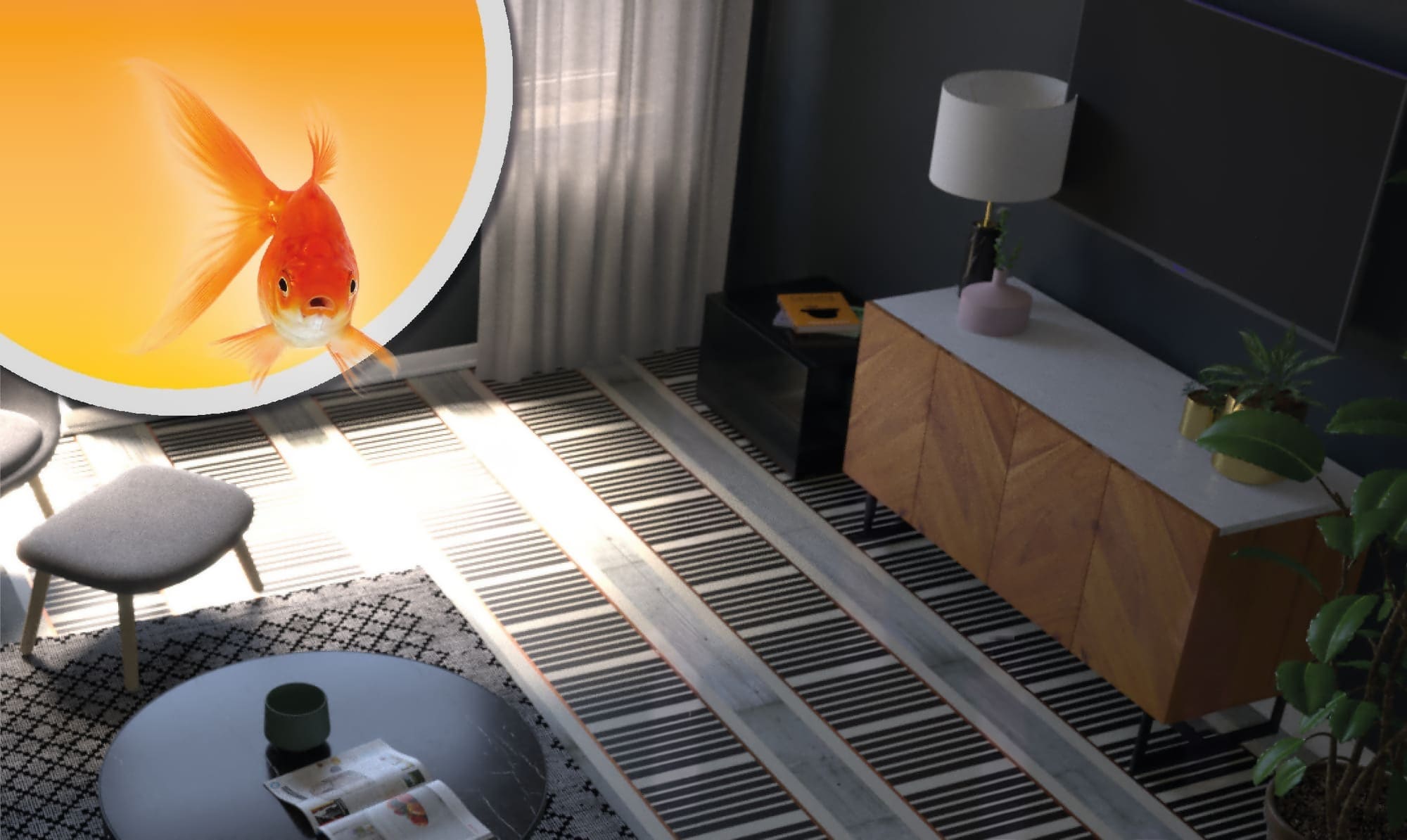
Electric underfloor heating with heating film
Infrared underfloor heating without wet pipework or a boiler: the 0.4 mm thick heating film goes under the floor covering, and every room can be controlled separately. Nearly 60% of our installations are this kind of underfloor heating.
In brief
- Electric underfloor heating = infrared underfloor heating: from under the floor covering, the 0.4 mm thick heating film warms the floor, objects and people by radiation.
- Under laminate and engineered wood flooring with a simple layer build, even without a solid layer. Under vinyl, carpet and tiles only with the right layer build: 4–5 cm of concrete or Rigidur dry screed goes over the heating film.
- Price: HUF 11,250–18,000 per m² gross for the area to be heated, installation included. This is a guide order of magnitude; the exact price comes from the on-site survey.
- Consumption: decided by the house's heat loss. In the three houses shown below, the planned annual heating electricity consumption is 3,740–10,560 kWh.
- Also as a retrofit: in a renovation the heating film goes on the existing level subfloor; if you would rather not break up the old tiles, the 3.8 mm T-Mat heating mesh can be laid in the tile adhesive under the new covering.
- Fast: the warmth is felt within 5–15 minutes, depending on the floor covering; installation on a well-prepared site is typically one day.
- 15.5-year warranty on the 4th-generation heating film if we carry out the installation.
What is electric underfloor heating, and how does it work?
Electric underfloor heating with heating film is infrared heating, which is why it is also called infrared underfloor heating. The heating film does not heat the air but warms the floor, objects and people by radiation. That is why the warmth is more even, the difference between floor temperature and head-height temperature is smaller, and there is no air movement to stir up dust.
The system is thin and quick to install. In new construction it goes on walkable thermal insulation or on concrete, in a renovation on the existing concrete or an earlier parquet; the point is that the surface is level. With a simple layer build, without a solid layer, laminate and engineered wood flooring can go over the heating film. Under vinyl, carpet and tiles a solid layer is also needed over the heating film: 4–5 cm of concrete or Rigidur dry screed.
The 4th-generation intelligent heating film is self-regulating: where something covers its surface, it reduces its power. This protects the floor covering and the furnishings, and the layout does not have to be fitted to the positions of the furniture. It can also be built into wet rooms, because the heating film's insulation is IP67.
Four situations in which heating film is the right underfloor heating
Retrofit, in a renovation
No wet system or thick screed has to be built: the heating film goes on the existing, level subfloor. Under laminate the floor height practically does not change.
With little build height
In an apartment building, hot-water underfloor heating did not fit because of the modified floor slabs; heating film did.
Részletek →In new construction
Laid on thermal insulation or concrete, it fits into the build sequence; installation is one day in the great majority of cases.
In a bathroom or kitchen
The heating film has IP67 insulation, so with the right layer build it can also be built into wet rooms, under tiles.
Which electric underfloor heating is better: heating film, heating mat or heating cable?
All three heat with electricity, without pipework, manifolds or a boiler, which is where they differ from wet underfloor heating. Among themselves, the floor covering, the room and the purpose decide: for the main heating of a whole house heating film is right, for retrofit heating of a single room a heating mat or heating cable.
| Heating film | Heating mat, heating mesh | Heating cable | |
|---|---|---|---|
| Thickness | 0.4 mm; 6 mm together with the reflective foil and vapour barrier | 1.8 mm (F-Mat ALU), 3.8 mm (T-Mat) | embedded in self-levelling compound or tile adhesive |
| Power per m² | 110, 150 or 220 W/m² | 80–130 W/m² (F-Mat ALU), 100–200 W/m² (T-Mat) | 100–200 W/m², depending on the laying spacing |
| Best for | main heating of a whole house, controlled room by room | smaller rooms, mainly as a retrofit: bathroom, kitchen, hallway | irregular floor plans: L-shaped bathroom, curved wall, step |
| Floor covering | laminate and engineered wood with a simple layer build; vinyl, carpet and tiles with a solid layer | T-Mat under tiles; F-Mat ALU for a smaller, retrofitted laminate area | under tiles |
| Can furniture cover it? | yes: the 4th-generation heating film is self-regulating | only on free floor area | only on free floor area |
| Control | thermostat per room, with floor and air sensors | thermostat with floor sensor | thermostat with floor sensor |
| How to get it | with installation, on an individual quote | from the web shop, or with installation: we install it | from the web shop; we also install it on request |
Sources: futofolia.hu layer builds and installation data; the data on heating mats and cables from the installation instructions of the distributor (Dimat Kft.) and the manufacturers. Details: heating mats and heating mesh, heating cable.
Infrared underfloor heating layer build under laminate flooring
Under the heating film goes 5 mm reflective foil with full coverage; the heating film covers 60–70% of the floor area, with a vapour barrier over it. We install these three layers; the rest are made by the floor layer or the client.
- Laminate flooringthe visible floor covering
- Tissue-paper underlayunderlay beneath the flooring
- Rigidur dry screed or 4–5 cm of concreteoptional under laminate
- Earthing mesh
- Vapour barrier (PE)
- Intelligent heating filmon 60–70% of the floor area
- Reflective foilwith full coverage, reflects heat upwards 5 mm
- Thermal insulationfor example walkable polystyrene
- Concrete subfloor
Infrared underfloor heating layer build under tiles
Tiles cannot be glued directly onto the heating film, because the radiation would dry out the adhesive. A solid, heat-storing layer, 4–5 cm of concrete or Rigidur dry screed, therefore goes over the heating film, and the tiler glues onto that. The same solid layer is needed under vinyl, PVC and carpet.
- Floor tiles, wall tilescold floor covering
- Flexible tile adhesive
- 4–5 cm of concrete or Rigidur dry screedsolid, heat-storing layer
- Earthing mesh
- Vapour barrier (PE)in a double layer according to the designer's layer build
- Intelligent heating film
- Reflective foil 5 mm
- Thermal insulationfor example walkable polystyrene
- Concrete subfloor
Which layer build is needed under which floor covering?
The layers under the heating film (thermal insulation, 5 mm reflective foil) are the same for every floor covering; the difference is above the heating film. Without a solid layer, with a simple layer build, laminate and engineered wood flooring can go over the heating film.
| Floor covering | Above the heating film | Solid layer (concrete or Rigidur) |
|---|---|---|
| Laminate flooring | vapour barrier, earthing mesh, tissue-paper underlay | not needed (optional) |
| Vinyl, PVC, carpet | vapour barrier, earthing mesh | needed: 4–5 cm of concrete or Rigidur |
| Engineered wood, solid wood | vapour barrier, earthing mesh | not mandatory (optional) |
| Floor tiles, wall tiles, stone | vapour barrier, earthing mesh, tile adhesive | needed: 4–5 cm of concrete or Rigidur |
Based on the layer builds by floor covering of futofolia.hu. Vinyl, carpet and tiles cannot go directly on the heating film; with laminate and engineered wood the solid layer is not mandatory. The exact layer build and the power of the heating film are recorded in the technical proposal after the on-site survey. The maximum floor temperature specified by the floor covering's manufacturer is held by the thermostat with a floor sensor.
How much does electric underfloor heating cost?
The complete heating-film underfloor heating system costs HUF 11,250 per m² (Lite), HUF 14,625 per m² (Standard) or HUF 18,000 per m² (Premium), gross, for the area to be heated, installation included, according to the investment calculator (Hungary). This is a guide order of magnitude, not a quote: the floor covering, the formation of junction and thermostat boxes and the protective-earthing inspection are not part of the price, and we give the exact price after an on-site survey.
There is no separate labour charge: the price per square metre already includes installation.
How much power does underfloor heating use in a real house?
The planned annual heating electricity consumption in our customers' technical proposals. Consumption is determined by the building's heat loss, which is why the numbers differ so much. All ten examples
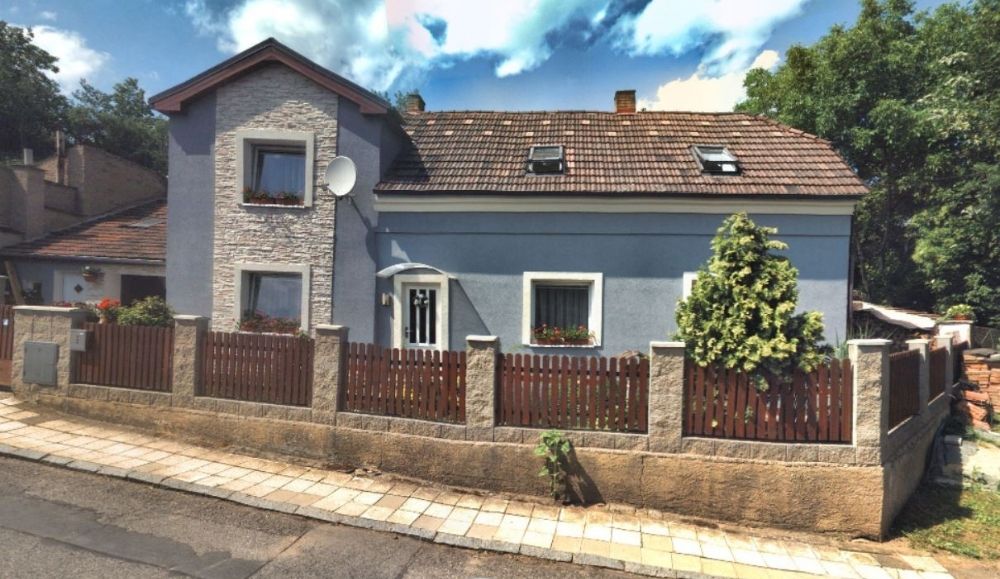
Renovation of an old house, 75 m²
80 W/m² heat loss, 4.8 kW installed power, thermostat; a fireplace as supplementary heating.
Részletek →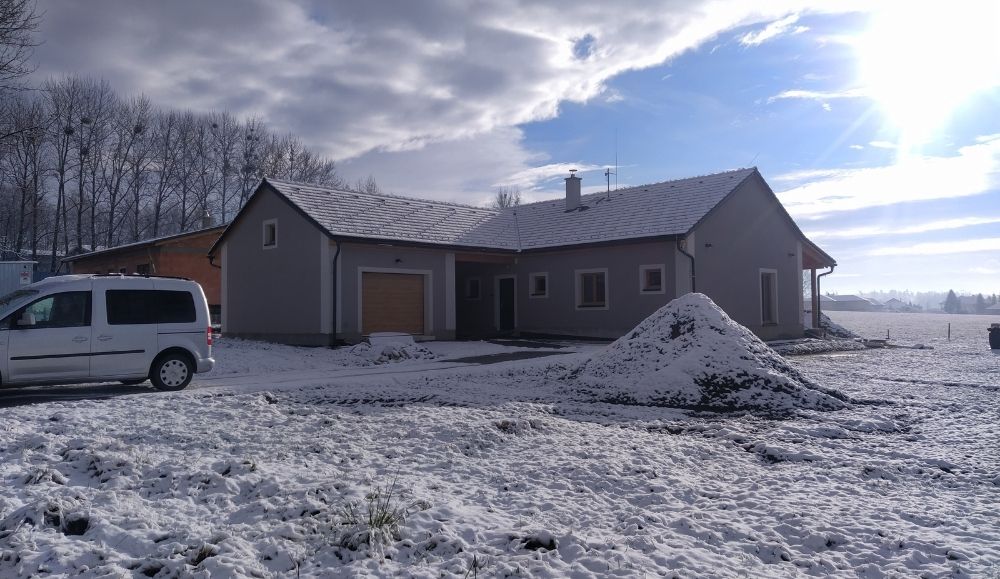
New family house, 121 m²
40 W/m² heat loss, 7.9 kW, vinyl and tile flooring, smart-home control.
Részletek →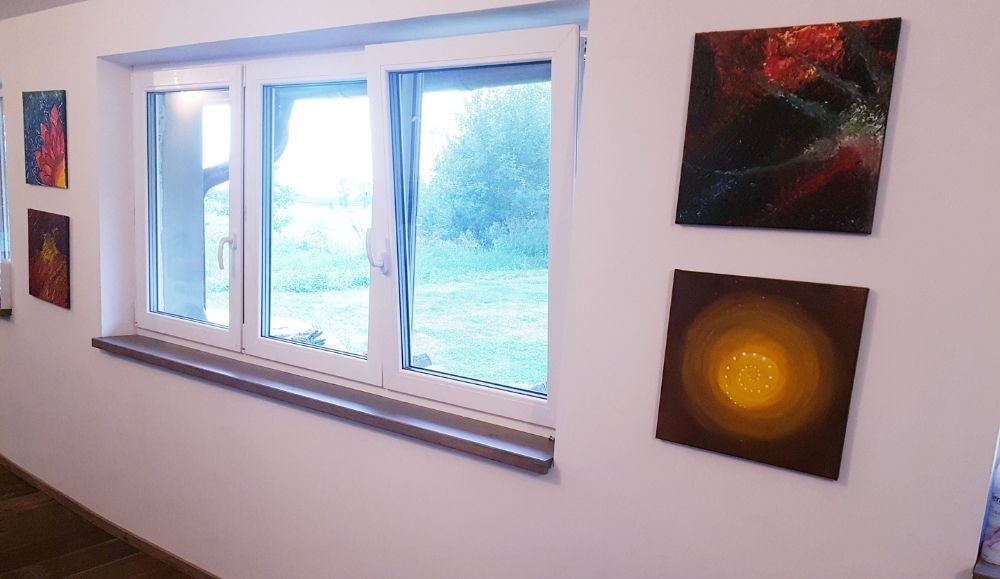
Family house renovation, 141 m²
80 W/m² heat loss, 16.3 kW, smart home; the damp walls of the old house dried out after the heating.
Részletek →How the underfloor heating is installed
- Survey and technical proposal. We design the power of the heating film and the controls room by room.
- Preparation. The client prepares the site according to the technical proposal: level subfloor, thermal insulation.
- Installation. 5 mm reflective foil with full coverage, the heating film and the vapour barrier on top: typically in one day. With concreting two visits are needed: the second 3–4 weeks after the concrete is poured, for commissioning.
- Measurement and commissioning. We measure and record every section, and commission the thermostat.
- Connection and floor covering. The electrical connection is made by a qualified electrician, who also issues the protective-earthing record. The floor layer continues according to the layer build; we help with how to lay the covering safely over the system.
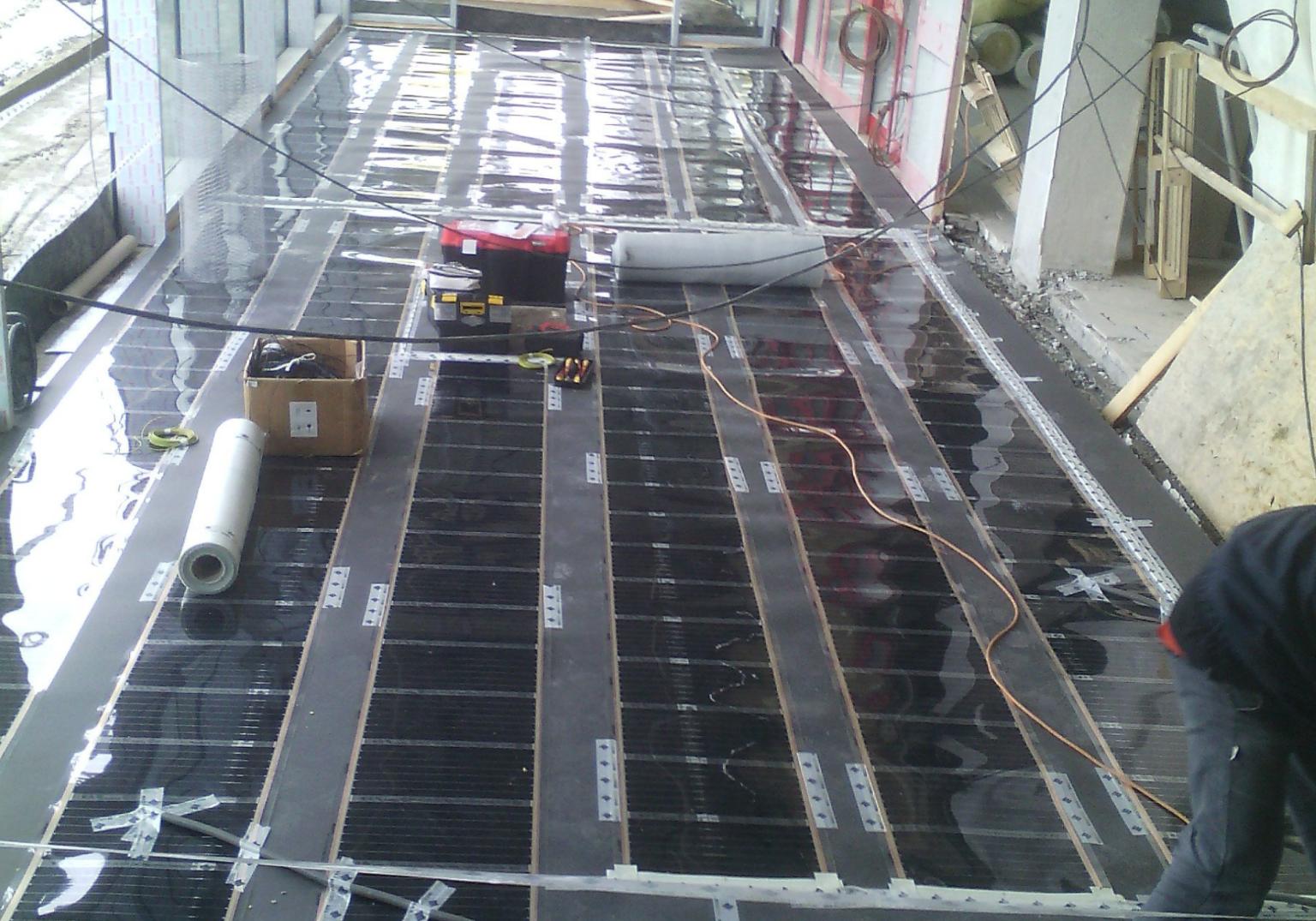
Underfloor heating as a retrofit: heating film or heating mat?
For retrofit underfloor heating an electric system is the simplest: no pipework, manifold or boiler is needed, and no thick screed has to be poured. Whether it should be heating film or a heating mat is decided by the existing floor covering and the area to be heated.
In a renovation: heating film on the existing subfloor
If the old floor covering is coming up anyway, the heating film goes on the existing level concrete or an earlier parquet, with reflective foil. Laminate and engineered wood flooring can be laid over it with a simple layer build; under tiles, vinyl or carpet, 4–5 cm of concrete or Rigidur dry screed goes over the heating film. This solution is for the main heating of a whole flat or house.
If you would rather not break up the tiles: heating mat
For a smaller room, a bathroom, kitchen or hallway, a heating mat is also a good solution. Under tiles the 3.8 mm thick T-Mat heating mesh is suitable: it can be laid in the tile-adhesive layer or the self-levelling compound, even under a new covering going onto the old tiles, so the floor level barely rises. Under laminate flooring we recommend the 4th-generation heating film: this is the main solution, and it can be laid with a simple layer build, without a solid layer. In a smaller, retrofit situation the 1.8 mm thick LIKEWARM F-Mat ALU heating mat is also an option, if the flooring's manufacturer permits underfloor heating.
A heating mat can only go on free floor area, not under a bath, shower tray or built-in furniture, and it needs a thermostat with a floor sensor, which is not in the package. You can also order the heating mat from the web shop, or we install it as part of a complete installation; the 230 V connection is made by a qualified electrician.
Heating mat and heating mesh: which to choose? · Heating mat calculator (Hungarian-language shop, delivery within Hungary)
Those who already heat with heating-film underfloor heating
"We have been through the first heating season, and even in very hard frost we were never cold. The heating was even everywhere, and we are completely satisfied."
Kata, Dunakeszi, newly built house (her account, in Hungarian)
"Because of regularly recurring mould, my partner and I decided to have the existing underfloor heating system in the flat replaced. We did not have to wait long for the positive results. We definitely came out ahead with infrared heating: it is much more modern and environmentally friendly."
Valéria Péteri (her account, in Hungarian)
"I would recommend both the company and the technology to everyone: it soon turned out that in the long run it pays for itself and installing the heating film was an advantageous investment for us. The technology is more economical, modern, and gives a much more pleasant feeling than heating with traditional systems. Several people in the family struggle with dust allergy, so it is a great relief for them too."
Mrs László Kerekes (her account, in Hungarian)
Questions about electric underfloor heating
What is electric underfloor heating, and how is infrared underfloor heating different?
Electric underfloor heating heats with electricity, without pipework, a manifold or a boiler. The heating-film version is also called infrared underfloor heating, because the 0.4 mm heating film warms the floor with long-wave infrared radiation, and the floor itself becomes a radiating surface. Heating mats and heating cables are also electric underfloor heating: they warm the solid covering above them, and that gives off the heat. Basics: infrared heating.
Which is the best electric underfloor heating?
There is no single best electric underfloor heating; the floor covering and the purpose decide. For the main heating of a whole house, heating film is right: thin, controllable room by room, and the 4th-generation version is self-regulating. Under laminate flooring too we recommend the 4th-generation heating film. For retrofit heating of a smaller room under tiles the T-Mat heating mesh is suitable, for an irregular floor plan the heating cable; for a smaller laminate area the F-Mat ALU heating mat is an option. Comparison: heating film, heating mat or heating cable.
How long does electric underfloor heating take to warm up?
Electric underfloor heating with heating film reaches full power within a few minutes, and the warmth is felt within 5–15 minutes, depending on the floor covering, because there is none of the warm-up inertia of a wet system. Under a concrete heat-storing layer, the floor also holds the heat for longer. Experience: infrared underfloor heating reviews.
Can heating film go directly under laminate flooring?
Heating film can go directly under laminate flooring; this is the simplest underfloor-heating layer build: reflective foil, heating film, vapour barrier, earthing mesh, tissue-paper underlay, then the flooring, without a concrete or Rigidur layer. An aluminium-laminated impact-sound underlay should not go over the heating film, because it reflects the radiation; the floor covering's permitted temperature is held by a thermostat with a floor sensor. Floor coverings: Which floor covering suits underfloor heating?
Can electric underfloor heating go under vinyl or carpet?
Under vinyl, PVC and carpet flooring, heating film can go only with the right layer build: these coverings cannot go directly onto the heating film. A vapour barrier, an earthing mesh and 4–5 cm of concrete or Rigidur dry screed go over the heating film, and the covering on that. Without a solid layer, with a simple layer build, laminate and engineered wood flooring can be laid over the heating film. Layer builds: underfloor heating layer build.
Can electric underfloor heating go under engineered wood flooring?
Yes. Under engineered wood flooring the heating film goes with a simple layer build: a vapour barrier and an earthing mesh over the heating film, and the flooring on that. A solid layer (4–5 cm of concrete or Rigidur dry screed) is not mandatory with engineered wood but is possible. Wood has a higher thermal resistance, so it is worth calculating with the upper end of the power range. The exact layer build and the power of the heating film are recorded in the technical proposal after the on-site survey. Floor coverings: Which floor covering suits underfloor heating?
Can electric underfloor heating be put under tiles?
Electric underfloor heating can also go under tiles, but tiles cannot be glued directly onto the heating film, because the radiation would dry out the adhesive. A solid, heat-storing layer, 4–5 cm of concrete or Rigidur dry screed, therefore goes over the heating film, and the tiler glues the tiles onto that; thanks to the heating film's IP67 insulation it can also be built into a bathroom. Floor coverings: Which floor covering suits underfloor heating?
Can underfloor heating be installed as a retrofit?
Underfloor heating can be installed as a retrofit, and with an electric system it is the simplest, because no pipework, manifold or thick screed is needed. If the floor covering is being replaced anyway, the heating film goes on the existing level subfloor. If you would rather not break up the old tiles, the 3.8 mm T-Mat heating mesh can be laid in the tile adhesive under the new covering, and the floor level barely rises. Details: underfloor heating as a retrofit.
Can electric underfloor heating go in a bathroom?
Electric underfloor heating can also go in a bathroom: the heating film's insulation is IP67, and under tiles 4–5 cm of concrete or Rigidur dry screed goes over the heating film, with the tiler gluing onto that. No heated surface goes under a bath, shower tray or built-in furniture. If you only want to heat the bathroom as a retrofit, the T-Mat heating mesh laid in tile adhesive barely raises the floor level. Heating mesh: heating mats and heating mesh.
How much insulation is needed under underfloor heating?
Underfloor heating needs walkable thermal insulation: under a heated floor we recommend 10–15 cm thick EPS, XPS or rock wool, because without insulation the underfloor heating loses heat towards the ground. In the heating-film system, 5 mm reflective foil with full coverage goes on the insulation, reflecting the heat upwards. In detail: insulation for underfloor heating.
How much power does electric underfloor heating use?
The consumption of electric underfloor heating is determined by the building's heat loss: according to our customers' planned data, a new 121 m² house with a heat loss of 40 W/m² uses 4,530 kWh of electricity a year for heating, and the ground floor of a renovated old 75 m² house at 80 W/m² uses 3,740 kWh. Ten examples: How much does infrared heating use?
How much does electric underfloor heating cost per square metre?
The complete heating-film electric underfloor heating system costs HUF 11,250 per m² (Lite), HUF 14,625 per m² (Standard) or HUF 18,000 per m² (Premium), gross, for the area to be heated, installation included, according to the investment calculator (Hungary). This is a guide order of magnitude, not a quote: the floor covering and the formation of junction and thermostat boxes are not part of the price, and we give the exact price after an on-site survey. Price and installation: heating film across Hungary.
How much current does electric underfloor heating draw?
At full load, 1 m² of 220 W/m² heating film draws about 1 A, and of 110 W/m² about 0.5 A. A 20 m² room with 110 W/m² heating film at 70–90% coverage draws 1,540–1,980 W, i.e. 6.7–8.6 A. For a larger floor area, several heating circuits or a three-phase connection may be needed; the electrician designs this.
Who connects electric underfloor heating?
The electrical connection of electric underfloor heating is made by a qualified electrician, who also issues the protective-earthing record. We carry out the survey, the installation of the heating film and the commissioning; we measure and record every section. The heating should preferably be a separate network, with every heating circuit on its own supply and a residual-current device. Steps: how we install heating film.
How long does the installation of underfloor heating take?
On a well-prepared site, installation of heating-film underfloor heating takes one day in the great majority of cases. With laminate flooring one visit is enough; with concreting two are needed, the second 3–4 weeks after the concrete is poured, for commissioning. We measure and record every section and commission the thermostat. The installation steps: how we install heating film.
Can I put furniture on a floor with underfloor heating?
Furniture can go on heating-film underfloor heating, because self-regulating heating film, where something covers its surface and the heat cannot escape, reduces its own power. This protects the floor covering and the furnishings, and the layout does not have to be fitted to the positions of the furniture; we still do not plan a heated surface under built-in furniture that reaches the floor. The heating film: 4th-generation heating film.
How is electric underfloor heating controlled?
Electric underfloor heating can be controlled room by room with a thermostat or a smart-home system, and two sensors work in every room: one monitors the air temperature, the other the floor temperature. This way comfort can be set room by room, and the floor does not exceed the temperature permitted by the floor covering's manufacturer. Thermostats: thermostat for electric heating.
Where do you take on electric underfloor heating installations?
We take on the survey and installation of heating-film electric underfloor heating across the whole of Hungary; since 2012 we have carried out more than 5,000 installations. The conditions of delivery, the survey and the exact price are recorded in the quote. Details: heating film across Hungary.
What are the disadvantages of electric underfloor heating?
The main disadvantages of electric underfloor heating: it does not make hot water and does not cool; with poor insulation, like any heating, it is expensive; and a larger electrical connection may be needed (typically three-phase above 20 m² of heating film). In Hungary the household's total consumption counts toward the discounted residential electricity allowance. Under vinyl, carpet and tiles a solid layer is needed, which raises the floor level. In detail: the advantages and disadvantages of infrared heating.
Can I lay electric underfloor heating myself?
We do not recommend laying heating film yourself: a qualified installer should install it, because professional installation is the condition of safety and long life, and with poor installation even good heating film can be dangerous. After connection, a protective-earthing inspection and record are mandatory. 15.5-year warranty on the 4th-generation heating film if we carry out the installation.
What is the labour charge for installing electric underfloor heating?
With us there is no separate labour charge: the price per square metre of heating-film underfloor heating, HUF 11,250, 14,625 or 18,000 per m² gross for the area to be heated, already includes installation. The floor covering, the formation of junction and thermostat boxes and the protective-earthing inspection are not part of the price. We give the exact price after an on-site survey.
Underfloor heating or radiator: which is better?
A radiator mainly warms the air, which rises, so it is warmer at head height than at the floor. Heating-film underfloor heating warms the floor, objects and people by radiation: the warmth is more even, the difference between floor temperature and head-height temperature is smaller, and there is no air movement stirring up dust. There is no heater on the wall either, so the room can be furnished freely.
Is electric underfloor heating harmful to health?
The heat radiation of heating film is the same kind of non-ionising infrared radiation that every warm surface gives off, and we know of no health-damaging effect arising from it in normal heating use. We examined the electric field with our own measurement: 345 V/m on the surface of 220 W/m² heating film and 0 V/m at 20 cm height, against a public limit of 5,000 V/m. The measurement: electrosmog: measured values.
What is the monthly cost of electric underfloor heating?
For a medium-insulated 100 m² house, according to our calculation (from the planned values of our case studies, 50.5 kWh/m²/year), electric underfloor heating costs about HUF 354,300 a year at the above-allowance price; most falls in January, about 1,060 kWh, i.e. about HUF 74,400. What falls within the discounted residential allowance costs about half as much. This is an example calculated from planned values, not measured data: expected consumption of ten houses.
Can electric underfloor heating be controlled room by room?
Yes. Every room gets its own thermostat with floor and air sensors, or smart-home control, so a different temperature can be set room by room (zone by zone), and a room that is not in use can be turned back. The floor sensor also holds the maximum floor temperature specified by the floor covering's manufacturer. Thermostats: thermostat for heating film.
Related pages
Infrared heating: the basics
How it works, and what to look out for before you decide.
Heating mats and heating mesh
Retrofit underfloor heating without breaking up the floor covering.
Insulation for underfloor heating
How much thermal insulation is needed under underfloor heating?
Thermostat for electric heating
Floor- and air-sensor versions, WiFi versions.
Ceiling heating
If you do not want to break up the floor.
4th-generation heating film
How it differs from earlier generations.
Consumption: ten real examples
Planned annual kWh by building type.
Infrared underfloor heating reviews
Experience of customers with underfloor heating.
Request a quote — installation anywhere in Hungary
We survey, design and install heating film and infrared heating throughout Hungary. Tell us about your home and we will get back to you.
Sources
- futofolia.hu: Underfloor heating (earlier page: layer builds by floor covering, the installed layers, heating mats) (2024-11)
- futofoliatervezoknek.hu: layer builds (laminate, tiles, ceiling, wall) (2026-09)
- Investment calculator: Lite HUF 11,250, Standard HUF 14,625, Premium HUF 18,000 per m² gross, installation included (futofoliatervezoknek.hu) (2026-09)
- futofolia.hu consumption case studies (planned data for ten buildings) (2022-03/04)
- futofolia.hu: Frequently asked questions (earlier page: IP67, tiled floors, installation time, ordering process) (2025-07)
- Our own electrosmog measurement with a KMOON GM3120 meter (futofolia.hu /elektroszmog/ and /brutalis-elektroszmog-intelligens-futofolia/) (2020-04 / 2021-12)
- Hungarian Decree 63/2004 (VII. 26.) ESZCSM on public exposure limits for electromagnetic fields between 0 Hz and 300 GHz
- futofolia.hu: Heating film across Hungary page: installation time (two visits with concreting) (2026-09)
- futofolia.hu: Infrared underfloor heating reviews (earlier page: two sensors per room) (2020-05)
- Statement by Fűtőfólia (Tamás Tóth): laminate and engineered wood flooring can go over the heating film with a simple layer build (a solid layer is not mandatory with engineered wood, 2026-09-22); vinyl, carpet and tiles only with a solid layer (2026-09)
- Dimat Kft. (dimat.hu): data on LIKEWARM F-Mat ALU heating mats and T-Mat heating mesh, installation instructions (2026-09)
- LIKEWARM heating cable installation guide (on the web shop's product page) (2026-09)