

Infrared Heating vs Air-Conditioner Heating: A Comparison in an Insulated Office Container
Author: Tóth Tamás · 10 min read
A container measurement from autumn 2025, processed by MOEFSZ: temperature stability, consumption with weather and comfort corrections, maintenance and environmental aspects - with a clear marking of what is measured data and what is an estimate.
In an autumn 2025 measurement processed by MOEFSZ (the Hungarian National Electric Heating Association), in an office container, 4th-generation heating film held a much more even temperature (21-25 °C, typically with a daily fluctuation of 1-2 °C) than the heating-cooling air conditioner (14-29 °C). In energy consumption the result is more nuanced: corrected for weather, infrared heating used 164.7 kWh/day and the air conditioner 150.01 kWh/day, and infrared heating comes in below the air conditioner only when the assumed comfort advantage of radiant heat is taken into account (129-142 kWh/day).
Below we summarise the study of the Hungarian National Electric Heating Association (MOEFSZ), and mark separately what is measured data, what is a calculated correction and what is an estimate.
Background to the study
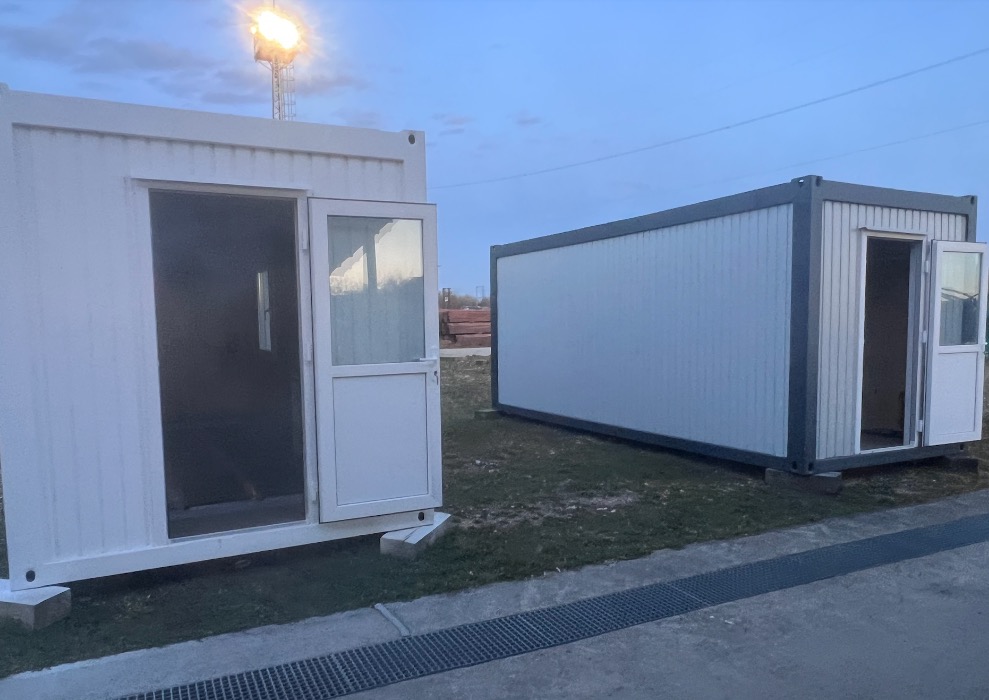
Opportunities to compare heating technologies under controlled measuring conditions are rare. This study took place at the own site of a Hungarian energy company, on two containers of identical basic construction, with the company's certified measuring system, over several weeks, with data recorded every minute. Besides building energy networks, the company taking part in the measurement also deals with measuring, calibrating and laboratory testing of electrical and energy systems. MOEFSZ's task was to process, interpret and evaluate the measurement data from a heating-engineering point of view.
The heating comparison was part of a series of studies. It examined how heating-cooling air-conditioner air heating behaves in a container modelling real office use, and how, in the same place, radiant infrared heating, 4th-generation heating film, behaves. The two systems operated in two separate 14-day periods:
- air-conditioner heating: 14-28 October 2025,
- infrared heating: 4-17 November 2025.
In both periods the outdoor temperature, the indoor temperature at several points and the energy consumption were recorded every minute. In this study the container was in its basic construction, without a separate thermal insulation coating, so the results were not influenced by the effect of an additional coating.
Note on transparency: the president of MOEFSZ is the founder of our company, Tamás Tóth, and the measurement included 4th-generation heating film of the kind our company also sells. We therefore publish the numbers together with their limitations, so that readers can judge them for themselves.
1. The outdoor temperature and consumption
The two systems did not operate in the same weather. According to the measurements:
- the average outdoor temperature in the air-conditioner period was 10.2 °C,
- in the infrared heating period it was 7.0 °C.
The difference of 3.2 °C is significant, because heating demand is, to a good approximation, proportional to the difference between indoor and outdoor temperature (ΔT). The study calculated with a target temperature of 21 °C:
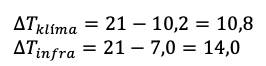
The ratio of the heat loads of the two periods:
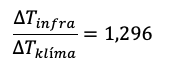
Accordingly, in the colder, infrared-heating period the heating demand was nearly 30% greater, regardless of the heating system. The raw consumption of infrared heating therefore had to be corrected for weather so that the two systems could be compared.
2. Air-conditioner air heating in the 14-day measurement
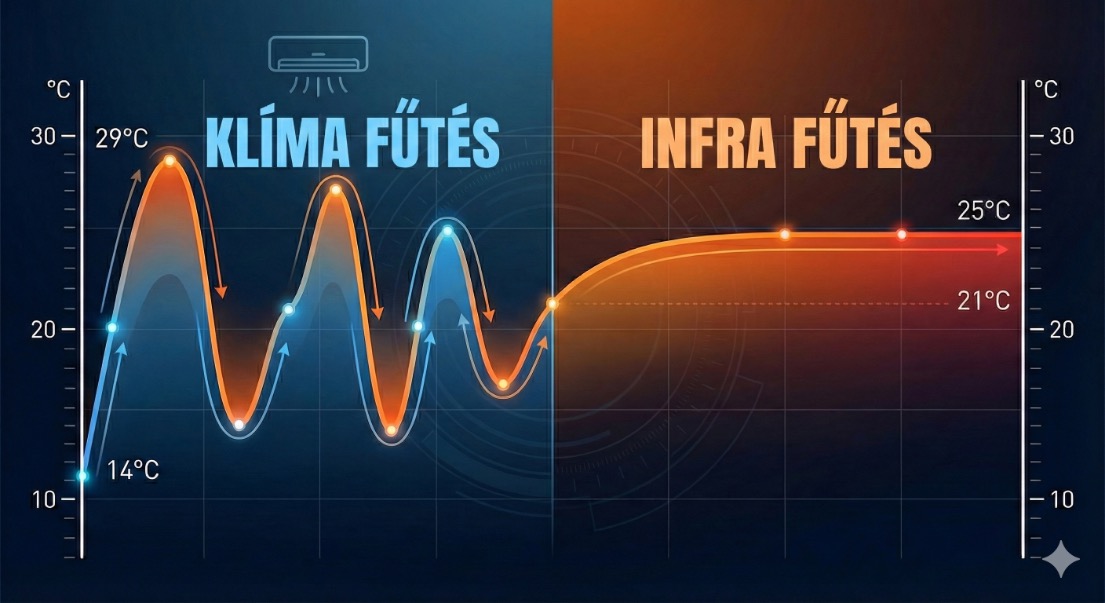
With air-conditioner heating, strong temperature fluctuation was measured: the indoor temperature varied between a lower value of 14-15 °C and an upper value of 27-29 °C, which could mean a swing of as much as 10-12 °C within a single day.
The phenomenon follows from how air heating works: the air conditioner warms the air quickly, then after the thermostat switches off, the air cools back quickly. The temperature measured near the wall was consistently lower, by an average of -0.37 °C, with a large spread - this suggests that the walls stayed colder, which worsens thermal comfort.
The specific energy consumption of air-conditioner heating: 150.01 kWh/day.
3. Infrared heating in the 14-day measurement
The temperature behaviour of heating film infrared heating was markedly different: the daily fluctuation was typically 1-2 °C, and the measured values stabilised between 21 and 25 °C. This stems from the nature of radiant heating: it warms mainly the surfaces - floor, walls, furniture - and these release the heat evenly and over a long time.
The difference between the wall and the middle of the space was -0.31 °C with infrared heating, with a smaller spread, which shows a more even warming of the space.
The raw, uncorrected energy demand of infrared heating: 213.1 kWh/day - in the colder period.
4. Correction of consumption
4.1. Weather correction (calculated)
For comparability, the consumption of infrared heating has to be recalculated to the heat demand of the air-conditioner period. The correction factor:
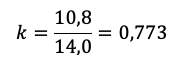
The weather-corrected infrared heating consumption:

The result is 164.7 kWh/day, that is, for the same weather, infrared heating in this container consumed about 10% more than the air conditioner (150.01 kWh/day).
4.2. Comfort correction (assumed)
With radiant heating, thermal sensation depends not only on the air but also on the temperature of the surrounding surfaces, so the study starts from the assumption that the same sense of comfort can be reached at an air temperature 2-3 °C lower. That would mean a further 14-22% energy saving:
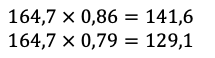
The consumption of infrared heating would thus fall between 129 and 142 kWh/day. Important: this is not a measurement result. In the container the air temperature was not lowered - in the infrared heating period too it was 21-25 °C -, so the saving is an estimate based on the thermal-comfort effect of radiant heating, which in reality arises only if users really set the thermostat lower.
5. What does the measurement show, and what does it not?
- Measured data: the temperature fluctuation (14-29 °C with the air conditioner, 21-25 °C with infrared heating), the difference between the wall and the middle of the space, the daily consumption (150.01 and 213.1 kWh/day) and the outdoor temperature.
- Calculated correction: the weather correction (164.7 kWh/day), which takes heat demand to be proportional to the temperature difference - a good approximation, but a simplification.
- Assumed correction: the comfort correction (14-22%), which the measurement did not confirm.
- Not examined by the measurement: service life, maintenance cost, environmental burden and health effects - the sections on these are general, literature-based evaluations in the study.
- The study does not state the average indoor temperature of the two periods, even though that also influences consumption.
In summary: on the basis of the measured and weather-corrected data, in this container the air conditioner heated with less energy, while infrared heating gave a substantially more stable and even temperature. Infrared heating can be more favourable in energy terms if, thanks to radiant heat, the room can be set to a permanently lower air temperature. What consumption depends on in a residential building is explained on our consumption page; the cost comparison with heat-pump systems is in our heat pump vs infrared heating cost comparison.
6. Thermal sensation and radiant heat
Radiant infrared heating does not primarily warm the air but the surrounding surfaces and objects, so the thermal sensation can be pleasant even at a lower air temperature. The feeling of warmth is similar to the warmth of sunshine, and the heating works without fan-driven air movement, so it stirs up less dust.
Air-conditioner heating releases heat by circulating the air. This allows quick heating up, but air movement can stir up dust, create a feeling of draught and - as the measurement also showed - the temperature is less even in time and space. The practical advantages and limits of heating with an air conditioner are covered in detail in our article on air-conditioner heating.

7. Maintenance and service life
An air-conditioning unit is a complex mechanical assembly: it contains a compressor, fans, filters and refrigerant, and needs regular servicing. The study puts its average service life at 8-12 years - this is a general estimate, not a result of the measurement.
In 4th-generation heating film, by contrast:
- there are no moving parts,
- there is no filter, fan or compressor,
- maintenance needs are small, and no regular servicing is required.
The study estimates the expected service life of heating film at 50-60 years. This is not a measured value either, and long-term operating experience does not yet support it, so it should be treated cautiously as design data. The warranty is independent of this: 15.5 years on 4th-generation heating film if we carry out the installation.
8. Other technical differences
Air-conditioner air heating needs an outdoor and an indoor unit; these are audible, take up space and can be aesthetically disturbing. The filters have to be cleaned regularly, and refrigerant leakage is an environmental risk. A great advantage, however, is that it also cools in summer, which infrared heating cannot do.
Infrared heating:
- is a hidden system (the film is behind the floor covering or plasterboard),
- is silent in operation,
- is modular and easy to extend,
- contains no refrigerant,
- creates no fan-driven air movement, which can also be favourable for people with allergies,
- but cannot cool.
9. Environmental burden
The environmental impact of a heating system comes not only from energy use during operation but from the whole life cycle: manufacture, transport, operation, maintenance and handling of the equipment once it becomes waste.
According to the measurement, the energy demand of the two systems - depending on the corrections - may fall in a similar range, so the other elements of the life cycle matter too. The study's argument is as follows:
- If heating film really lasts 50-60 years, then, taking the 8-12-year service life of air conditioners, over that time 4-5 air-conditioning units would have to be manufactured, serviced and handled as waste.
- Heating film contains no refrigerant. The leakage of fluorinated refrigerants (F-gases) used in air conditioners carries a significant greenhouse effect, which is why they are strictly regulated substances.
- Lower maintenance needs mean fewer service call-outs and less cleaning agent.
The study did not prepare a full life-cycle analysis, so we do not quantify the size of the difference: the direction of the arguments above favours radiant heating, but the exact proportion depends on real service lives and on how the electricity is generated.
10. Summary
Based on the two 14-day measurements, the high-resolution data of the industrial partner and MOEFSZ's evaluation:
- Temperature stability: with air-conditioner air heating the indoor temperature moved between 14 and 29 °C, the daily fluctuation often reached 10-12 °C, and the walls stayed colder. With infrared heating it stayed between 21 and 25 °C, typically with a 1-2 °C fluctuation.
- Spatial evenness: the difference between the wall and the middle of the space was ~0.37 °C with the air conditioner, with a large swing; with infrared heating ~0.31 °C, with a substantially smaller spread.
- Consumption: the raw infrared heating figure (213.1 kWh/day) is not comparable because of the colder period. Corrected for weather, infrared heating used 164.7 kWh/day and the air conditioner 150.01 kWh/day - so on a measured basis, the air conditioner consumed less. With the assumed comfort correction of 14-22%, infrared heating would be 129-142 kWh/day.
- Maintenance: the air conditioner needs regular servicing and, according to the study's estimate, lasts 8-12 years; heating film has small maintenance needs, and the study estimates its expected service life at 50-60 years.
General differences not shown by the measurement: heating film is hidden and quiet, with no moving parts; radiant heat does not stir up dust or cause draughts; the outdoor unit of an air conditioner is audible, but the air conditioner also cools in summer.
Conclusion for the containers studied
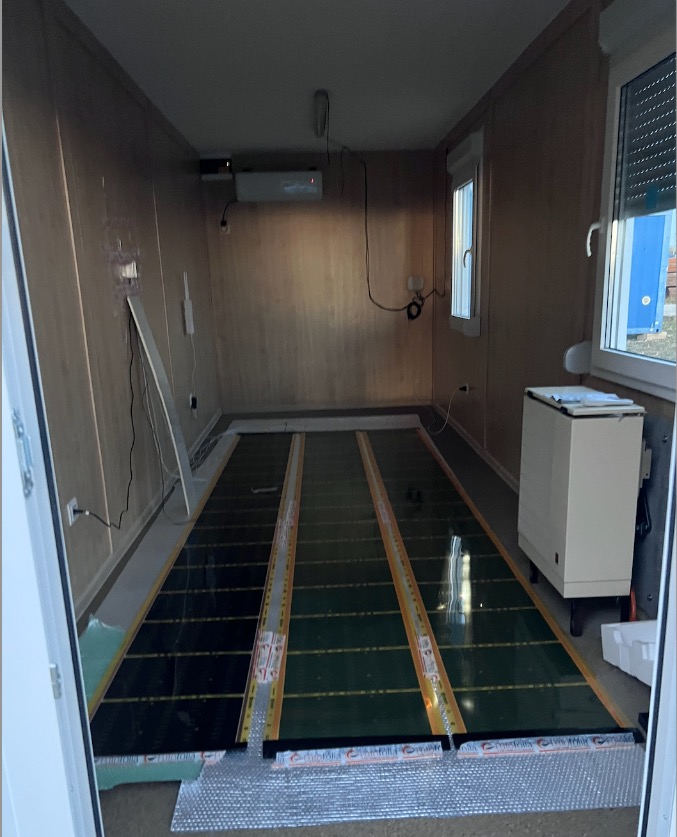
Because of the construction of the containers, the study evaluated only the heating results. In summer an air-conditioning unit is indispensable in these containers, but for heating, to improve working conditions, it recommends supplementary infrared heating, because an even, pleasant thermal sensation can be reached faster with 4th-generation heating film. In industrial containers, to avoid damage, it is advisable mainly as ceiling heating, instead of conventional bottled-gas heating; this can improve operational safety and, since there is no combustion, it does not consume the oxygen of the indoor air either. You can read about industrial applications in our article Heating film in an industrial environment; an overview of electric heating methods is on our pillar page.
Request a quote — installation anywhere in Hungary
We survey, design and install heating film and infrared heating throughout Hungary. Tell us about your home and we will get back to you.