

Polytunnel Heating with Heating Film – How Does Infrared Heating Get into a Polytunnel?
Author: Tóth Tamás · 5 min read
In a polytunnel, heating film warms the plants and the soil, not the air space of the tunnel. Heating levels, placement for ridge and table growing, build-up, zoning and control – the experience from our 2020 article, organised.
In a polytunnel, heating film warms the plants and the soil, not the whole air space of the tunnel. For plants grown in the ground, we place the film vertically between the rows; for table growing, we lay it on the surface of the table, on a reflective foil. Planning starts with deciding whether the aim is emergency heating, moderate heating or the temperature that is physiologically optimal for the plants – the investment and the heating cost depend on this.
What is heating needed for in a polytunnel?
Infrared heating is used in many fields today, but it is most often mentioned in connection with heating houses and flats. This article presents its agricultural use. In polytunnel growing, heating has two main tasks:
- in the early, frosty period, to protect seedlings from frost and so reduce financial loss;
- to let the grower take the crop to market as early as possible and so earn extra income.
Heating levels: what must the heating be able to do?
It must be clarified at the very start of planning what the heating is for, because the investment and the expected heating cost depend on it. We distinguish three levels:
| Heating level | What it ensures | Advantage | Disadvantage |
|---|---|---|---|
| Emergency heating | the plants must not die and no damage must occur (the requirement differs from plant to plant) | the lowest investment cost | in bad weather the plants develop with difficulty, and sales may be delayed |
| Moderate heating | the lower temperature does not harm development | the plants' development is not impaired | the time to market is still not ideal, and the expected profit is lower |
| Physiologically optimal heating | the most favourable temperature for development can be maintained | plannable time to market, fast and reliable growth | the highest temperature has to be maintained |
How does infrared radiation heat?
Infrared radiation has a longer wavelength than visible red light; it is invisible to the eye but perceived by our skin as warmth. It got its name because in the series of electromagnetic waves it comes "below" visible red. It is in fact the part of solar radiation that gives warmth: this is why a skier can ski in a single T-shirt in sub-zero temperatures in the sunshine, and why, sitting in a car in cold but sunny weather, we feel the sun almost burning.
Infrared radiation does not use the air as a transmitting medium: it passes through it without significant loss and directly heats solid bodies – in a polytunnel, the plants, the soil and the tables.
The heating film we work with
When the article was published in 2020, we supplied the heating film from the factory in rolls 0.5 metres wide and 100 m long, from which we cut pieces to size to suit the site and the installation habits. It was made in several power ratings (110 W/m², 220 W/m² and 400 W/m²), and the power suited to the project was always installed. In a polytunnel we use 8–10 metre pieces in practice. You can find out about our current range on the page for 4th-generation heating film.
Placement for ridge planting or on a flat surface
We place the heating film vertically between the rows or the plants. Infrared heating can be a fixed installation – for example fastened to a frame for as long as it is needed – or mobile, so it can be rolled up and stored at any time.
The film heats in two directions, with a range of 2 metres each way. In a tunnel 50 m long we recommend 5 pieces of 8-metre film per row, and we repeat this row in parallel every 4 metres.
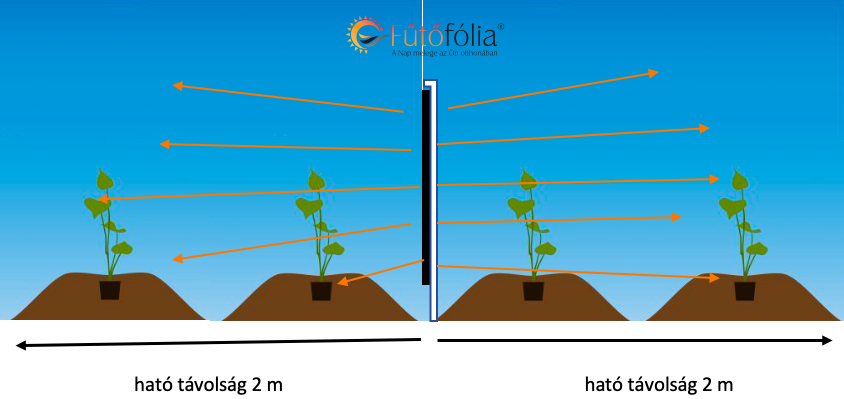
This way the plants get an even temperature everywhere in the tunnel. The heating film units can be controlled separately, so the cooler zone typical near the doors can also be balanced out, and development and flowering do not become uneven. With an even temperature you can avoid staggered flowering, plants catching a chill and loss of the crop.
The heating system shown in the article had IP67 insulation (waterproof), so with proper installation watering did not harm it either.
Growing on tables
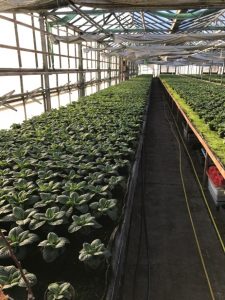
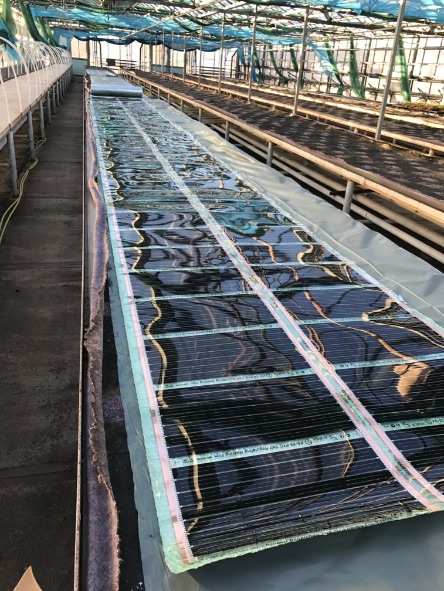
If the plants grow not on the ground but on a table, the heating film goes on the surface of the table, with the following build-up (from bottom to top):
- 5 mm reflective foil over the whole table surface;
- 0.5 mm thick infrared heating film – 50 cm wide, so 2 pieces of 50 cm go in parallel on a table 1.2 metres wide;
- vapour barrier film;
- if necessary, a covering layer against mechanical impact.
In plant growing it is mostly the temperature of the soil that matters, so we place several measuring points in the plants' soil. With this solution the air temperature can be disregarded: the system looks only at the soil temperature.
A great advantage is that you do not have to heat the whole tunnel, only the area under the plants. If different plants are grown in one tunnel, each can get the temperature it needs: the control can be arranged row by row, or with a row divided into further sections.
Specifically for seedling heating: narrow heating film
In autumn 2020 we supplemented the article with the news that a 25 cm wide heating film designed specifically for seedling heating had been launched. You can find today's sizes and packaging on our seedling heating page.
Controlling the tunnel heating
Infrared heating can be controlled with two kinds of device:
- Thermostat: worthwhile only with 1–2 measuring points, because the number of measuring points is strongly limited here.
- Smart-home control (IQotthon): you can see remotely, from a phone or computer, what is happening in the tunnel. Temperature, humidity and light can be measured and traced back on a graph; besides heating, the system can also control lighting, watering, cooling or any connected electrical consumer. Every process can be preset and tied to various conditions for when it starts by itself. Details: smart-home control.
Summary
Polytunnel heating with heating film uses radiant heat to bring the warmth where the plants need it: between the rows or onto the growing table. It can be built as a mobile or fixed installation, as permanent or seasonal heating, with remote control as well, and the installed power can be sized to the chosen heating level. For heating insulated tents used for storage, events or industrial purposes, see our detailed article on tent heating.
Request a quote — installation anywhere in Hungary
We survey, design and install heating film and infrared heating throughout Hungary. Tell us about your home and we will get back to you.