

Home Energy Storage: Benefits of Battery Systems
Author: Tóth Tamás · 6 min read
What a home battery adds to a solar system: your own electricity in the evening and in overcast weather, less purchased power, backup supply – and why it does not remove the electricity cost of winter heating under gross metering.
A home battery helps with the biggest limitation of a solar system: solar panels produce during the day, whereas a household typically consumes the most in the morning and evening. The storage unit saves the daytime surplus and gives it back when the panels no longer produce – so the share of your own electricity used rises, the electricity bought from the grid falls, and with a suitable inverter important appliances can keep working during a power cut.
Solar panels have become very popular in recent years, but on their own they do not make a household independent of the grid. When and how much home energy storage is worth depends on consumption habits, the way electricity is settled and the type of heating.
The weak point of a solar system: the timing mismatch
The biggest challenge of solar systems is that production and consumption do not coincide. During the day, when the panels produce the most, many households need little electricity; in the morning and evening, however – when heating, cooking, lighting and entertainment electronics are running – production is low or zero.
This mismatch used to be smoothed out by net metering: the grid acted as a kind of virtual battery, and summer surplus was credited against winter consumption. In Hungary today this applies only to older systems. For new household solar systems, gross metering has applied since 1 January 2024, in which electricity fed into the grid and electricity drawn from the grid are settled separately. Net metering could be kept only by those who submitted their connection request by 13 September 2023 and commissioned the system by 1 January 2026 – and even they for 10 years at most. Because of gross metering, every solution that keeps the electricity produced on site has gained value; one such tool is the battery.
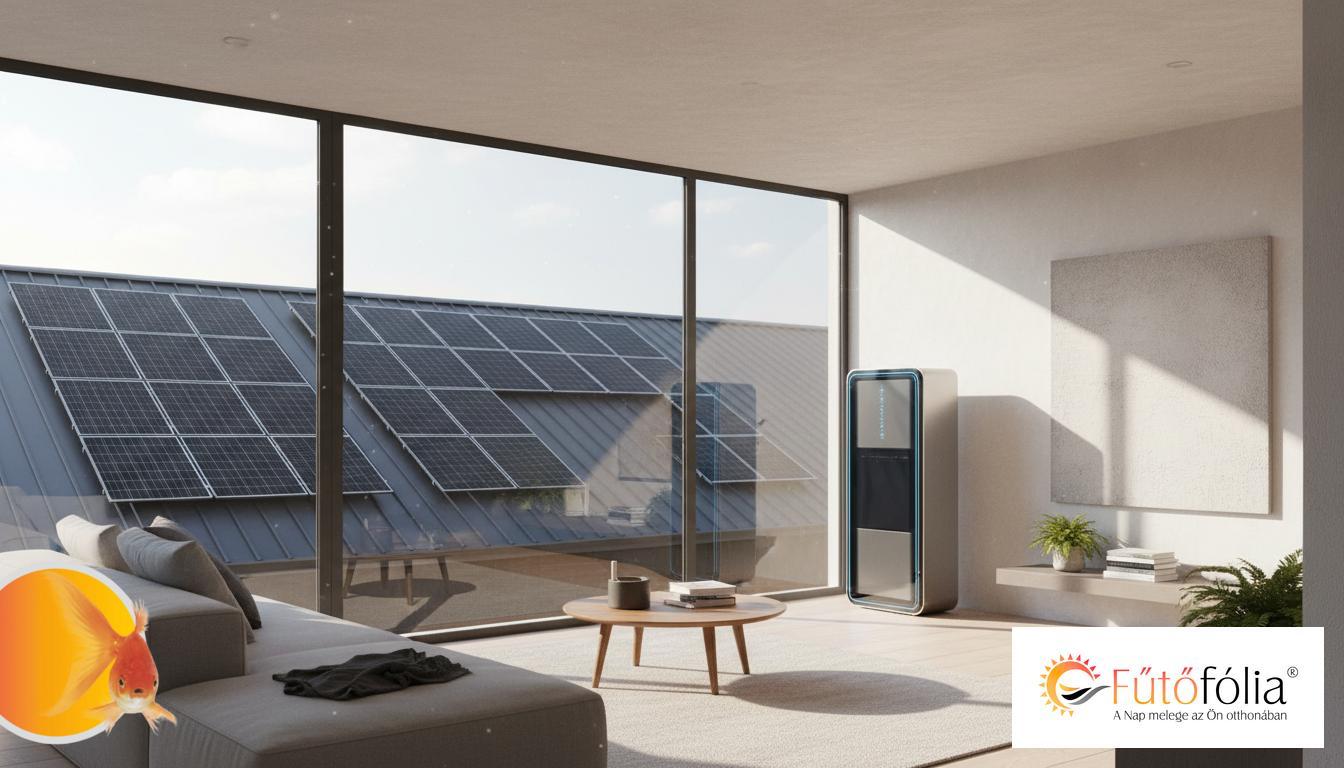
What does home energy storage give you?
- Greater self-sufficiency: part of the electricity produced is used not at the moment of production but when it is needed, so less electricity has to be bought from the grid.
- Lower costs: your own stored solar energy replaces part of the purchased electricity in the evening or in overcast weather. If the price of electricity differs by time of day, stored energy can also be saved for the more expensive periods.
- Relieving the grid: if households use more electricity locally, the midday surplus fed into the grid and peak-time drawing decrease.
- Supplying heating systems: electric heating – infrared heating, underfloor heating, a heat pump or an air conditioner in heating mode – has significant consumption. If part of it runs on your own stored electricity, the electricity purchased for heating falls.
- Backup power supply: if the inverter and the system are suited to island operation (backup power), selected important appliances can be run during a power outage. This is worth clarifying separately when buying, because not every system with storage can do it.
- Environmental protection: with better use of renewable production, less grid electricity, partly generated from fossil sources, is needed.
How does battery storage work?
- Production: during the day the solar panels produce electricity from sunlight.
- Direct use: the electricity first covers the house's instantaneous demand (lighting, appliances, cooling, heating).
- Charging: the surplus above instantaneous consumption goes into the battery.
- Discharging: when the panels do not produce enough – in the evening, at night, in overcast weather – or when there is a power cut (with the backup function), the house draws from the battery.
- Feed-in: if the battery is full and there is still a surplus, the rest of the electricity may go into the grid under the rules in force.
Energy storage and electric heating
Storage deserves particular thought together with electric heating, because heating demand and solar production move in opposite directions:
- Daily bridging: on winter days, whatever remains of the production of the short sunny period during the day can be used from the battery in the evening or at night for heating too.
- The limit of winter: a home battery is a daily-scale store; summer surplus cannot be saved for winter with it. In the coldest months solar production is small, so the larger part of the heating electricity must still be bought from the grid. That is why heating combined with a battery can reduce the cost but not eliminate it. Our article on heating with solar panels gives details on winter production.
- With which heating? Stored energy can be used by any electric heating: a heat pump, infrared heating (infrared panels, heating film, heating film (3rd generation)), underfloor heating with heating mats or heating cables, ceiling heating, wall heating and panel heaters. How the electricity demand and cost of a heat pump and infrared heating compare is shown in our cost comparison.
- Smart control: with programmable thermostats and an energy management system, charging, discharging and heating can be coordinated: the system can, for example, heat when the solar panels are producing, or charge when electricity is cheaper. It can equally serve smaller, occasional needs, such as seedling heating.
- Continuous operation: with a system that has a backup function, the heating controls (infrared heating, underfloor heating and so on) can keep working during a short power cut – up to the limit of the storage capacity.
- Electromagnetic field: the inverter and the battery are also electrical equipment; their location must be chosen according to the manufacturer's installation instructions. We write about electrosmog and our measured values for heating film on a separate page.
Technology and costs
The most widespread home energy storage technology at present is the lithium-ion battery, which has high energy density, good efficiency and withstands many charge cycles. The investment is higher than for a solar-only system, so it is worth thinking through the payback in advance: the battery price, the share of self-consumption, the household's electricity price and the settlement method together determine it. If a residential subsidy happens to be available, it can shorten the payback – on the state of the energy storage grant, see our article on the solar grant with battery.
When planning the system it is worth having an expert assess the building's energy demand and the production potential of the solar panels, and choosing the storage size and the inverter – which manages the flow between the panels, the battery and the grid – accordingly. You can read about planning solar panels and electric heating together on our solar page.
Summary
Home energy storage has become an important tool in solar homes in the age of gross metering: it increases the use of your own electricity, reduces purchased electricity, and with the right setup serves important appliances during a power cut. Combined with electric heating – infrared heating, underfloor heating or even terrace heating – daily production can be used better, but the heating electricity of the winter months cannot be fully covered from your own production even with a battery. With a well-considered system sized to the real consumption of the house, you can make your energy costs more predictable in the long run.
Request a quote — installation anywhere in Hungary
We survey, design and install heating film and infrared heating throughout Hungary. Tell us about your home and we will get back to you.