

Electric Heating Compared: Gas Boiler, Heat Pump, Air Conditioner, Panels and Heating Film
Author: Tóth Tamás · 7 min read
A comparison of gas boiler, heat pump, air conditioner, electric radiator and heating film by criterion: type of investment, maintenance, controllability, space, installation, running cost and environmental impact – with a table and a selection guide.
No single number decides when you choose a heating system. A gas boiler, a heat pump, an air conditioner, an electric radiator or heating panel and heating film differ from one another in the type of investment, the maintenance they need, controllability, space requirements and the way they are installed. Our comparison shows, criterion by criterion, where electric heating is strong and where it is weaker, and fits the seven arguments we formulated in 2022 into this framework.
The five heating methods in brief
- Gas boiler central heating: the boiler heats water, which a pipe network carries to radiators or to water-based underfloor heating.
- Heat pump: using electricity, it raises the heat of the environment – air, ground or water – to heating temperature; it mostly works with water-based emitters.
- Air conditioner: an air-to-air heat pump whose indoor units heat the room air, and cool it in summer.
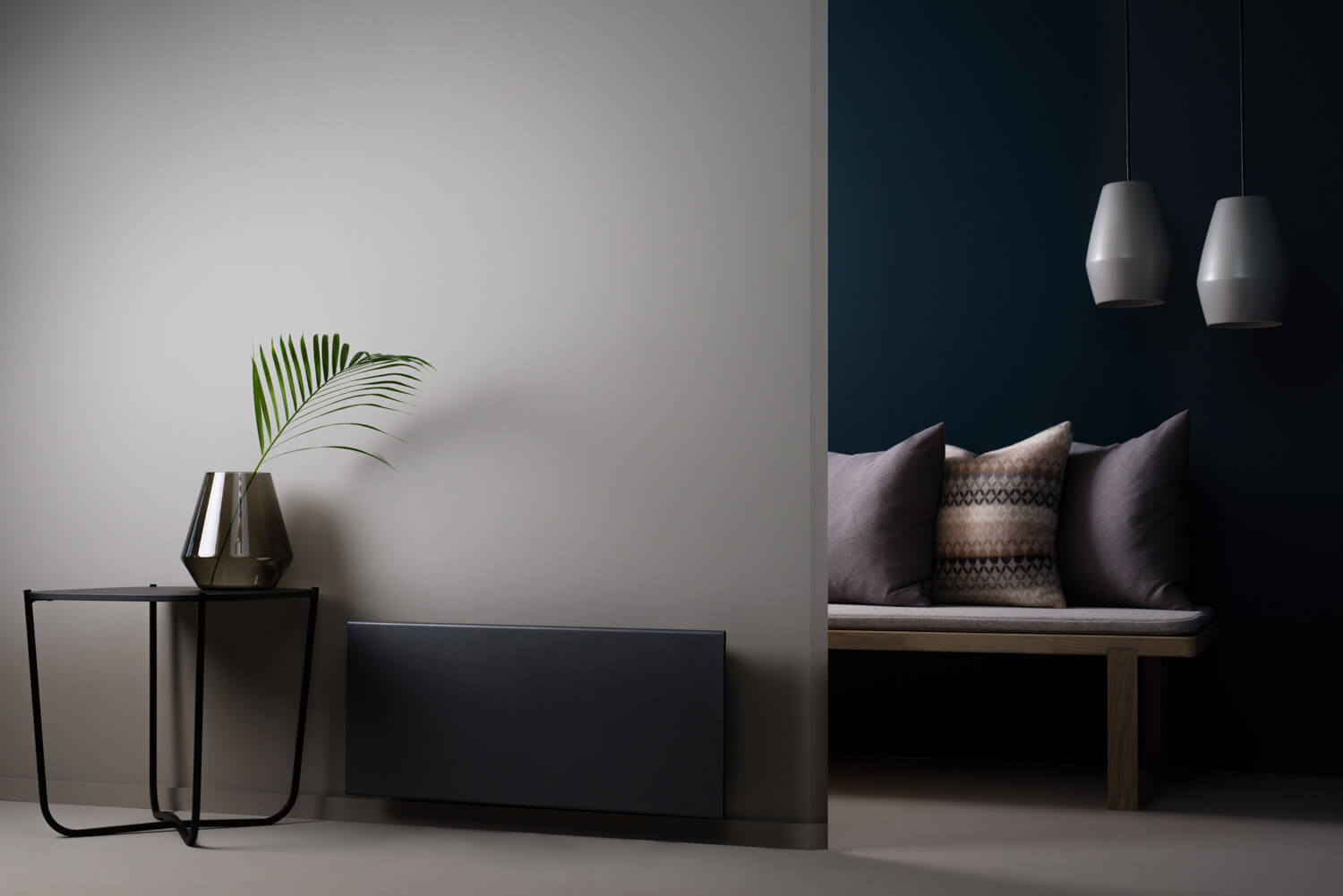
- Electric radiator, heating panel: a wall-mounted, ceiling-mounted or free-standing appliance that turns electricity into heat on the spot; an infrared panel heats mainly by radiation.
- Heating film: a large-area radiant electric heating system built into the structure of the floor, wall or ceiling.
Comparison by criterion
The table compares the nature of the systems, not specific prices: the amount of the investment depends on the size and condition of the house and on the products chosen.
| Heating method | Type of investment | Maintenance | Controllability | Space required | Installation |
|---|---|---|---|---|---|
| Gas boiler | gas connection, boiler, flue gas outlet, pipe network and emitters; in an existing system only the boiler replacement | periodic boiler service, checking the flue outlet | with a central thermostat; room by room only with valves and zones | boiler, chimney, radiators on the wall | gas fitter, design; can take days or even weeks |
| Heat pump | outdoor and indoor unit, water-based emitters, often a storage tank; typically the largest investment | periodic service, keeping the outdoor unit and filters clean | good, but slow to react with underfloor heating | outdoor unit, indoor plant, emitters | plumber and electrician; the position of the outdoor unit must also be planned because of noise |
| Air conditioner | an indoor unit per room, an outdoor unit; cooling is solved as well | regular filter cleaning, periodic service | fast room by room, by remote control, often from a phone | indoor unit on the wall, outdoor unit on the facade | qualified A/C installer; it gives off heat by air movement |
| Electric radiator, heating panel | per appliance; no boiler or pipe network | needs no regular service | room by room with a thermostat, many types are programmable | panel on the wall or ceiling, radiator on the wall or floor | portable type into a socket; an electrician for fixed installation |
| Heating film | together with the flooring or installation work; most practical in a renovation or new build | no combustion or moving parts, needs no regular service | room by room with a thermostat, can be timed | invisible, takes up no space | designed for the build-up of layers, with proper electrical connection |
The 7 criteria in detail
Originally we collected seven arguments for electric heating against gas heating. If we also bring in the heat pump and the air conditioner, some arguments become stronger and others weaker – so we go through them below in that light. The limits of the arguments against gas are set out in a separate article on the advantages of electric heating.
1. Operational reliability: one heat source or many
In a central system, one boiler or one heat pump and its pipes serve the whole house, so a boiler fault or a burst pipe leaves every room cold. The indoor units of an air conditioner, electric radiators, heating panels and the circuits of heating film work independently of one another. Without electricity, however, none of these solutions will heat: the gas boiler's controls and pump, the heat pump and the air conditioner also need electric power.
2. Noise
Noise comes from moving parts: the ignition, fan and pump of a gas boiler, the compressor and fan of a heat pump and an air conditioner. Radiant electric heating – heating panels, heating film – works without such parts, so in this respect it is the quietest.
3. Control and timing
The most economical heating is the one that works only where and when someone is present. With an air conditioner and electric heating, room-by-room control is built in; in a central water-based system it can be solved with zone valves or smart radiator valves, at extra cost. Programmable thermostats that can be controlled from a phone over the internet are available today for every system – we write about the timer and smart-home options of electric heating on a separate page.
4. Maintenance
A gas boiler and a heat pump need periodic servicing, and with an air conditioner the filters must be cleaned regularly. In a water-based system there is also the risk of a burst pipe or a leak, which is expensive to repair under the flooring. Electric radiators, heating panels and heating film need no regular service; for them the thermostat and the controls are the most sensitive element.
5. Installation
A portable electric radiator is up and running fastest. Fixed electric heating needs an electrician, a suitable circuit and protection, and it must be clarified beforehand whether the house's electrical network can carry the load. Building gas heating involves a gas fitter's work and flue gas discharge, and a heat pump involves mechanical design and emitters. We install heating film to suit the layers of the floor, wall or ceiling – we show the steps on the page how we install heating film. We give a 15.5-year warranty on 4th-generation heating film if we carry out the installation.
6. Energy efficiency and running cost
Electric radiators, heating panels and heating film turn the electricity they draw into heat on the spot, with no distribution pipework. In a gas boiler part of the heat leaves with the flue gas, and heat can also be lost in pipes running through unheated spaces. A heat pump and an air conditioner also use the heat of the environment, so for the same amount of heat they consume far less electricity than an infrared panel or an electric radiator. The heat loss of the building, however, is the same with every system – insulating the walls, windows and roof reduces the cost with every heating method.
The running cost is also affected by the price of the energy and by the tariff. In Hungary, residential gas is cheaper than electricity in the preferential band. The preferential H tariff can be requested for heating with a heat pump with an SCOP of at least 3.4 – and for some split air conditioners that can also heat – but not for electric boilers, heating panels, infrared panels and electric radiators. We compare the cost of a heat pump and infrared heating in a separate comparison.
7. Environmental impact
Only a gas boiler involves combustion on site: carbon dioxide and combustion products are formed that have to be discharged. The other systems run on electricity, so their environmental impact depends on how the electricity is generated; for the same amount of heat a heat pump and an air conditioner use less electricity. In detail: is electric heating environmentally friendly.
Which heating method is the right choice, and when?
- Existing gas heating in good condition: if consumption stays in the preferential band, replacing it on cost alone is rarely urgent.
- A new or well-insulated house with water-based emitters: the low electricity demand of the heat pump comes into its own here, at the price of a larger investment.
- Summer cooling is also needed: an air conditioner solves both; for those who dislike air movement it can be combined with radiant electric heating.
- Supplementary heating, a rarely used room: an electric radiator or infrared panel, with no demolition.
- Renovation, invisible and room-by-room controllable full heating: heating film, with quiet operation and no regular servicing.
The types, advantages and uses of electric heating are summarised on our electric heating page. If you would like a recommendation tailored to your own house, during the on-site survey (available in Hungary) we can recommend a system once we know the heat demand and the electrical network.
Request a quote — installation anywhere in Hungary
We survey, design and install heating film and infrared heating throughout Hungary. Tell us about your home and we will get back to you.