

7 Reasons to Choose Electric Heating Instead of Gas Heating
Author: Tóth Tamás · 6 min read
Seven advantages of electric heating over gas heating - independence from a boiler, quiet operation, room-by-room control, no boiler servicing, simpler installation, local heat output, combustion-free operation - each with its own limitation.
Compared with gas heating, electric heating is stronger mainly in comfort, reliability and controllability: there is no boiler or pipe network that can shut down the whole house, boiler servicing is no longer needed, heat can be scheduled room by room, and no combustion products are produced in the house. The price of energy, however, favours gas: in Hungary, household gas in the discounted band is cheaper than electricity. That is why we state the limitations alongside each of the seven arguments.
This article first appeared in March 2022, when household gas prices were still low and many people stuck with gas heating for that reason. Energy prices and billing conditions have changed since then, so we have reviewed and refined the arguments. Electric heating has also developed enormously in the meantime: even then it was nothing like what it meant 20 years earlier, and thanks to programmable electric radiators, panel heaters and heating film, more and more people are choosing it.
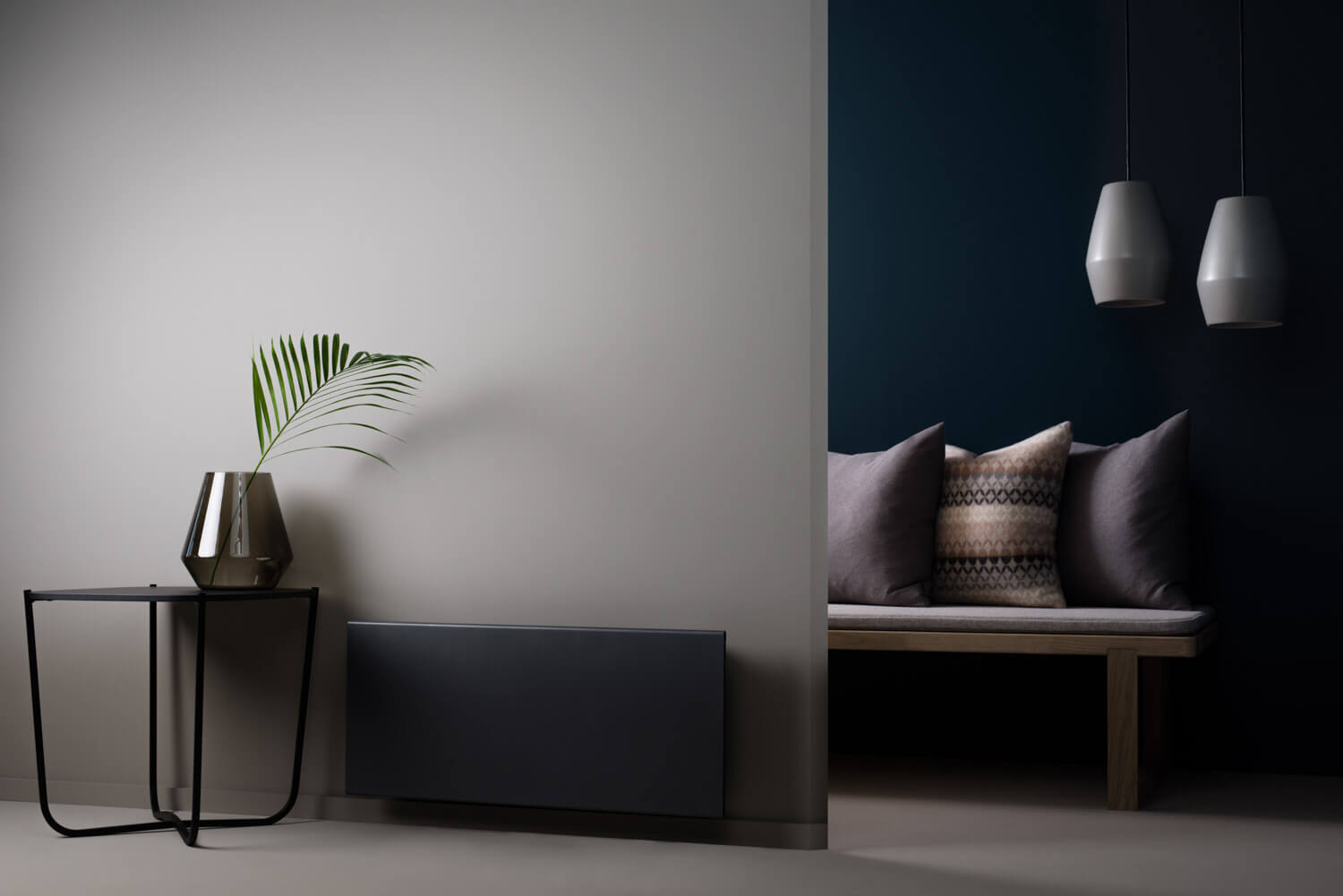
The advantages of electric heating in 7 arguments
1. It does not depend on a single boiler
With gas heating, the boiler heats the water and the pipes carry it to the radiators: the boiler is the heat source, the pipe network the distributor. If the boiler breaks down, or a pipe bursts in the house, no room gets any heat. With electric heating, each appliance or heating circuit produces and releases heat at the same time, so a fault affects only that one room.
The limitation: in a power cut, electric heating does not work. The same is true of gas heating, though, because the boiler's controls and circulation pump need electricity too.
2. Quiet mornings
One of the most annoying companions of gas-boiler central heating is the click and hum when it switches on, often just during the quiet minutes of morning coffee. An electric radiator, panel heater and heating film heat without moving parts, so at most you hear the thermostat switching.
The limitation: this is true of radiant electric heating; the sound of fan heaters is clearly audible.
3. Complete control over your heating
It is convenient to be able to set a timer in the evening and have a pleasant warmth throughout the house by morning. Programmable thermostats are available for gas heating too, but room-by-room control requires installing a valve on every radiator or separate zones, which is an extra cost and typically needs a professional. With electric heating, every room can have its own thermostat, and many electric radiators can be programmed over the internet and controlled from a computer or phone. See the options on our electric heating page.
Besides the convenience, it shows on the bill too: there is no need to heat an empty home or a room nobody is using. A well-set programme can save a lot of energy.
The limitation: the saving depends on use. Where people are home all day and every room is heated equally, it is smaller than where the home is empty during the day.
4. No annual boiler service
We tend to forget the annual maintenance cost of gas heating. By our 2022 calculation it could even exceed HUF 50,000, and even so it does not guarantee that the boiler or the pipes will not fail. A failure also typically comes at the worst time: not in summer but in mid-January, when the house stays cold until the repair. With electric heating there is no combustion, no chimney and no water system, so this cost and this risk are gone.
The limitation: the thermostat or the controls can also fail, and with a built-in system tracing the fault needs a professional. It is worth asking a service company for the current annual fee.
5. Simpler installation - but not always "plug it in and done"
Installing gas heating requires a gas connection, a boiler, flue gas removal and a pipe network; the work usually takes days, possibly weeks, and only a professional can do it. Installing electric heating is considerably simpler. A portable electric radiator really does need only a socket.
The limitation: built-in electric heating - a wall-mounted panel heater, or heating film built into the floor or ceiling - requires proper electrical connection: a suitable circuit and protection, a thermostat, and it must first be checked whether the house's electrical network can bear the heating load. We examine this at the design stage, during the on-site survey.
6. It releases heat where it is produced
Gas is cheaper, we do not dispute that. With gas heating, however, the water has to travel from the boiler to the radiators, and if the pipes run uninsulated through an unheated basement, attic or ceiling void, considerable heat can be lost along the way. With electric heating there is no distribution piping; the heat is produced in the room that needs heating.
The limitation: the heat loss of the house - what escapes through the walls, windows and roof - does not depend on the heating method; the same amount of heat has to be replaced with gas and with electricity. In pure running cost, therefore, the price of energy decides, and in the discounted band that favours gas. Electric heating really pays off where the house is well insulated, where heating is controlled economically by room and by time, or where the gas connection, boiler and pipe network can be left out altogether.
7. No combustion in the house
Natural gas is the cleanest fossil fuel, but when it is burned in the boiler, carbon dioxide and other combustion products are produced, which have to be led away through a chimney or flue. Electric heating burns nothing on site: no flue gas, no chimney.
The limitation: that does not make it entirely environmentally friendly, because the overall environmental impact depends on how the electricity is generated - the larger the share of renewable and low-emission sources, the better. More on this: is electric heating environmentally friendly?
When is it worth switching, and when should you stay with gas?
- Existing gas heating in good condition, moderate consumption: if the boiler and radiators are in order and consumption stays in the discounted band, on cost alone gas is generally cheaper.
- Renovation or a new house, no gas system installed: here the cost of the gas connection, boiler, chimney and pipe network also goes on the scales - it is worth calculating it together with electric heating.
- Well-insulated house, different use from room to room: this is where the advantage of room-by-room control and scheduling is felt most.
- Rarely used room, supplementary heating: an electric radiator or panel heater is a simpler solution than extending the central system.
In summary: electric heating is quiet, can be controlled room by room, does not depend on a boiler and eliminates boiler servicing; the price of gas in the discounted band is nonetheless lower, so the decision depends on the condition of the house and how it is used.
If you would like to compare not only gas but also heat pumps, air conditioning and the various electric heating types, read our article comparing several heating methods point by point. The types and uses of electric heating are presented on our electric heating page.
Request a quote — installation anywhere in Hungary
We survey, design and install heating film and infrared heating throughout Hungary. Tell us about your home and we will get back to you.