

How to Plan Infrared Heating for Your New Home - From a New Angle
Author: Tóth Tamás · 6 min read
Infrared heating for a new house is best planned at the sketch-plan stage: heat demand and insulation, room-by-room zones, floor, ceiling or wall heating, control, then professional installation and commissioning. Step by step.
You plan infrared heating well in a new house when you treat it not as a later add-on but as part of the house from the sketch-plan stage: with the architect and an energy engineer you assess the heat demand and insulation, mark out zones room by room, decide where floor, ceiling or wall heating goes, then leave the installation to a professional and fine-tune the thermostats after commissioning.
Building a new home is one of the biggest investments of a lifetime, and among the many decisions, choosing the heating system is one of the most important. Infrared heating is the choice of more and more people, because it is comfortable and can be run economically in a well-insulated house. In this article we show why it is worth thinking through the planning comprehensively from the first minute. You can also read about the planning process and the on-site consultation on our on-site survey and consultation page.
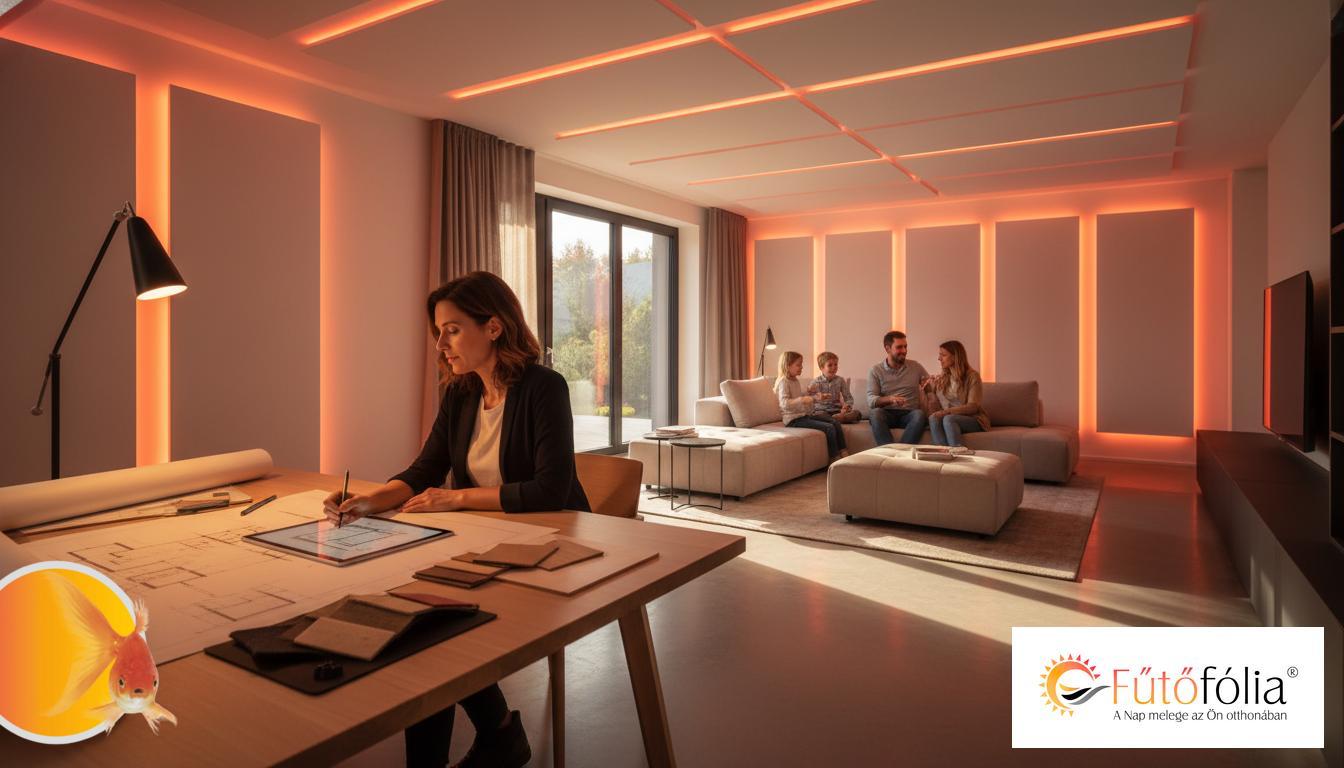
Why does infrared heating suit a new house?
Heating based on the principle of infrared radiation warms not primarily the air but the surfaces and objects of the room and the people in it - similar to the way you feel the sun's radiation. In a newly built house this is an advantage in several ways:
- Lower consumption with good insulation: thanks to radiant heat, a room can feel comfortable at a lower air temperature, which can reduce consumption. In a well-insulated house, this form of electric heating can be run economically.
- Less air movement: because it does not heat by circulating air, there are no draughts and it stirs up less dust. Radiant heat also warms wall surfaces, which helps prevent cold, damp surfaces from forming.
- Space saving and aesthetics: there are no radiators, boiler or pipe network, so there is more free space and the interior stays clean-lined.
- Little maintenance: a heating element built in behind the floor covering or ceiling is not visible and has no moving parts, so it needs little maintenance in the long term.
A new approach to planning: integration from the start
The essence of the new approach is that heating is accounted for in the very first phase of the house plan. That way the advantages work best, and later no compromises have to be made over floor coverings, furnishing or the electrical network.
Phase one: the foundations at concept level
- Consulting the architect and the energy engineer: discuss your wish for infrared heating with the architect already at the sketch-plan stage. The energy engineer helps to determine the heat demand precisely, based on the orientation of the house, the size of the windows and doors and the planned insulation.
- Heat loss and insulation: it is worth mapping out the possible heat-loss points. Well-designed and well-executed insulation is a basic condition for infrared heating to work effectively - think of the thermal insulation of the walls, ceiling slab, subfloor and windows and doors alike.
- Layout and functions: which room will be used for what? A bedroom has different heat needs from a living room or a bathroom, so it is worth thinking through the zones at this point.
Phase two: choosing and placing the system
Infrared heating is flexible: the heating elements can be adapted to the characteristics of the rooms and to personal needs.
- Underfloor heating with heating film or a heating mat: we recommend it for the living room and children's room, where the comfort of a warm floor matters. Heating film is thin and goes under the floor covering. A heating mat serves a similar purpose; which suits a given floor covering is worth deciding at the design stage. The layer build-up of underfloor heating is covered in our article on planning underfloor heating.
- Ceiling heating with built-in heating film: a solution completely invisible from the living space, and the radiant heat coming from the ceiling is distributed evenly. We especially recommend it for spaces with high ceilings or open-plan spaces. Today we install 4th-generation heating film.
- Wall heating: heating film built into the wall tempers a given area in a targeted way. No furniture or large pictures may be placed in front of a heated wall, because they block the heat radiation.
- Infrared panel or panel heater: for supplementary heating, or for rooms where surface heating cannot be done (for example a bathroom, a cellar). There are aesthetic versions, some even working as a picture.
Smart home integration: in a newly built house a smart home system is by now almost a basic expectation, and infrared heating fits it well, since every zone can be controlled by its own thermostat.
- Zone-by-zone control: every room, or even part of one, can be a separate temperature zone, so it heats only where and as much as necessary.
- Remote control and programming: it can be controlled from a smartphone and a weekly programme can be set, which reduces unnecessary consumption.
- Energy monitoring: modern controls provide real-time consumption data, which helps to fine-tune the settings.
Phase three: installation and fine-tuning
- Professional installation: leave the installation of infrared heating to a professional. Accurate power calculation, safe connection and the right choice of materials are the conditions for long-term, trouble-free operation. What to watch out for before installation is listed in our article Before installing infrared heating.
- Choice of materials: choose quality, certified products, whether it is heating film, heating film (3rd generation), heating mats, heating cable or infrared panels. References and warranty conditions help with the decision: with us a 15.5-year warranty applies to 4th-generation heating film if we carry out the installation.
- Setting and trial run: after commissioning, run a trial period, fine-tune the settings of the thermostats, and check that every zone reaches the desired temperature.
Think about supplementary solutions too
When planning a new home it is worth thinking through temperature control as a whole:
- Cooling: infrared heating is suitable for heating on its own, but it does not solve summer cooling. If you need cooling too, it is worth planning a modern heat-pump air conditioner alongside it.
- Special heating needs: have you thought of seedling heating in a greenhouse, or terrace heating for cooler evenings? There are infrared solutions for these too, and because of the electrical network they are worth accounting for at the design stage.
The less visible advantages of infrared heating
In planning, it is not only the technical details that count but also the aspects that give a home its long-term usability:
- Electrosmog: we examined the electromagnetic field of modern heating films with our own measurements; the results are presented on our electrosmog page.
- Modern building services: an energy-saving, well-controllable heating system serves the long-term usability of the house.
- With renewable energy: combined with a solar system, part of the electricity demand of infrared heating can be covered by your own generation.
Summary
If you build infrared heating into the concept of the house from the start, you are not just installing a heating system but planning a coordinated, energy-efficient and comfortable indoor climate. Foresighted planning, involving specialists early and well-chosen control together ensure that the house remains comfortable and economical to heat for decades. If you are planning a new house, you can read about the on-site survey and consultation here.
Request a quote — installation anywhere in Hungary
We survey, design and install heating film and infrared heating throughout Hungary. Tell us about your home and we will get back to you.