

Planning Underfloor Heating – But With What? TOP 3 Electric Underfloor Heating Options
Author: Tóth Tamás · 5 min read
Planning electric underfloor heating: when heating cable, when heating film and when a heating mat? Why the decision must be made at the start of planning, what to watch for in new builds and renovations, and what you gain compared with a water-based system.
When planning electric underfloor heating, it is worth choosing from three solutions: for new construction, heating cable that goes into the concrete layer; for renovation, thin heating mat that can be laid under tiles; and heating film that can be built in under most coverings with a small layer thickness. The decision is determined by the condition of the building, the covering and the available layer thickness – which is why it is worth dealing with it right at the start of planning.
Why must the decision on underfloor heating be made at the start of planning?
In construction or renovation, designers still think of electric underfloor heating less often than of a water-based system. One reason is that the price gap between electricity and gas used to be larger, in gas's favour. The other is that the work is split between trades: heating is typically designed by the mechanical engineer for a water-based system, and the electrician mostly arrives when the way of heating has already been decided. If electric underfloor heating may be an option, it is worth bringing the parties around one table at the start of planning, because the layer structure, the supply and the controls must be planned together.
Before a new infrared heating system or the conversion of the heating of an existing building, the first question is the budget. Electric heating systems can be favourable on the investment side because they need no boiler, chimney or pipework. A detailed, covering-by-covering comparison of the three electric underfloor heating solutions is in our article on types of electric underfloor heating; here we go through the planning considerations.
1. Heating cable: for new construction, with precise sizing
Heating cable is thin, so a small layer thickness can be counted on: on a levelled substrate it can be fixed directly under the covering, and it is also recommended for wet rooms. Laying it requires professional experience, because its sizing depends on the size of the room.
In planning, the most important point is that heating cable cannot be cut to fit the room, so its length must be chosen precisely in advance. It can be controlled only with a 2-sensor thermostat designed for electric underfloor heating, because the cable can overheat, which leads to failure.
As full-value indoor heating it has two main variants: direct underfloor heating and heat-storing underfloor heating. In both the cable goes into the concrete layer that carries the walking surface, so it can typically be done in new construction. Heating cable has many other uses too – for example frost protection of outdoor ramps and driveways, snow and ice melting:
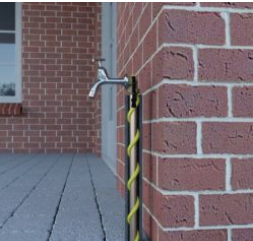 Frost protection heating cable
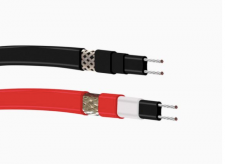 Self-regulating heating cable
 Heating in asphalt and under paving stones
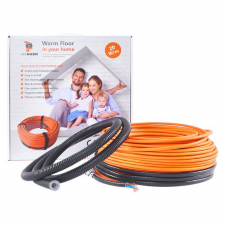 Electric heating cable
2. Heating film: radiant heat, small installation height
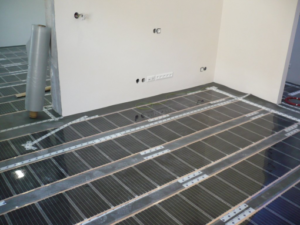
Heating film heats by radiant heat: it warms the surface of the floor and gives an even, pleasant feeling of warmth in the room. It is suitable for heating every type of building. Radiant heating stirs up less dust than heating methods that circulate air. When this article was published in 2020 we installed 3rd-generation heating film; today we install 4th-generation heating film, which is self-regulating: under furniture or a rug it automatically reduces its output.
In planning with film, the type of covering decides the layer structure: the layers between the thermal insulation, the film and the covering must be agreed in advance. Request a technical proposal for heating film!
3. Heating mat: for retrofitting, in renovation
In renovation too, electric underfloor heating can be built in afterwards. In that case, under tiles we suggest a heating mat fixed to a mesh – under cold coverings the 3.8 mm thick T-Mat heating mesh, which goes directly into the tile adhesive or the levelling compound; under a smaller laminate or parquet area the 1.8 mm thick LIKEWARM F-Mat ALU heating mat (if the laminate is being replaced anyway, we recommend 4th-generation heating film under it). In renovation a floor-levelling compound mostly goes onto the old concrete; if the T-Mat heating mesh is laid before levelling, the compound fixes and also covers it, which makes tiling easier. If the layer thickness allows, it is worth putting a special thermal insulation board under the heating mat.
If you want laminate flooring – although other coverings suit this way of heating better – an insulation board goes onto the existing concrete. This replaces the usual levelling and impact-sound damping, and more importantly, as true thermal insulation it reduces the heat escaping toward the substrate, and so the energy use too. The 1.8 mm thick F-Mat ALU heating mat (80, 100 or 130 W/m²) goes on this insulation board, and the laminate sits neatly on it — if the floor manufacturer permits underfloor heating. Both solutions work as direct electric underfloor heating. For a larger laminate area, for heating a whole flat, we recommend 4th-generation heating film.
Types of heating mat and heating mesh
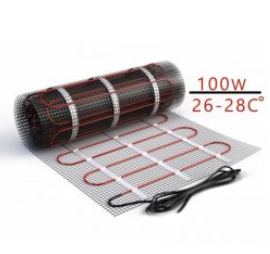 Heating mat, heating mesh 100 W/m²
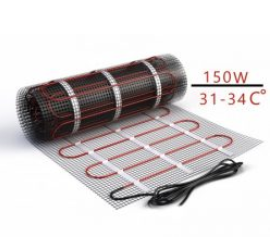 Heating mat, heating mesh 150 W/m²
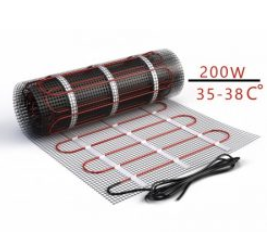 Heating mat, heating mesh 200 W/m²
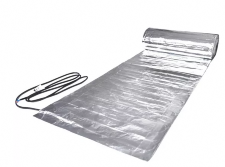 Heating mat, heating mesh for warm coverings 80 W/m²
- Heating mat, heating mesh for warm coverings 100 W/m²
- Heating mat, heating mesh for warm coverings 130 W/m²
- Heating mat, heating mesh for warm coverings 150 W/m²
What do you gain by planning electric underfloor heating?
- There is no need to watch the quality of the heating water or bleed the system.
- With no water, no circulation pump gets clogged with limescale.
- You do not have to buy a boiler, and no chimney is needed – building it, permitting it and later renovating it are all avoided.
- There are no smoke or other pollutant emissions on site.
- No gas meter replacement, and no need to prepare and permit a gas connection plan.
- It is also a simple solution for heating occasionally used properties and holiday homes.
- The heating can even be controlled remotely, from a phone.
Do you have experience with electric underfloor heating, or are you unsure which solution suits your building? Contact us via the quote request, and we will help with the planning. Installation is available in Hungary.
Request a quote — installation anywhere in Hungary
We survey, design and install heating film and infrared heating throughout Hungary. Tell us about your home and we will get back to you.