

Measuring Heating Film Electricity Consumption: How to Calculate Accurately
Author: Tóth Tamás · 7 min read
Heating film consumption is the installed power multiplied by the measured running time. Step by step: how to measure running time, calculate kWh and cost, and what the actual consumption depends on.
You can calculate the electricity consumption of heating film accurately by multiplying the installed power - the film's power per square metre times the heated area - by the actual running time. The running time is given most accurately by an energy meter, a sub-meter or a smart thermostat that logs run time; multiply the resulting kilowatt-hours by the current electricity price and you have the cost of heating.
There is a lot of uncertainty about the cost of electric heating, and many people are put off by the idea of heating with electricity in the first place. The reality is more nuanced: measuring and calculating show how much heating film actually consumes in a well-designed, well-insulated home. In this guide we go through the calculation step by step. We have collected the key facts about the running costs of infrared heating on our consumption page.
Why is it worth measuring and calculating?
- Cost control: it becomes clear what makes up the monthly electricity bill and where it can be trimmed.
- Checking efficiency: you find out whether the system works as designed, and any fault (for example a badly placed thermostat) shows up too.
- Informed decisions: when planning new heating, the calculation helps compare the different solutions realistically.
- Conscious settings: based on the measured data, heating habits and thermostat programmes can be adjusted in a targeted way.
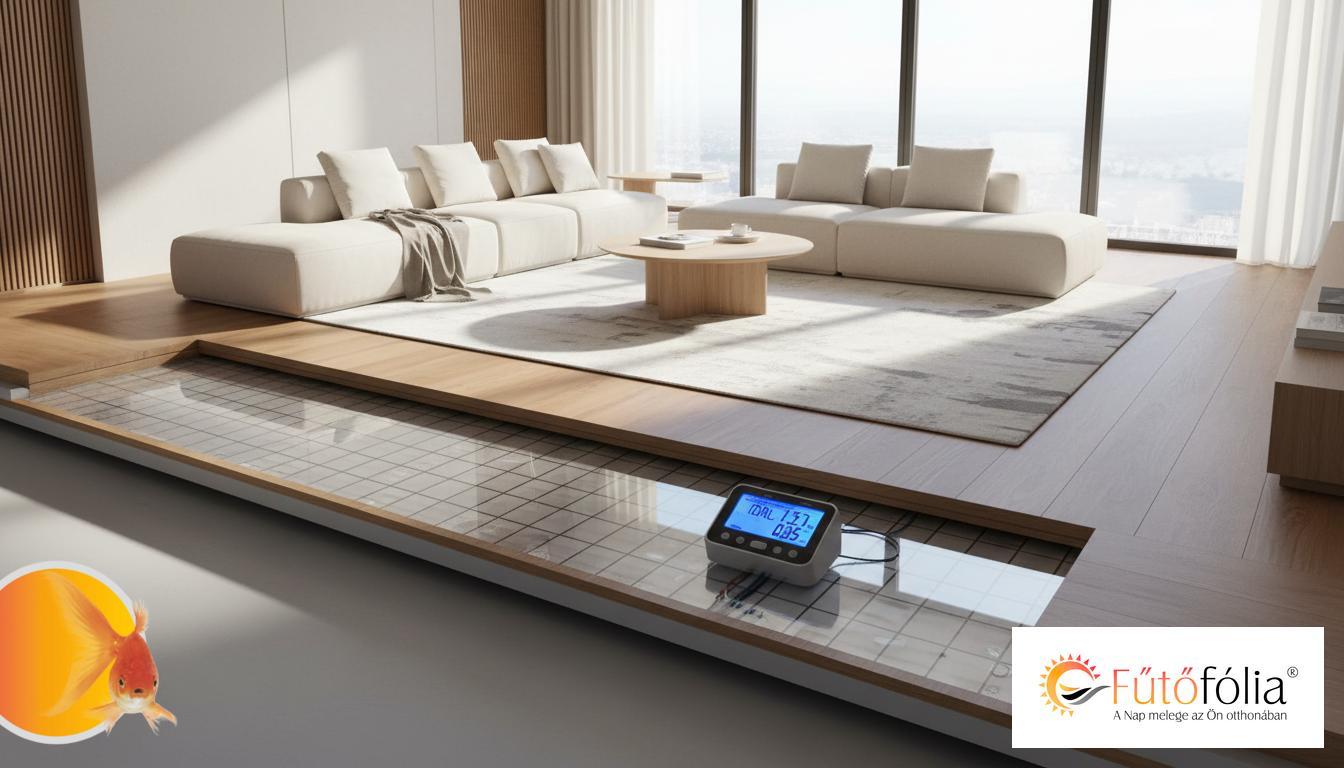
What does the consumption of heating film depend on?
Heating film works on the principle of infrared heating: it does not primarily warm the air, but warms walls, objects and the people in the room with infrared radiation. Thanks to radiant heat, a room can feel comfortable at a lower air temperature, which in itself reduces consumption. The actual use is determined by the following factors:
- The thermal insulation of the building. This is the most important: in a well-insulated house the heat stays inside, and the film has to run far less to maintain the desired temperature.
- The outdoor temperature and the weather. The colder it is outside, the more heating is needed; wind and humidity also affect heat demand and thermal comfort.
- The set indoor temperature. Every degree counts: according to a 2022 estimate by the International Energy Agency (IEA), setting the thermostat 1 °C lower saves roughly 7% of heating energy - and conversely, turning it up raises use by a similar proportion.
- Usage habits. How many hours a day does it need to heat, is there a night-time temperature setback, is the system controlled room by room?
- The installed power. The film's power per square metre (W/m²) and the size of the heated area.
- The type and setting of the thermostat. A programmable, smart thermostat controls more precisely and economically than a simple mechanical one.
- Internal heat sources. The heat from cooking, baking, electronic devices or a fireplace reduces the load on the film.
- Covering the heated surface. A thick rug or large pieces of furniture on a heated floor obstruct heat output and increase consumption.
The calculation step by step
For an accurate result you need two pieces of data: the installed power and the measured running time.
Step 1: the installed power
- The film's power (W/m²): given by the manufacturer, for example 80 or 120 W/m².
- The heated area (m²): the area where the film has actually been installed - in a 10 m² room, the part of the underfloor heating covered with film might be 8 m², for example, because we do not put film under built-in furniture.
- The installed power (W): the film's power multiplied by the heated area. In round numbers: 8 m² × 100 W/m² = 800 W.
Step 2: measuring the running time - accuracy depends on this
Heating film switches on and off on the thermostat's signal, so it never runs continuously. The real consumption is decided by the total time it receives power. You can measure the running time in several ways:
- Plug-in energy meter: if the heating circuit runs from a thermostat with a plug, a meter plugged in ahead of the thermostat measures that circuit's consumption exactly.
- Sub-meter on the heating circuit: with a hard-wired system, an electrician can install a separate meter on the heating circuit in the distribution board - this shows the consumption of the whole heating system.
- Smart thermostat: many smart thermostats log the switched-on time, which can also be followed as a graph in the app. If you enter the installed power, it also calculates the consumption - this is the most convenient solution.
- Manual notes (for an estimate): if you have no measuring device, you can watch the thermostat display and note how many hours it heated in a day or a week. This is the least accurate method.
Step 3: consumption in kilowatt-hours
- Daily consumption (kWh): installed power (W) × running time (hours) / 1000. If the 800 W film ran for a total of 6 hours in a day: 800 W × 6 hours / 1000 = 4.8 kWh.
- Monthly consumption (kWh): daily consumption × the days in the month, for example 4.8 kWh/day × 30 days = 144 kWh/month.
- Annual consumption (kWh): the measured or estimated consumption of the heating-season months added together (see below).
Step 4: the cost
Multiply the monthly consumption (kWh) by the unit price of electricity (HUF/kWh). The unit price depends on the contract and the quantity used, so calculate with the price on your own bill. For information: according to information requested from MVM Next in September 2026, Hungarian households receive electricity at the reduced (rezsicsökkentett) price up to 2,523 kWh per year per metering point; above that, under the general tariff, they pay a gross residential market price of HUF 70.104/kWh.
As an example, rounded and calculated at the above-allowance price: 144 kWh × HUF 70/kWh = HUF 10,080/month. If the household's total consumption stays within the discounted allowance, the cost of heating is lower than this.
Estimating annual consumption
Heating is seasonal, so annual consumption has to be summed over the heating months. As a guide: in a well-insulated Hungarian family house, over a heating season of roughly 5-7 months, heating film may run 4-8 hours a day; more in extreme cold, less in the shoulder seasons. For your own house, though, the measured running time gives the reliable figure - it is worth measuring at least one cold and one milder week. We write in detail about why radiant heating can manage with less energy in our article on the consumption of infrared heating.
How can consumption be reduced?
- Solar panels: solar panels can reduce the electricity cost of heating, but the size of the saving also depends on the billing method. Since 1 January 2024, new household solar systems in Hungary are on gross billing: fed-in and drawn electricity are accounted for separately, so a summer surplus does not automatically cover winter heating. Net metering can only remain for systems applied for by September 2023 and put into operation by 1 January 2026 at the latest, for up to 10 years. With home energy storage (a battery), more of your own generation can be used on site. In detail: solar heating - myth or real saving?
- Smart thermostat: a programmable, self-learning thermostat adapts heating cycles to your daily routine and can be adjusted remotely from your phone.
- Zone control: with a separate thermostat for each room, it heats only where it is really needed.
- Night setback: it is worth lowering the temperature by a few degrees at night.
- Leaving heated surfaces free: do not cover the heated surface with furniture or a thick rug - this is true of heating mat, heating cable or heating film underfloor heating, of infrared panel or heating film ceiling heating and of infrared panel wall heating too.
Summary
The consumption of heating film is not a matter of guesswork: it can be calculated exactly from the installed power and the measured running time, and the cost follows by multiplying with your own electricity price. In a well-insulated home, with smart control and conscious settings, heating film can be run economically. If you would also like to compare the investment cost - for example with a heat pump and the surface heating recommended for it - you will find guidance in our 2026 cost comparison of heat pumps and infrared heating. Our specialists help with sizing and installing the system.
Request a quote — installation anywhere in Hungary
We survey, design and install heating film and infrared heating throughout Hungary. Tell us about your home and we will get back to you.