

The Link Between Dust Mites and Airborne Dust, and Their Negative Health Effects
Author: Tóth Tamás · 3 min read
What is a dust mite, why does it cause allergy, and how much do airborne dust and the heating method matter? Symptoms, the most effective protection (bedding, humidity, cleaning) and the real role of infrared heating.
The dust mite is one of the most important allergen sources in house dust: it is not the mite itself but proteins from its droppings and dead bodies that cause the allergic symptoms. According to the American Lung Association, these allergens mostly do not float for long but settle quickly into dust and textiles. The basis of protection is therefore bedding, textiles and humidity – the heating method is a supplementary consideration.
What is a dust mite, and where does it live in the home?
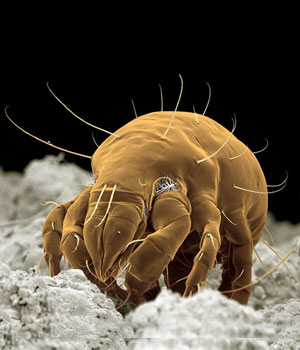 The dust mite is a tiny arthropod, barely visible to the naked eye, that lives in the textiles of the home and feeds on flakes of skin shed by people. It cannot digest freshly shed skin: here it is helped by certain mould species living together with it, which "pre-digest" it for the mite. Most mites are found where there are many skin flakes and the environment is warm and humid – in bedding, the mattress, pillows, soft toys, upholstered furniture, carpets and curtains.
Because most of the allergen settles, most of the exposure reaches a person during sleep, in bed. Airborne dust still matters: when we stir up the dust – when making the bed, cleaning, or with strong air movement – the allergen particles get into the air for a while, and we breathe them in.
What symptoms can a dust mite allergy cause?
A dust mite allergy may be indicated if at home – especially in the morning, on waking – you sneeze, your nose runs or is blocked, your eyes water and itch, your throat is scratchy or you cough. According to the WHO fact sheet on asthma, dust is also among the factors that trigger asthma symptoms, so for asthmatics the dust load is especially important. With persistent complaints it is worth clarifying with an allergy test whether the dust mite really is behind them.
For many people the complaints get stronger at the beginning and end of the heating season, when the humidity of the home changes. Mites take up moisture from the air, so they like humid environments, and reproduce with more difficulty in drier indoor air.
How can you protect yourself against dust mites?
- Bedding: wash it weekly in hot water; clean pillows, blankets and soft toys regularly at high temperature too.
- Humidity: the American Lung Association recommends that the relative humidity of the home stay below 50%.
- Cleaning: wipe dust with a damp cloth so that the dust does not rise, and vacuum carpets and upholstery regularly.
- Ventilation: regular, thorough ventilation also reduces humidity.
- Fewer dust traps: the fewer hard-to-clean textiles in the bedroom, the fewer places the mite can settle.
What can heating do here?
With radiator, convection or fireplace heating, warmed air rises, sinks when it cools, and this circulation can also move settled dust. Infrared heating – heating film built into the floor or ceiling heating – warms surfaces by radiation, so it does not create such strong air currents and stirs up less dust.
It is important, however, to see its limits clearly: heating does not kill mites, does not remove the cause of allergy, and does not replace the steps above. In a home where the bedding and humidity are in order, though, less stirred-up dust can give a more pleasant environment for those who are sensitive. If, for a healthy home, the electric field of heating film is also a question, we present our own measurement on the electrosmog page; and you can read about the effect of airborne dust on the lungs in our interview with a pulmonologist.
More useful articles
- What a mouldy wall causes in my home
- Heating film demonstration at the Mapei professionals' meeting
Request a quote — installation anywhere in Hungary
We survey, design and install heating film and infrared heating throughout Hungary. Tell us about your home and we will get back to you.