

What Does a Mouldy Wall Cause in My Home
Author: Tóth Tamás · 4 min read
What health risks come with a mouldy wall, what causes it, and in what order should it be eliminated? Based on the guidance of Hungary's national public health centre – with ventilation advice and what heating can (and cannot) do.
A mouldy wall is not only ugly but also a health risk: according to guidance from the Hungarian National Public Health and Pharmaceutical Centre (NNGYK), indoor mould is associated with hay fever, asthma and other respiratory diseases, and in a mouldy home the likelihood of developing asthma and other respiratory diseases is 50% higher. That is why it is not enough to paint over the stain: first the cause of the dampness has to be eliminated.
What is mould, and why does it appear on the wall?
Mould is a collective name for various fungus species. It likes high humidity and cold, damp surfaces, so it most often appears in the bathroom, the kitchen, around windows and in the cold corners of external walls – but it can also settle in places out of sight, such as behind furniture or under a covering.
The NNGYK lists among the most common causes of dampness and mould:
- humidity above 60% and unsuitable habits of using the home (little ventilation, laundry dried indoors),
- thermal bridges and condensation,
- deficiencies in the insulation of the foundation, facade and roof, water ingress,
- design and construction faults, a poorly maintained ventilation system.
An unusual musty smell can indicate hidden mould, especially if plasterboard, a suspended ceiling, the floor or built-in furniture has previously been exposed to moisture.
What health complaints can it cause?
The complaints are mainly caused by spores and fungal particles getting into the air, which the occupants breathe in. Typical are coughing, a blocked nose, red eyes, itchy skin and difficulty breathing. It is suspicious if respiratory symptoms persist at home and ease away from the home – in that case it is worth suspecting mould and seeing a doctor about the complaints.
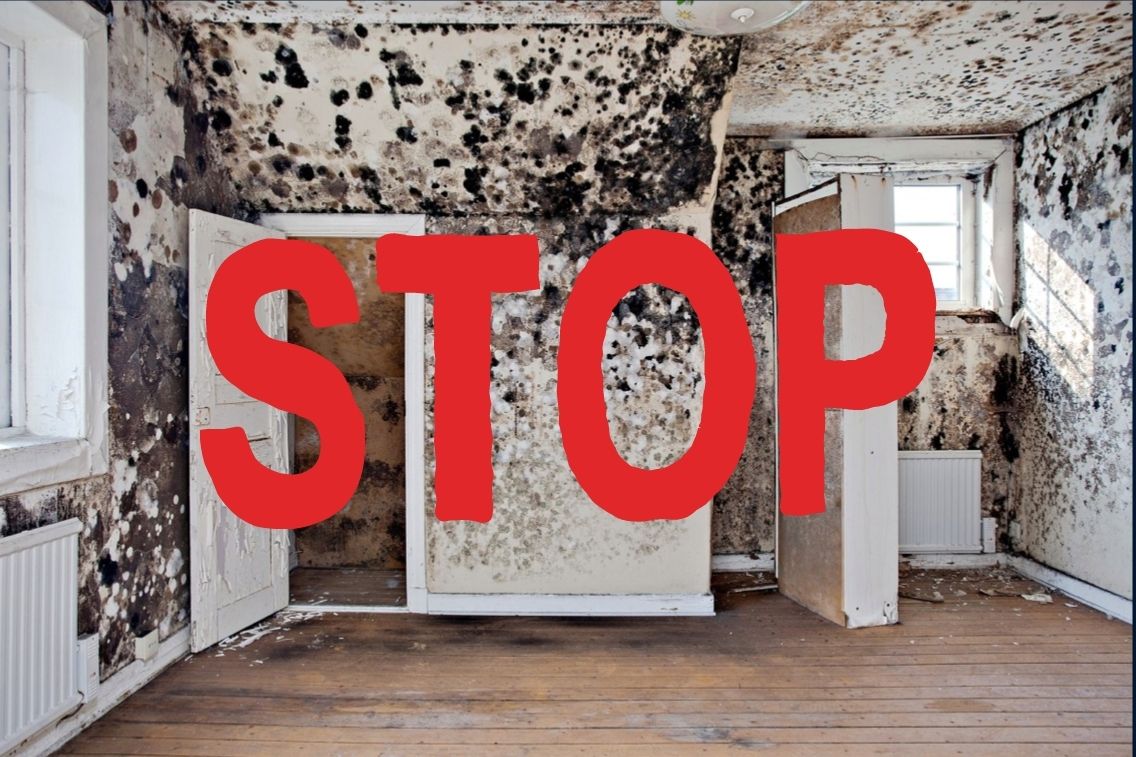
mouldy wall
Not all mould is equally dangerous. According to the NNGYK, among the fungi that cause allergic rhinitis, Cladosporium and Penicillium species are the most common. Some Aspergillus and Fusarium species can also cause serious infection, but this generally occurs only in people with weakened immune systems. Certain fungi also produce toxic substances (mycotoxins), but according to the guidance there is not yet enough evidence that these make people ill through the air. The guidance specifically emphasises that in small children the link between mould and symptoms is stronger, so their surroundings are especially worth checking.
How do you eliminate mould?
- Finding and eliminating the cause. Water ingress, rising damp, a thermal bridge or too-high humidity – as long as the cause remains, the mould returns.
- Mould removal. The mouldy surface must be disinfected; afterwards paint with anti-mould additive may help. Instead of lasting, frequent use of chemicals, however, the cause must always be treated.
- Drying. Soaked, porous materials must be dried within 48 hours, whereas an already mouldy wall only after mould removal, so that the spores are not released as dust.
- Thorough cleaning. Dead fungal colonies and spores can also cause allergies, so they must be removed. The effective order: wipe furniture and hard-to-reach places with a damp cloth, ventilate, then vacuum and mop.
If the source of the moisture is not clear, or the mould is hidden, it is worth calling an independent expert (a building diagnostician or aerobiologist).
Ventilate briefly, but thoroughly
Regular ventilation can do a lot against mould. It is not effective to leave several windows ajar – the air is not exchanged properly this way, while the walls cool down. Open the windows wide for 5–10 minutes, preferably with a cross draught: in this time the humid, stale air is replaced with fresh air, and the warmed walls and furniture do not cool down.
Can heating help against mould?
The way of heating affects one of the conditions: the temperature of the wall surface. If the inner surface of the wall is so cold that its temperature falls below the dew point of the air, moisture condenses on it. Infrared heating also warms walls and objects by radiation, and less moisture condenses on a warmer wall surface, so one of the conditions for mould can decrease.
This does not mean, however, that there can be no mould in a home with infrared heating. Heating does not solve water ingress, rising damp, an insulation fault or a thermal bridge, and ventilation is needed just the same. If the cause of the mould is structural, that must be fixed first – only after that can heating help keep the wall dry. How the air in the home relates to children's health we write about in our article on choosing heating; on the electric field of heating film, we present our own measurement on the electrosmog page.
Useful articles
- The link between dust mites and airborne dust, and their negative effects on health
- The beneficial effects of the infrared sauna
- Heating film demonstration at the Mapei professionals' meeting
- Electrosmog at heating film: how we measured
Request a quote — installation anywhere in Hungary
We survey, design and install heating film and infrared heating throughout Hungary. Tell us about your home and we will get back to you.