

Autumn Heating Maintenance: Get Away With It or Pay?
Author: Tóth Tamás · 6 min read
A 12-point autumn checklist for before the heating season: what you can check yourself, what the boiler service looks at, when to call a professional immediately, and why electric and infrared heating need fewer service items.
In autumn, before the heating season, it is worth going through the heating checklist: the thermostat, radiators, water pressure, filters, pump, safety components and the chimney. Gas boiler and heat pump servicing should be done by a professional – what you skip now you will typically pay for in winter with a more expensive repair or a failed heating system, and with a gas boiler safety is also at stake.
A familiar situation: it is a cold morning, the house is still asleep, you turn up the thermostat, and instead of warmth comes a strange smell, clicking, then silence. Few things are worse than the system giving up during the first cold snap. Autumn maintenance is therefore not a luxury but a way to prevent costs and dangers. Why regular maintenance matters in general we described in a separate article; here we have collected the concrete autumn tasks.
Autumn heating maintenance: 12-point checklist
You can go through the list in about 1 hour and see what is urgent and what can wait. You can check many points yourself, but leave the service tasks to a professional.
- Thermostat and timing: does it measure accurately? is the battery fresh? does the daily schedule fit your habits?
- Radiators: if their tops are lukewarm, bleed them, and check that the valve is not leaking.
- Water pressure: in most systems around 1–1.5 bar is ideal, but this depends on the appliance – the exact value is given in the appliance documentation. If the pressure drops, look for a leak.
- Filters, sludge separator: check the sludge level and the condition of the magnetic filter; if the heating water is black, a flush may be needed.
- Circulation pump: does it start? does it hum or vibrate? Take signs of seizing and scale deposits seriously.
- Expansion vessel: if you often have to top up water, the vessel membrane may be weak.
- Safety valve: if it drips, it may need cleaning or replacement.
- Chimney, flue: is the draught in order, is the condensate drained without obstruction? Ask for a professional inspection for this.
- Valves and mixers: with water-based underfloor heating, the position of the mixing valve is key.
- Electrical connections: if there is a loose connection or any trace of overheating, call an electrician immediately.
- Cleaning heat emitters: a dusty convector, radiator bank or fan unit reduces efficiency.
- Backup heating: think through what you would heat with in an emergency – a radiant heater, a mobile infrared panel or supplementary electric heating.
Gas, mixed fuel, heat pump: where most people go wrong
Skipped boiler maintenance is not only a waste of money but also dangerous. The most common problems:
Gas boiler (condensing or fan-assisted)
- Fouled heat exchanger: efficiency falls, consumption rises.
- Blocked condensate drain: shutdown, fault code, even water damage.
- Dirty burner head or ionisation electrode: starting faults, intermittent operation.
- Poor combustion air supply: carbon monoxide risk – this invisible danger is no joke.
Mixed fuel, pellet
- Dirty chimney and flue: lack of draught, backflow, fire risk.
- Skipped ash removal and heat exchanger cleaning: sharply deteriorating efficiency.
Heat pump
- Dirt and leaves on the fins of the outdoor unit: weak airflow, risk of freezing.
- The condition of the filters, the condensate drain and the antifreeze fluid: winter reliability depends on these.
Tip: the annual inspection prescribed by the manufacturer is often a condition of the appliance warranty. Always check chimney sweep and utility inspections against local rules and the appliance documentation.
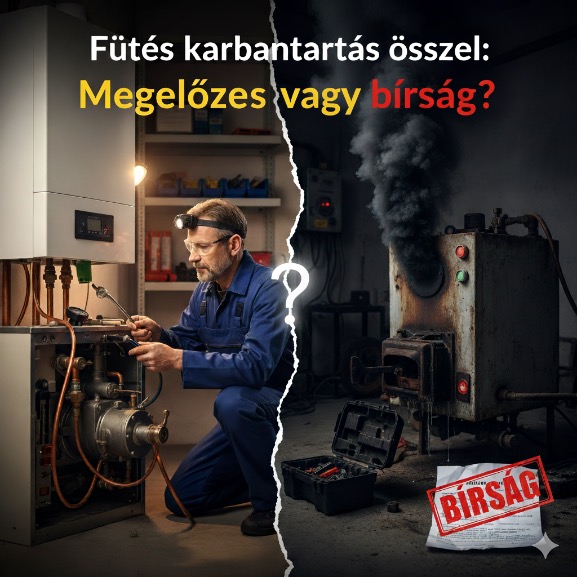
Boiler service: what do they check in autumn?
The content of the service depends on the type of appliance, but it generally includes:
- flue gas analysis, carbon monoxide check, cleaning of the burners;
- assessing the condition of the heat exchanger, the fan and the pump;
- testing the gas connections for tightness and leaks;
- checking that the condensate drain is clear;
- checking the system pressure, the expansion vessel and the safety valve;
- fine-tuning the commissioning parameters for better efficiency and lower noise.
What not to put off: the smell of smoke, backflow, unusual noise, frequent pressure drops or a recurring fault code. These get worse under peak winter load, and besides the cost they endanger the safety of the family.
Electric and infrared heating: fewer service items
With electric heating – especially infrared heating, electric underfloor heating and panels – most of the list above does not apply:
- There is no chimney, combustion or boiler, so the most expensive service items disappear.
- The construction is simple: there is no pump or heat exchanger, and there are few or no moving parts.
- With room-by-room thermostats it heats only where and when needed.
- Infrared panels heat surfaces, not the air, so less heat is lost when ventilating.
- Easy to extend: another panel or heating mat can be added later.
There is something to do in autumn here too, just less: it is worth checking the thermostat calibration and the floor sensor limit before the season, because a power cut can reset factory settings – the details are described in the heating film chapter of our article on maintenance.
The advantages of infrared heating are particularly clear in renovation: it can be installed cleanly with little demolition, and comfort improves quickly. The cost efficiency of electric heating, however, depends on thermal insulation, controls and the tariff: in a well-insulated home, with smart timing and zones, it can be competitive, whereas in a poorly insulated house electricity consumption decides, not the service fee saved.
Quick financial balance: when is it worth switching?
- If the service bill on your existing system is regularly high (burner head, chimney, heat exchanger, pump), it is worth calculating the electric alternative – for this, the expected electricity consumption must be compared alongside the service fee. The up-to-date cost comparison of heat pumps and infrared heating helps with this.
- Partial replacement works too: an infrared panel in the living room, electric underfloor heating in the bathroom, overnight temperature maintenance in the bedroom.
- With smart control, heating can be matched to your daily routine so that it consumes only when needed – you will find the setup steps in this guide. On tariffs, note that according to MVM Optimum's information, the preferential H tariff in Hungary is available for heat pump heating, not for infrared panels or electric radiators.
- Alongside a heat pump: the heat pump provides the base heating, while infrared gives fast, local comfort and frost protection – without regular service items.
When should you call a professional immediately?
- a smell of gas, or a smoke or carbon monoxide detector alarm;
- frequent pressure drops, dripping water, brown deposits at the joints;
- a recurring fault code, a boiler switching on and off;
- lack of draught, smoke coming back at the chimney.
In such cases do not experiment: "tomorrow" can be expensive and dangerous.
Closing: prevention in autumn, peace of mind in winter
One autumn afternoon of effort can give you a whole season of peace of mind: prevention spares your wallet and avoids the greatest danger. And if you are fed up with the boiler and the chimney, electric heating – especially infrared heating – is a clean alternative with few service needs.
- Book an appointment with the service company before starting the heating.
- If you are considering electric or infrared heating with zone control, request an on-site survey (available in Hungary).
- Set up the autumn programmes and test the system before the real cold arrives.
Request a quote — installation anywhere in Hungary
We survey, design and install heating film and infrared heating throughout Hungary. Tell us about your home and we will get back to you.