

Underfloor Heating Mistakes to Avoid
Author: Tóth Tamás · 9 min read
The most common underfloor heating mistakes from design to operation: missing insulation, wrong pipe spacing, no heat load calculation, damaged heating element, heating up too fast, wrong floor covering, covered floor – and how to avoid them.
The most common underfloor heating mistakes fall into four groups: design mistakes (missing insulation, no heat load calculation, a system without zones), installation mistakes (damaged pipe or heating element, wrong screed thickness, missing expansion joints, heating up too fast the first time), wrong floor covering choice, and operating mistakes, such as covering the heated floor. Almost all of them can be prevented by careful design and professional installation.
Underfloor heating gives even, invisible warmth and takes no space on the walls. It is, however, a complex system: mistakes reduce efficiency, raise running costs, and can even cause serious damage. The guide below goes through the typical mistakes group by group, and for each describes how to avoid it. Where wet and electric systems differ, we point this out separately.
1. Design and preparation mistakes
Mistakes made at the design stage can later be corrected only at great cost, or not at all, so this is where the most attention is worthwhile.
Missing or insufficient thermal insulation in the sub-floor
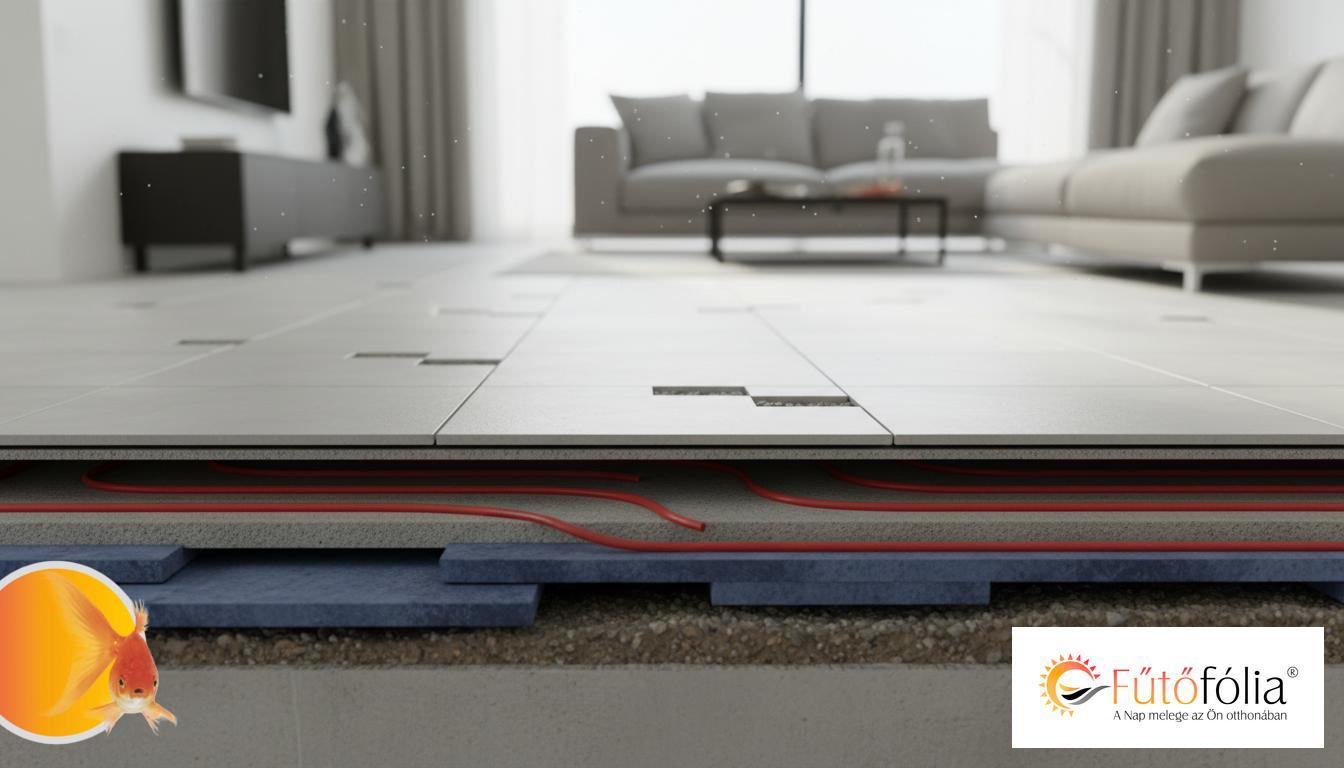
One of the most serious mistakes. If there is no proper thermal insulation under the screed or the heating element, part of the heat escapes into the slab, the room below or the ground, instead of reaching the space to be heated. This is a significant energy loss, which shows up directly in consumption.
Solution: provide thermal insulation of suitable thickness that can bear foot traffic already at the design stage; on a ground floor also damp-proofing. With heating film underfloor heating, the thermal insulation is topped with a reflective foil, and the heating film goes on that. We described the layers in detail in our article on insulating underfloor heating.
Pipe spacing too large or uneven layout (wet system)
The spacing of the heating pipes is critical for heat distribution. With too large a spacing (for example 25-30 cm), "cold and warm stripes" can form on the floor, which reduces comfort. The typical spacing is 10-20 cm, depending on the heat demand.
Solution: professional design and precise installation, matched to the heat demand of each room.
No heat load calculation
The sizing of the heating system must be preceded by a heat load calculation. Without it the system will be under- or over-sized: an undersized one cannot heat the room, and an oversized one is needlessly expensive and harder to control.
Solution: have a professional do the calculation, taking into account the building's insulation, windows and doors, and orientation.
Missing or faulty zoning
Rooms or larger areas must be controllable independently. Without zones the whole house heats to one temperature, which is neither economical nor comfortable.
Solution: every room, and in a larger open space every zone, should get a separate thermostat. With a wet system this requires separate heating circuits on the manifold; with an electric system every room can be an independent heating circuit from the outset.
Inaccurately placed heating elements (electric system)
Whether it is a heating mat, heating cable, heating film or older heating film, the heating elements must be placed precisely, according to the manufacturer's instructions. Heating wires that are too close or cross each other can overheat, and those too far apart cause cold stripes.
Solution: a layout plan, marking on site, and strict adherence to the manufacturer's instructions when laying.
2. Installation mistakes
Badly installed underfloor heating causes trouble for a long time, because the fault is under the floor covering.
Damage to pipes or heating elements during installation
If the pipe, heating cable or heating mat is damaged while being covered, that is among the most serious faults. With an electric heating element it can cause a failure, with a wet system a leak, which can only be repaired by breaking up the floor.
Solution: careful work and proper fixing. With a wet system, a pressure test before and after pouring the screed; with an electric system, resistance measurement during installation. It is worth documenting the route with a photo or a plan, so that it is not damaged later when drilling.
Wrong screed thickness or quality
Above the pipes of wet underfloor heating, a screed at least 4.5-6.5 cm thick is needed for heat distribution and load-bearing. A thinner screed can crack, a thicker one means slower heat-up and a greater heat-storing mass, which makes control harder.
Solution: screed of suitable thickness and strength, with additives if necessary.
Missing expansion joints
For larger continuous areas (above about 30 m²), at doorways and at the boundary of different heating circuits, an expansion joint is needed. Without it the screed can crack because of thermal expansion. A perimeter insulation strip along the walls takes up the movement.
Solution: expansion joints matched to the floor area and the building structure.
Heating up too fast at first commissioning
The screed and the floor covering need time to adapt. Sudden heating at the first commissioning can lead to the screed cracking, or the covering warping or cracking.
Solution: follow the manufacturer's heat-up instructions; with a wet system this typically means raising the water temperature in steps of 2-3°C a day. With electric heating embedded in screed, it likewise has to be heated up gradually.
3. Material selection mistakes
The floor covering and auxiliary materials affect how underfloor heating works at least as much as the heating element itself.
A floor covering not suited to underfloor heating
One of the most common and most easily avoided mistakes. Some coverings – for example thick carpet or thick solid wood parquet – have too high a thermal resistance, so heat passes through them with difficulty. The result is a lower room temperature and a higher running cost.
Solution: a covering that conducts heat well: tile, ceramic, stone, thin vinyl, LVT, as well as laminate flooring or engineered parquet recommended for underfloor heating. Always check the covering manufacturer's recommendation and the maximum permitted thermal resistance, which is usually 0.10-0.15 m²K/W. We wrote about this in detail in our articles on choosing a floor covering and on parquet.
Unsuitable underlay or adhesive
Under laminate flooring or engineered parquet, an underlay suited to underfloor heating, with low thermal resistance, is needed. For tile and stone, a flexible adhesive and grout are needed, which take up the movement from thermal expansion.
Solution: use only auxiliary materials recommended for underfloor heating.
Covering too thick
Even with a material that conducts heat well, thermal resistance grows with thickness: heat-up becomes slower, and the system follows temperature changes more sluggishly.
Solution: for underfloor heating, a thinner covering is better.
4. Operating and maintenance mistakes
Even the best-built system works badly if it is not used or maintained properly.
Frequent, large temperature swings
Underfloor heating of large mass, embedded in screed, reacts slowly. Raising and lowering the temperature too often or by too much is not efficient and increases consumption.
Solution: a relatively stable temperature, or a programmable thermostat that heats according to a preset programme.
Covering the heated floor
A thick rug, a sofa reaching the floor, low furniture with a closed base or a beanbag acts as thermal insulation. It reduces the efficiency of the heating, and can cause local overheating, which can damage the screed, the covering, the pipes or the heating element.
Solution: large furniture with a closed base should not go on the heated surface; furniture standing on legs is better, and a thick rug should not cover the heated part either. It is worth leaving the places of built-in furniture out of the heated surface already at the design stage.
Badly set control
A badly set thermostat or an unbalanced manifold significantly reduces efficiency and comfort. With a wet system, too high a water temperature overheats the floor surface, which is unpleasant and can also damage the covering.
Solution: a programmable, room-by-room thermostat; with a wet system, have a professional do the hydraulic balancing at commissioning.
Missed maintenance and bleeding (wet system)
In a wet system, deposits (sludge, limescale) can form over time, narrowing the pipes, worsening heat transfer and increasing the pump's consumption. Air left in the system obstructs the flow of water: it causes noisy, uneven heating.
Solution: periodic flushing by a professional, and bleeding before the season at the manifold and the boiler. With electric underfloor heating there is no such maintenance.
5. Myths about underfloor heating
"Underfloor heating is slow and expensive"
Wet underfloor heating embedded in screed does indeed heat up slowly because of its large heat-storing mass, but it also cools slowly and gives an even thermal sensation; with a programmable thermostat it is easy to control. With a well-sized and well-installed system, the low flow water temperature favours efficient operation. The thin-layer versions of electric heating, such as heating film, react faster and can be run economically when controlled by zone.
"Underfloor heating stirs up dust and is unhealthy"
Underfloor heating gives off heat largely by radiation and does not create strong air currents, so it stirs up dust less than radiator, convection heating. The picture of "swollen feet" comes from old systems run at too high a temperature; today the surface temperature in living spaces is worth limiting to at most 29°C. On infrared heating and electrosmog, we have published the result of our own measurement on the electrosmog page.
"Any underfloor heating will be fine for the house"
There are many types of underfloor heating – wet, electric heating mat, heating cable, heating film – and each has its advantages, limits, and installation and operating features. What is ideal for one home is not necessarily so for another. We have compared the wet and electric versions point by point, and for choosing between the electric types we go through the question of film, mat or cable.
Solution: choose the system together with a professional, based on the features of the building, the thermal insulation, the available energy source and the budget.
Summary
Underfloor heating is comfortable and economical heating in the long term, if we avoid the mistakes above. Careful design, professional installation, materials suited to underfloor heating and conscious use together make a well-working system. It is worth leaving design, installation and commissioning to a professional – so that underfloor heating brings not trouble but even warmth to the home.
Request a quote — installation anywhere in Hungary
We survey, design and install heating film and infrared heating throughout Hungary. Tell us about your home and we will get back to you.