

Summer Comfort and the Role of Shading in a Home's Heat Balance
Author: Tóth Tamás · 6 min read
In summer, the sense of warmth is determined not only by the air but also by radiation from warmed walls and floors. We show why external shading is the most effective, what internal shading is worth, and how all this reduces air-conditioner consumption.
In summer, shading keeps the home pleasantly cool by intercepting solar radiation before it can warm the window, the walls and the floor. External shades – roller shutters, venetian blinds, awnings, pergolas – are the most effective; internal curtains and blinds are only a supplement. If the heat stays outside, less cooling is needed, so air-conditioner consumption falls.
Summer heatwaves are an increasingly frequent guest in our homes. In winter we focus on keeping the warmth in, but in summer the main task is keeping the heat outside out. The key to a pleasant summer sense of warmth is not just the air conditioner, but prevention: the conscious use of shading and understanding the home's heat balance. In this article we show how shading affects the sense of warmth and energy consumption.
Summer comfort: more than the air temperature
A thermometer shows only one data point, but the real sense of warmth is shaped by several factors together:
- Air temperature: the most obvious, the one we usually measure.
- Humidity: in humid heat the air feels stuffier, because the body finds it harder to cool by evaporation.
- Air movement: a gentle air current, for example from a fan, can noticeably improve the sense of warmth even if the air temperature does not change.
- Radiant temperature: perhaps the most underestimated factor. If the walls, floor and ceiling have been warmed by solar radiation, they radiate the heat back, and we feel the room warmer even if the air is relatively cool. In winter the same is true in reverse: next to cold walls we feel cold even if the thermostat has already warmed the air. In winter, infrared heating, underfloor heating, ceiling heating and wall heating make use of this principle – the surface radiates the warmth.
Controlling summer comfort therefore means not only cooling the air, but also keeping the surfaces from warming up.
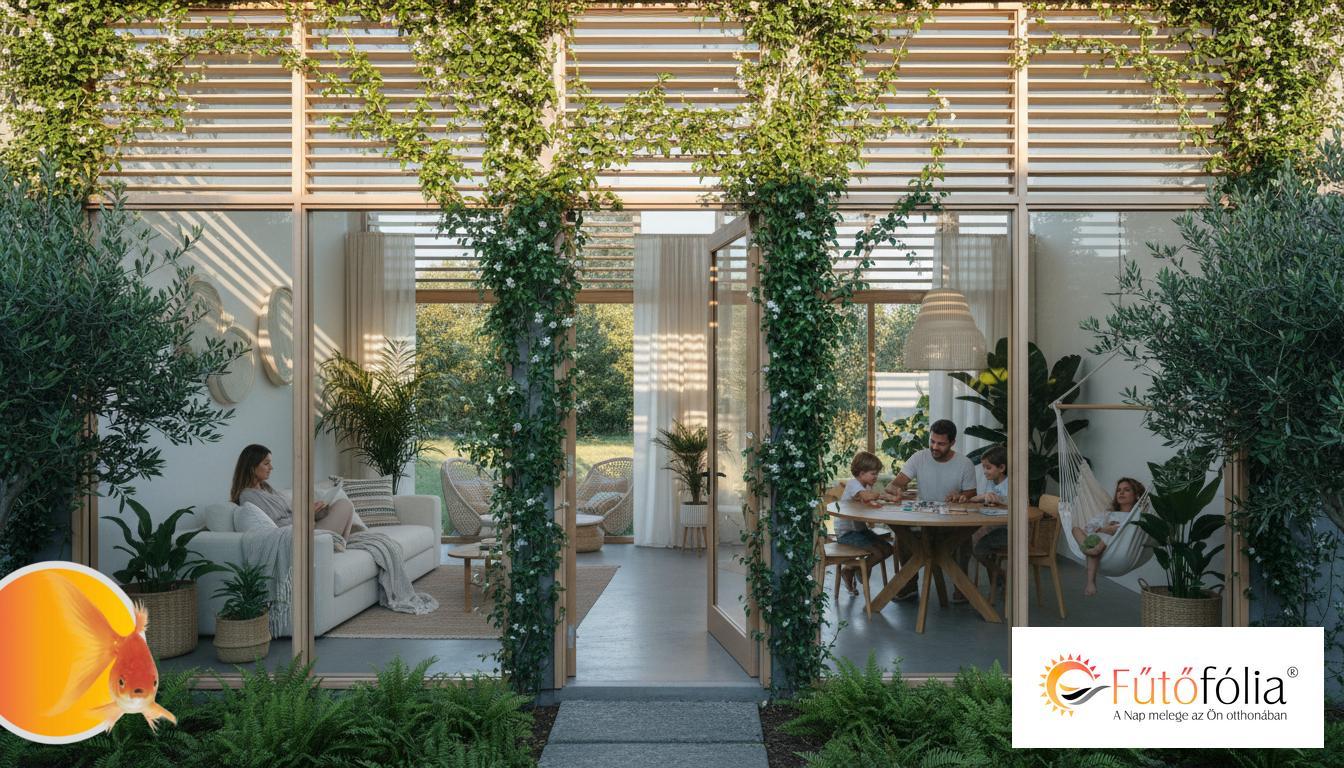
How heat gets in, and the role of shading
The first step of defence is knowing where the heat comes from. It gets into the home mainly in three ways:
- Windows and glass surfaces: usually the most significant. Direct solar radiation enters through the glass and warms the furnishings, walls and floor; behind the glass the heat is also trapped, which increases the warming further.
- Walls and roof: poorly insulated walls and roofs heat through in the sun and give the heat off towards the interior spaces.
- Ventilation: hot outside air gets in through ventilation or through leaks around the doors and windows.
This is where shading takes the lead role: it prevents solar radiation from getting into the building and warming the inner surfaces.
External shading – the most effective solution
The most effective shades are those that intercept and reflect solar radiation before the glass surface.
- Roller shutter: one of the most effective solutions. When lowered it excludes solar radiation almost completely, so the heat entering through the window falls significantly. The air gap between the shutter and the window gives further thermal insulation.
- Venetian blind: also in front of the window, but the angle of its slats can be adjusted, so the light and heat entering can be controlled without the room going completely dark.
- Awning and pergola: especially useful for shading south- and west-facing windows and terraces. It prevents the sun from shining directly on the wall and window, and gives cool shade in outdoor living spaces. On a covered, shaded terrace, terrace heating can also be used more effectively on cooler evenings.
- External slatted shade: fixed or movable slats that block direct solar radiation attractively and effectively.
- Vegetation: trees and climbing plants – especially on the south and west side – give natural shade and also cool their surroundings by evaporation.
Internal shading – supplementary protection
Internal shading is less effective, because by then the heat has already passed through the glass, and the shade only holds back its further spread. It still has a role:
- Blackout curtain and roller blind: it creates shade, but dark material absorbs heat, warms up and may radiate it towards the room. Light-coloured, heat-reflecting materials are more effective.
- Blinds: they control light and heat with adjustable slats.
- Heat-reflecting window film: it can be stuck on the glass, with a UV- and heat-filtering layer; its effectiveness falls short of external shades, and it may reduce transparency.
Shading and consumption
Good shading directly affects the home's energy consumption:
- Less air-conditioner use: if most of the heat has already been excluded, the air conditioner has to be used much less, in some cases not at all. In summer the air conditioner is one of the household's big energy consumers, so the saving can be noticeable.
- More efficient cooling: if cooling is still needed, in a shaded room the air conditioner has to work less to reach the desired temperature, which means lower consumption.
- In the longer term: the investment cost of shades can pay back through a lower electricity bill.
You can read about healthy and economical use of the air conditioner – setting, cleaning, maintenance – in our article How should we cool healthily?
More tips for improving summer comfort
- Night ventilation: when it is cooler outside than inside – typically at night or early in the morning – open the windows so that the heat trapped inside escapes and the walls cool down too.
- Insulation: good thermal insulation keeps the warmth in during winter and the heat out during summer, so it is the basis of year-round energy efficiency. The efficiency of electric heating – heating film, heating foil, heating mat, heating cable, infrared panel, heating panel – and of underfloor heating also depends on good insulation.
- Light colours: a light roof and facade reflect solar radiation; a dark one absorbs it and heats up.
- Fewer internal heat sources: in the hottest hours avoid using the oven, hairdryer and iron, and switch off unnecessary lighting.
- Fan: it does not cool the air, but by moving the air it helps the body's evaporation and improves the sense of warmth – and it uses far less electricity than an air conditioner.
- Smart home: a smart thermostat or control system can coordinate the operation of shades, ventilation and the air conditioner.
Summary
The basis of pleasant summer comfort is prevention: shading, which cuts off the path of solar radiation before it can warm the interior spaces. External shades are the most effective, but internal solutions and conscious ventilation also improve comfort. This way the home not only becomes more pleasant on hot days, but energy consumption and the cost of air-conditioner use can fall as well. So do not regard shading merely as an aesthetic element, but as an important part of the home's energy efficiency.
Request a quote — installation anywhere in Hungary
We survey, design and install heating film and infrared heating throughout Hungary. Tell us about your home and we will get back to you.