

Infrared Heating in a Wooden Modular House
Author: Tóth Tamás · 3 min read
How much heating film does a wooden modular house need, and why might more go into the floor than the energy balance justifies? Design decisions of a 2020 holiday home at Balatonfenyves: floor and ceiling heating, a 6 mm layer structure, remote control.
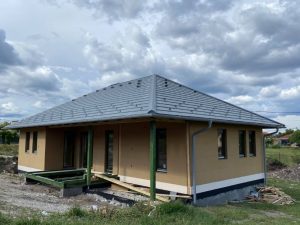
In a wooden modular house, infrared heating has to be sized from the heat loss of the house and the owner's comfort expectations: in a well-insulated house little heating film would be enough, but if warmth over the whole floor is wanted, more goes in. In the 2020 holiday home at Balatonfenyves, both floor and ceiling heating were therefore built – the floor gives comfort, the ceiling gives fast heat-up.
This was not the customer's first infrared heating: earlier we had also built ceiling heating with heating film for him in a plastic surgery operating theatre (see also: infrared heating in the operating theatre). The construction of the modular house, the manufacturer's basic types and photos of the whole installation are presented in detail in our article Heating a modular house, wooden house – here we concentrate on the design decisions.
How much heating film does a modular house need?
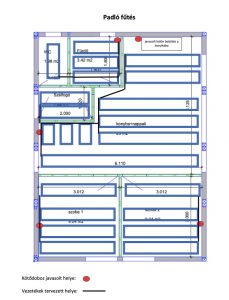
Design starts with the technical calculation. Our specialists determine the amount of heating film needed from the building's energy loss and from what the customer expects of the heating. The two do not always give the same result:
- Energy need: in a well-insulated house a few strips of film might be enough to provide the necessary heat.
- Comfort need: if, however, the owner wants the whole floor surface to be pleasantly warm, covering it takes more film than the heat demand alone would justify.
In such a case the output of the film and the control have to be coordinated so that the larger heated area does not mean unnecessary consumption. You can read about how sizing is done on our on-site survey and consultation page.
Why floor and ceiling heating together?
The owner wanted a warm floor, but the thick Swedish-type solid wood flooring he chose has greater thermal inertia and warms through more slowly. Since the house is used as a holiday home, it was important that it be warm quickly after arrival. The solution was two systems:
- ceiling heating above the plasterboard gives those inside noticeable warmth in 5–15 minutes, depending on the covering;
- underfloor heating under the Swedish-type floor provides lasting, pleasant warmth for the soles of the feet.
Installation in step with production and assembly
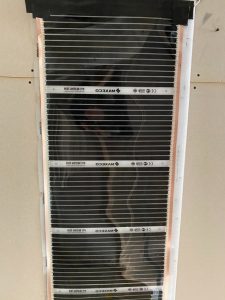
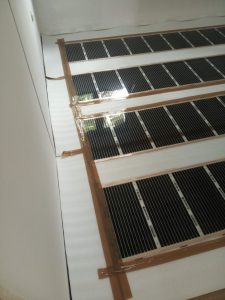
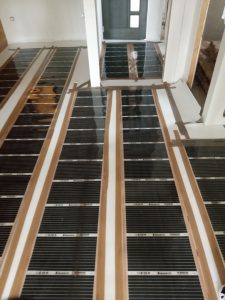
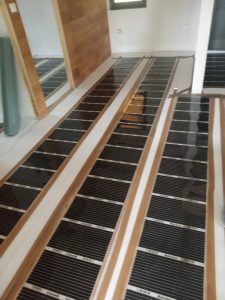
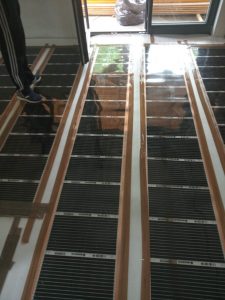
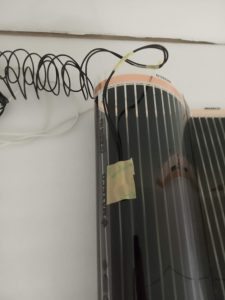
In a modular house, the installation of the heating has to be matched to manufacturing. The ceiling film was fixed together with the reflective foil at the manufacturer's site, and the plasterboard lining went on afterwards, so no heater is visible in the living space.
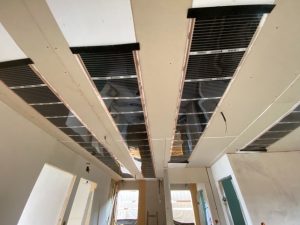
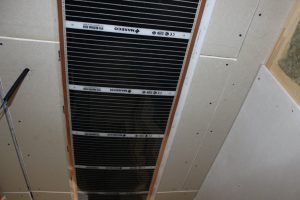
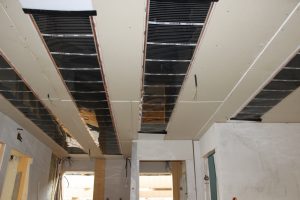
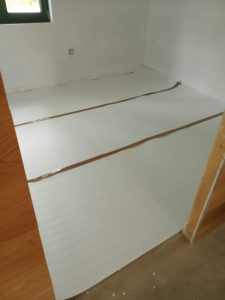
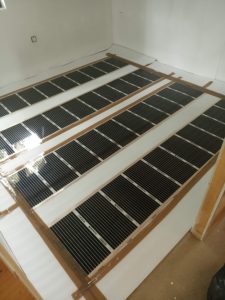
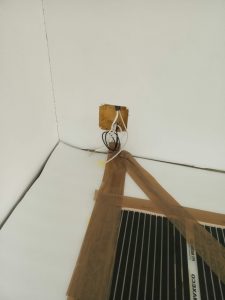
In the floor, the reflective foil had to be cut out along the route of the wires so that the Swedish-type flooring would sit on a flat surface; the whole heating layer structure ended up only 6 mm thick. The wires run into a junction box, and a floor sensor monitors the floor temperature.
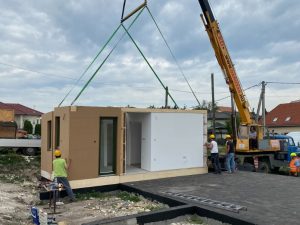
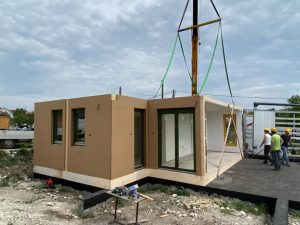
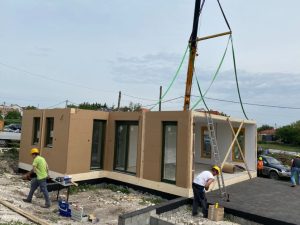
Joining the modules, roofing and technical handover took a few days on site, after which the house could be occupied. The modular house was manufactured by Németh-Fa.



Control in a remotely used holiday home
The heating is controlled by a smart home system, with a separately adjustable temperature for each room; the same system also controls the water heater and the roller shutters. In a holiday home this has a practical benefit: the heating can be started remotely before arrival, and in winter the house can be kept at a lower temperature. You can find details on room-by-room control on our thermostat page.
Video of the installation:
Request a quote — installation anywhere in Hungary
We survey, design and install heating film and infrared heating throughout Hungary. Tell us about your home and we will get back to you.