

Heating Small Rooms - Efficient Solutions
Author: Tóth Tamás · 6 min read
Bathroom, hallway, study, guest toilet: a small room needs heating that warms up quickly and can be controlled separately. Infrared panels, electric underfloor heating, towel radiators and air conditioning - which suits where.
A small room - a bathroom, hallway, study or guest toilet - is best heated with heating that warms up quickly, can be controlled separately room by room and takes up no space. Typically an infrared panel, electric underfloor heating and a towel-dryer radiator suit this, and in a well-insulated study an air conditioner too. The basis of efficiency is good insulation and precise, timed control.
In modern homes, energy efficiency and comfort matter regardless of the size of the rooms. Although heating large spaces gets the most attention, small rooms often have their own particular needs: quick heat-up, occasional use, or a constant, pleasant temperature with as little energy use as possible. Central heating is not always the best for this, because it is less flexible and its temperature control is often not fine enough. Below we go through the options.
Why do small rooms pose a separate challenge?
Heating small rooms requires a separate approach because:
- They cool quickly: the air volume is smaller and the external surface is often proportionally larger, so heat loss is faster.
- We use them intermittently: we do not use a bathroom or guest toilet continuously, so the ability to heat up and shut down quickly is important.
- Temperature needs differ: in the bathroom we often want it warmer than in the bedroom, and in the hallway basic tempering may be enough.
- Space is limited: in tight spaces placing a heater can be awkward.
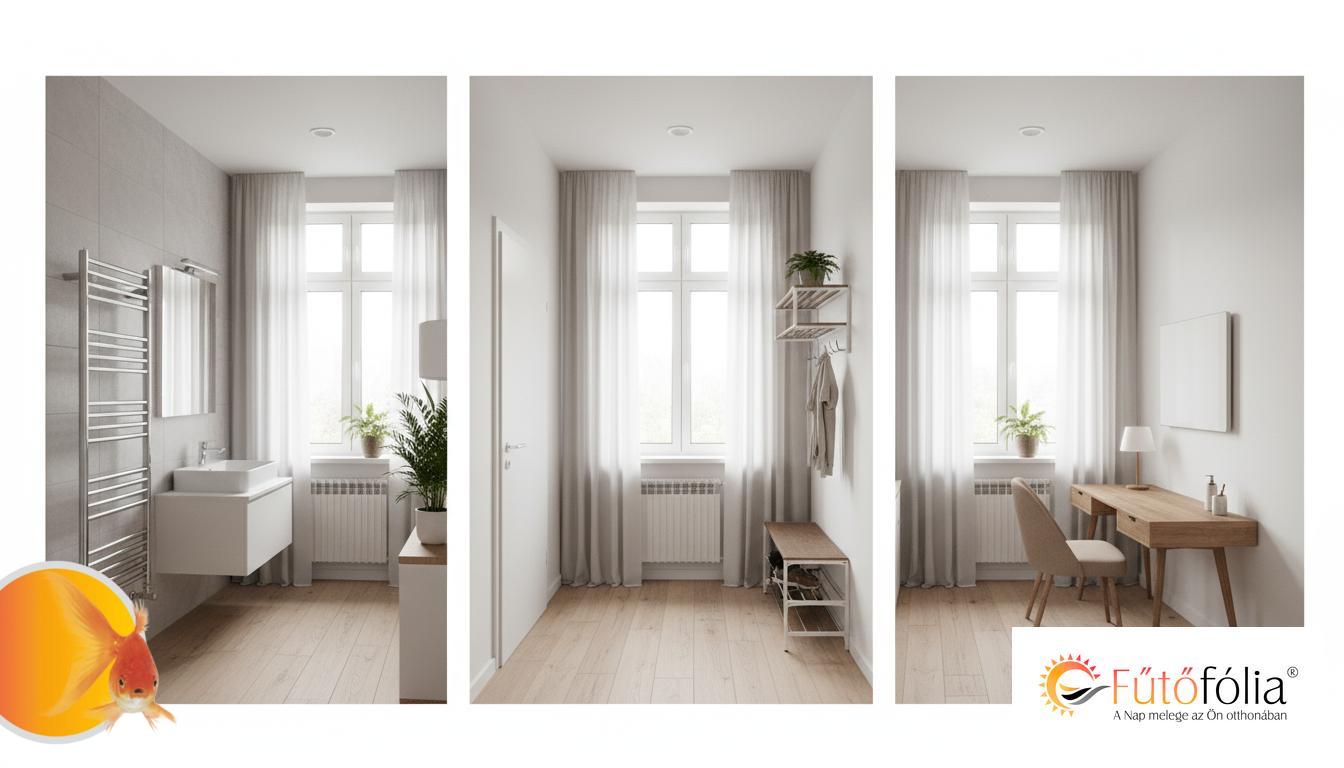
General principles for heating small rooms
Before turning to specific solutions, it is worth thinking through a few basic principles:
- Insulation: always start with the basics. In a well-insulated room (walls, windows and doors) the heat demand is much smaller, so any heating can be run more economically.
- Zone control: it should be possible to regulate the temperature separately in every room - this is one of the most important steps in reducing energy consumption.
- Quick response: the heating should warm up the space quickly and follow the instructions of the thermostat quickly.
Efficient solutions for small rooms
Infrared heating (infrared heating)
Infrared heating suits small rooms well, because it does not warm the air but directly objects and people, so radiant warmth is felt soon after switching on.
- Infrared panels and panel heaters
- Advantages: they can be mounted on a wall or ceiling, so they save space. They warm up quickly and give direct heat: in a small bathroom, for example, mounted above the shower or bath they soon give pleasant warmth. They do not rely on air movement, so they stir up less dust - which is why they are popular in homes with allergic family members too. We present our own measurement of the electromagnetic field on the electrosmog page.
- Where they suit: bathroom, study, hallway. They can be controlled precisely with a thermostat.
- Consumption: with good insulation and smart thermostat control they can be economical, especially for occasional use.
Electric underfloor heating
One of the most comfortable forms of electric heating: it gives pleasant, even warmth from under the floor.
- Heating mat, heating cable, heating film/heating film (3rd generation)
- Advantages: completely hidden, takes up no space. Under tiles (for example in a bathroom or hallway) it is especially comfortable, and distributes heat evenly over the floor surface. Heating film is a thin layer and responds quickly.
- Where it suits: bathroom (warm floor, faster drying), hallway (a pleasant arrival), kitchen.
- Consumption: controlled with a thermostat with a floor sensor thermostat and timed, energy consumption can be optimised.
Electric towel-dryer radiator
A heater designed specifically for the bathroom, which performs two tasks. We write about it in more detail in our article on the electric towel dryer.
- Advantages: heats the room and dries towels; takes up little space, elegant.
- Where it suits: bathroom, guest toilet.
- Consumption: switchable, often fitted with a timer, so it heats only when needed.
Air conditioner (air-to-air heat pump)
Although it is used primarily for cooling and heating larger spaces, it can be effective in a smaller, well-insulated study or a studio apartment too.
- Advantages: it heats with a good coefficient of performance (COP), so its energy consumption can be favourable. It responds quickly and can also cool.
- Where it suits: a smaller study, a room where cooling is also an important consideration.
- Disadvantages: it involves air movement, which can be disturbing, and the indoor unit takes up space. In very small, transitional spaces (hallway, guest toilet) it is less than optimal.
- As a supplement to electric heating: the air conditioner combines well with underfloor heating or infrared heating: the air conditioner warms the space up quickly, and radiant heating holds an even base temperature.
When to choose which?
The right solution depends on the function of the room and on habits of use:
- Bathroom, guest toilet: here quick heat-up and radiant warmth matter most. An infrared panel (even as ceiling heating) or electric underfloor heating (heating mat) works best. A towel-dryer radiator can also come into question as a supplement or instead, and wall heating can be a good solution too, if it can be built in.
- Hallway, corridor: usually only basic tempering or occasional boosting is needed. An infrared panel, a smaller electric panel heater or underfloor heating (heating film under laminate flooring) may also be suitable.
- Study, hobby room: here the aim is a continuous, even temperature. An infrared panel, panel heater or a smaller air conditioner can also be a good choice.
- Special needs: if, for example, seedling heating is needed in a small greenhouse or conservatory, special forms of electric heating (heating film, heating cable) can provide the solution.
How to make it most efficient
- Smart thermostat: with a programmable thermostat that can even be controlled from a smartphone, unnecessary heating can be avoided.
- Timing: heat only when it is really needed.
- Reliable products: choose a product from a known manufacturer, with documented technical data and clear warranty conditions, and leave the installation to a professional.
Summary
Heating small rooms need not cause headaches or high energy bills. Modern electric heating solutions - infrared heating (especially infrared panels and panel heaters), electric underfloor heating (heating mat, heating cable, heating film) or a towel-dryer radiator - offer a good alternative to conventional systems. Where cooling is needed too, a well-sized air conditioner can also heat the room comfortably. What matters most is a system suited to the room, smart control and proper insulation: that improves not only comfort but, in the long term, reduces energy consumption and cost too.
Request a quote — installation anywhere in Hungary
We survey, design and install heating film and infrared heating throughout Hungary. Tell us about your home and we will get back to you.