

Heating Film and Air Conditioner Together? A Smart Combination for All Four Seasons
Author: Tóth Tamás · 6 min read
In winter heating film provides even, radiant base heating, in summer the air conditioner cools, and in between it gives a quick boost. When the combination pays off, what to watch in sizing and control, and what the Hungarian H tariff means.
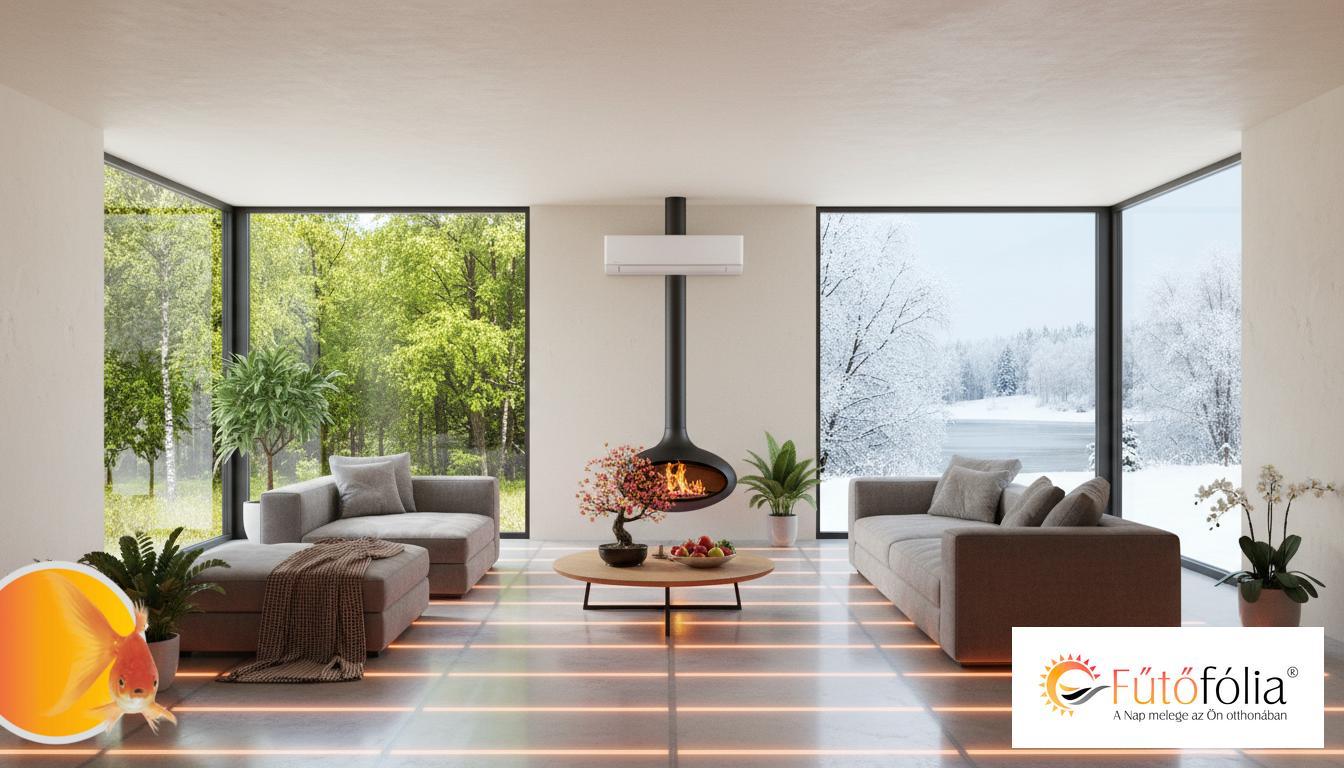
Yes, heating film and a heating-cooling air conditioner complement each other well: in winter the heating film provides even, radiant base heating, in summer the air conditioner cools, and in the transitional seasons it can also be used for a quick boost. The combination runs economically in a well-insulated house, and is most comfortable when the two systems are controlled by coordinated thermostats.
Choosing heating and cooling is an increasingly complex decision, because both energy efficiency and comfort matter. Among radiant heating options, heating film is becoming more and more popular, and for cooling and supplementary heating the air conditioner – that is, the air-to-air heat pump – is the most widespread. Below we show how the task can be shared between them across the four seasons.
Heating film as heating
Heating film is a modern form of electric heating that gives off heat by infrared radiation. Like the sun, it warms not primarily the air but the objects, surfaces and people in the room, so it gives an even, pleasant thermal sensation.
- Even heat distribution: heat radiates from below (as underfloor heating) or from above (as ceiling heating), so there is little temperature stratification and few cold corners.
- Hidden, space-saving: it goes under plasterboard, laminate flooring or other coverings, so it is not visible and takes no space on the wall or floor – similar to heating film, heating mat and heating cable systems.
- Moderate consumption with good insulation: in a well-insulated building with low heat demand it can be run economically. Thanks to the radiant heat of infrared heating, a room can be comfortable even at a lower air temperature, which moderates consumption.
- Fast response: it lies in a thin layer under the floor covering, so it warms up quickly and soon follows the thermostat settings.
- Less dust circulation: it does not blow air, so it stirs up less dust than forced-air heating. Like every electrical device, heating film also produces an electromagnetic field; how large it is, we show with our own measurements on our electrosmog page.
- Little maintenance: it has no filter, combustion chamber or circulating water, so it does not need the regular maintenance of a gas boiler, a radiator system or the air conditioner itself.
- Flexible design: it can be installed as floor, ceiling and wall heating.
The role of the air conditioner
Modern heating-cooling air conditioners have long not only cooled but also heated, and they are especially efficient in the transitional seasons.
Its advantages:
- Cooling and heating in one device: it cools in summer and heats in cooler weather.
- Good efficiency: as a heat pump it gives off more heat than the electricity it takes in, because it also uses the heat of the outside air – for example 3-4 kWh of heat from 1 kWh of electricity, depending on the outside temperature.
- Fast response: it warms or cools the room in a short time.
- Simple installation: a split air conditioner with a single indoor unit in particular can be installed relatively easily.
- Preferential tariff: according to MVM Optimum, in Hungary the H tariff can be requested for the heating of a split air conditioner that can both heat and cool and has an SCOP of at least 3.4, during the heating period from 15 October to 15 April. This benefit does not apply to electric boilers, infrared panels and other direct electric heating – including heating film.
Its limits when heating:
- Air movement: the blown air can be disturbing and can stir up dust.
- Dry air: with prolonged heating it dries the air.
- Heat distribution: it heats the air, warm air rises and the floor stays cooler – the thermal sensation is less even than with radiant heating.
- Performance drops in the cold: on very cold days (for example below -10°C) its efficiency can fall significantly, and supplementary heating may be needed.
The advantages and disadvantages of heating with an air conditioner are covered in detail in our article on heating with air conditioning.
How they complement each other through the four seasons
- Summer: the air conditioner is the star, keeping it pleasantly cool even in a heatwave. The heating film is switched off.
- Spring and autumn: when the temperature fluctuates even within the day, the air conditioner heats or cools quickly – for a short boost in the morning, or if it cools down by evening.
- Winter: this is where the advantage of the combination really shows.
- Base heating: the heating film provides constant, even, radiant warmth – noticeable on the feet as underfloor heating. Thanks to the radiant heat, a lower air temperature can also be enough.
- In severe cold: when the air conditioner's efficiency drops, the heating film carries the base heating and the air conditioner is needed at most for a short boost.
- Room by room: the heating film – as floor, ceiling or wall heating – keeps the whole house at a pleasant temperature, and with the air conditioner (even with several indoor units) a single room can be quickly set to a different temperature. This avoids unnecessary heating.
When does the combination pay off?
- In a well-insulated, newly built house: heat demand is low, so heating film can be run economically, and the air conditioner provides cooling and a quick boost.
- In a renovation where no wet system is needed: if you want to avoid wet underfloor heating with its demolition and thick screed layer, thin heating film is a good alternative.
- With a solar system: both systems run on electricity, so the solar panels' own production can reduce the consumption of both – in summer that of the air conditioner at the production peak. Covering winter heating, however, also depends on the metering: since 1 January 2024, for new household systems in Hungary, fed-in and drawn electricity is accounted for separately, on gross metering. Net metering can be kept only by systems applied for by September 2023 and commissioned by 1 January 2026 at the latest, for up to 10 years.
- In open spaces, in a multi-zone home: where the needs of the rooms differ, the combined system can be controlled flexibly.
What to watch in implementation
- Thermal insulation: the basis of economical operation. In a poorly insulated house neither system will be cheap.
- Sizing: both the heating film and the air conditioner must be sized for the room and the heat demand of the building – it is worth asking a professional for this. You can read about the on-site survey on its own page.
- Coordinated control: smart thermostats that communicate with each other, or shared central control, significantly improve operation and prevent the two systems working against each other. We write about the options in our article on modern heating control.
- Professional installation: installing both systems requires expertise for safe and efficient operation.
Summary
The combination of heating film and air conditioner is not a fashion but a sensible division of labour: heating film provides even, radiant base heating in winter, the air conditioner cools in summer and gives a quick boost in the transitional seasons and in severe cold. In a well-insulated house, with proper sizing and coordinated control, a pleasant temperature can be kept all year round with moderate energy use.
Request a quote — installation anywhere in Hungary
We survey, design and install heating film and infrared heating throughout Hungary. Tell us about your home and we will get back to you.