

"You Can't Get an Occupancy Permit with Electric Heating?" - Myths and Solutions from a Real Project
Author: Tóth Tamás · 4 min read
Can you get an occupancy permit with electric heating? Using the energy calculation for a 97 m² new family house, we show the air-conditioning, heating film and solar variants, and what the regulation requires today (Hungary).
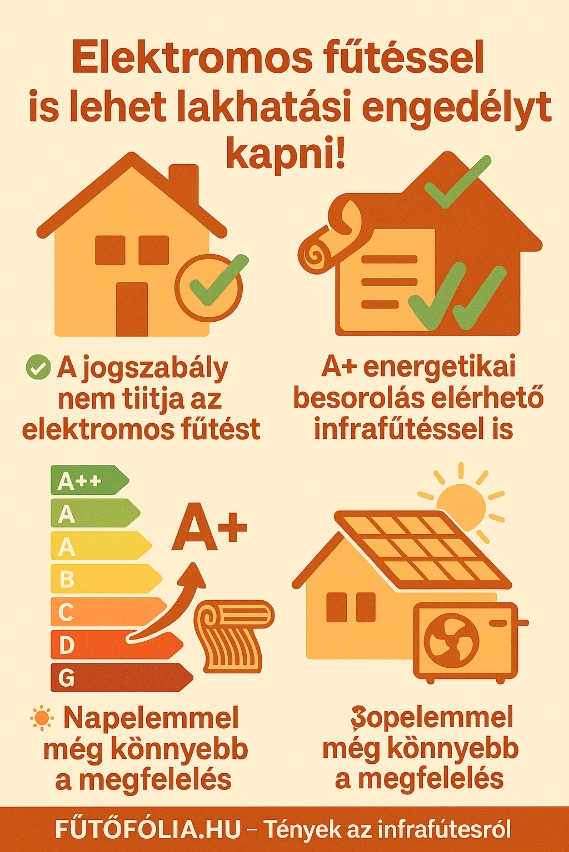
The energy requirements for new buildings in Hungary can also be met with electric heating, if the system is designed together with the energy calculation. In one of our 2025 projects, a new family house with 97 m² of usable floor area complied with cooling-and-heating air conditioners, heating film in every room and a heat-pump water heater; according to the calculation, with a 5 kW solar system it would have complied with heating film alone.
In recent years, tightening regulation has frightened many builders: can the requirements for nearly zero-energy buildings really only be met with a heat pump? The answer: no. Using a real example, we show how the required energy level can be reached with infrared heating and combined solutions - while keeping the investment manageable.
What does the regulation require?
For new buildings in Hungary, the energy requirements are set by Decree 9/2023 (V. 25.) of the Minister of Construction and Transport (ÉKM), which entered into force on 1 November 2023. According to the decree, a building is nearly zero-energy if it meets the requirements in Annexes 1 and 2. Annex 2 sets requirements for three indicators: the specific heat loss coefficient, the aggregate energy performance indicator and the specific carbon dioxide emissions; for residential buildings, the requirement values of the latter two are set relative to the reference building according to Annex 5.
The decree therefore does not prescribe a specific heating method: what counts is whether the building's structure and mechanical systems together meet these values. This is shown by the energy engineer's calculation - and that has to be in order for the occupancy approval, commonly called the "occupancy permit".
The case study: a new-build family house
The project was a new family house with 97 m² of usable floor area and a total volume of 252 m³. The client had originally planned heat-pump heating, but by the time of construction prices had risen so much that he could no longer take on the investment, so he looked for an alternative. That is how heating film came up as a comfortable and economical option.
The system that was built:
- 4 cooling-and-heating air conditioners in the living room and bedrooms. These covered 80% of the floor area, so in the energy certificate they were listed as heat-pump main heating.
- Heating film in every room for comfort; in the energy calculation it had only a supplementary role.
- A heat-pump water heater to produce domestic hot water.
According to the energy engineer's calculation, the building met the requirements: specific CO₂ emissions came to 17.53 kg/m²year, the aggregate energy performance indicator to 67.86 kWh/m²year, and the certificate gave an A+ rating. The rating is the certificate's classification, not the legal requirement itself - compliance is decided by the indicators above.
What changes if solar panels are added to the house?
Calculations were also prepared for two further variants for the energy certificate:
First variant: with a 2 kW solar system
- For thermal compliance, 2 air conditioners would already have been enough.
- Infrared heating was still kept in this case, but compliance was provided by the output of the air conditioners.
- The indicators improved further: CO₂ emissions came to 14.88 kg/m²year, the aggregate energy performance indicator to 66.89 kWh/m²year.
Second variant: with a 5 kW solar system
- An inverter air conditioner would not have been needed at all for compliance.
- The only heating system listed was electric heating film, and according to the calculation it still met the requirements - that is, the building could have obtained its occupancy permit with infrared heating alone.
In the calculation, solar panels improve the indicators through their own renewable generation. Their effect on monthly energy bills, however, also depends on the billing: from 1 January 2024, gross billing applies to new household systems in Hungary, meaning that electricity fed into the grid and electricity drawn from the grid are accounted for separately. Only systems applied for by September 2023 and put into operation by 1 January 2026 at the latest could remain on net metering, for up to 10 years. Solar panels can therefore reduce the electricity cost of heating, but not eliminate it; we have collected the details on our solar panel page.
Conclusion: do not believe the myth
The claim "you can't get an occupancy permit with electric heating" is outdated: today's energy calculation evaluates not a heating method but the building as a whole. A well-designed hybrid system (air conditioners and infrared heating), or infrared heating combined with a smaller solar system, can also meet the requirements of Decree 9/2023 ÉKM - whether it does so for a given building is always decided by the calculation made for it.
Benefits for the builder:
- no need for a complicated, expensive mechanical system;
- faster, simpler installation;
- more comfortable thermal feel, especially with underfloor heating.
Plan with us
If you or your client are in a similar situation and are unsure about the permitting because of the heating, get in touch. With an energy engineer, we examine every project individually, with a solution-focused approach - so that the occupancy permit does not depend on the heating. The planning process is described on our on-site survey and consultation page, and our electric heating page offers guidance for comparing heating methods. You can request a technical proposal here.
Request a quote — installation anywhere in Hungary
We survey, design and install heating film and infrared heating throughout Hungary. Tell us about your home and we will get back to you.