

The 5 Biggest Myths About Infrared Heating Film
Author: Tóth Tamás · 6 min read
Does it ruin a building's energy rating, make installation expensive, draw far more power than rated, or produce strong electrosmog? Five common myths about infrared heating film, and what the facts and our own measurements say.
Five myths about infrared heating film come up most often: that it gives the building a poor energy rating, that installing it makes the project more expensive, that a lab test on one heating film applies to every film, that it draws much more power than its nominal rating, and that its electrosmog is many times the permitted level. Below we answer each one with facts.
Where do the myths come from?
This article was written in 2019, after the Construma building trade fair. Several thousand visitors passed our stand (Hall D, 302A4); the first 2 days are for professionals, so many tradespeople got to know infrared heating technology there. Electric heating is becoming more and more important in heating system design: infrared underfloor heating is one of the popular dry underfloor heating systems, and more and more people are also considering electric ceiling heating.
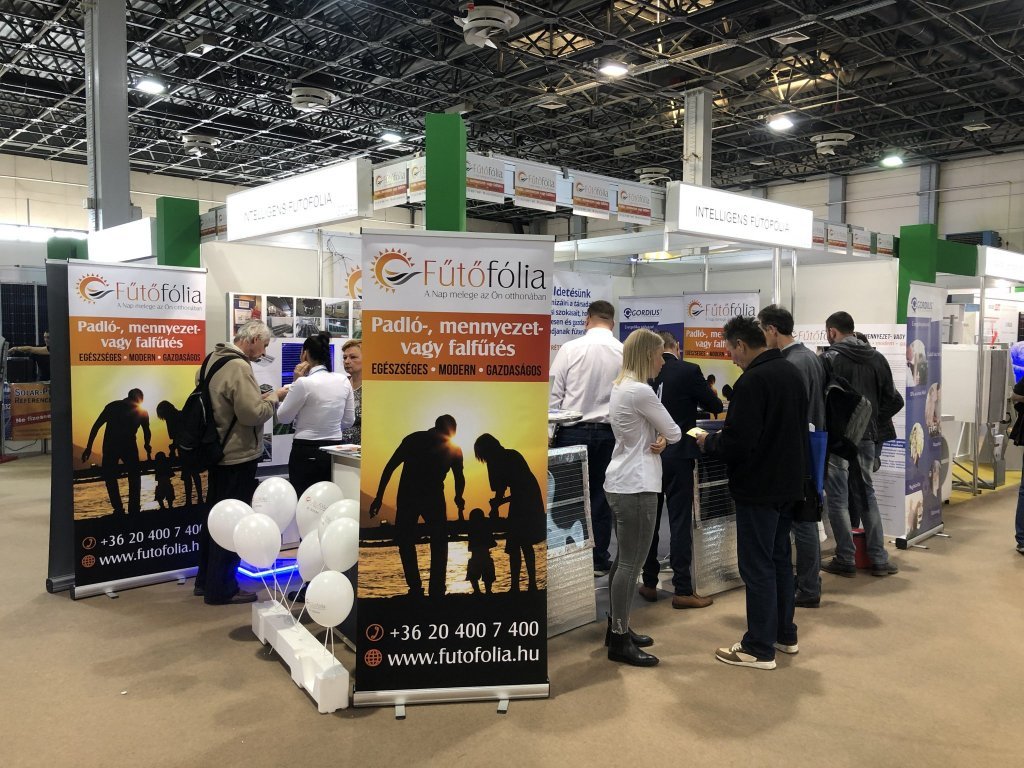
Our company's mission is: "To modernise society's heating habits so that people can heat in a healthy and economical way." We followed that aim at the fair too, and collected the most common misunderstandings from the questions we were asked. Besides the older, general objections – that heating with electricity is expensive, or that nothing is more economical than a heat pump – a few newer myths also came up.
The 2019 article was about the infrared heating film of the time, the 3rd-generation heating film; today we install 4th-generation heating film. As a buyer, it is always worth checking whether a claim about heating technology is based on a measurement and, if so, which product and what conditions it applies to.
Myth 1: "Because of heating film, a building can only get a poor energy rating"
This is a generalisation, and as such it is not true. A building's energy rating is not decided by the type of heating alone, but by the calculated energy demand of the whole building: thermal insulation, windows and doors, building services and locally generated renewable energy all together. With poor insulation the result will be poor with any heating system; with a well-insulated building and locally generated electricity – for example solar panels – the rating of an electrically heated building can also be improved. The same applies to other direct electric heating: panel heaters, heating mats and heating cables. The question is decided by the building as a whole.
For new buildings and major renovations of existing ones, energy requirements in Hungary are currently set by Decree 9/2023 (V. 25.) ÉKM, which entered into force on 1 November 2023. How the calculation treats infrared heating is worth agreeing with the energy certifier at the very start of the design.
Myth 2: "Installing heating film makes the project significantly more expensive"
A heating film system needs no boiler, pipework or radiators; installation is a dry technology. According to our 2019 calculations, the investment cost was therefore typically much lower than for other heating systems, especially heat pumps; customers often brought us other quotes to compare. At today's prices, our recent cost comparison sets the two systems side by side. Because the film has no combustion and no moving parts, its maintenance needs are also small.
The electricity cost of operation can be reduced by a solar panel system, but instead of promises it is better to calculate with today's rules. Since 1 January 2024, new household solar systems in Hungary are on gross metering: electricity fed into the grid and electricity drawn are accounted for separately. Net metering can only be kept by systems applied for by September 2023 and commissioned by 1 January 2026 at the latest, for up to 10 years. The size of the saving therefore depends on how much of the generated electricity the household uses at the time it is produced.
Myth 3: "Heating films have already been tested by labs, and the result applies to every film"
Several heating films and foils of different construction and quality are available on the market, and cheaper products that are only said to be similar appear quickly – we cannot take responsibility for these. A measurement is valid only for the product and the conditions it was made under, so a result measured on another make cannot be extended to the whole product group.
As of writing, no Hungarian laboratory had been asked to test the infrared heating film we supply. We gladly provide a sample for correct, professional measurement, because we are confident that the product will stand up to independent testing. If an article or quote refers to a lab measurement, ask: which product was measured, who carried out the measurement, and was it done under conditions that match the installation instructions?
Myth 4: "Heating film draws 400 W/m² from the mains instead of 220 W/m²"
Such a fault has been mentioned for some similar products on the market; it did not occur with the infrared heating film we supply. The power drawn can be measured after installation, so conformity with the nominal value can be verified.
Correct sizing is at least as important. In 2019 we supplied heating film in 110 W/m², 220 W/m² and 400 W/m² versions, and installation is always matched to the building's heat loss: in a well-insulated building we do not install 400 W/m² if the heat loss is only 20 W/m². For today's product, see the page on 4th-generation heating film.
Myth 5: "The electrosmog is many times the permitted value"
Measurements made not according to the installation instructions – for example without earthing – do not show the real operating state. We always install the infrared heating film with earthing. According to our own measurements, after installation electrosmog is not measurable above 20 cm, and below that it complies with the limit values in force in Hungary. You can read the detailed measurement results here, and our page on electrosmog covers the topic in more depth.
Just the film, or with installation?
In 2019 we offered the heating film only together with installation and did not sell it separately. Today the heating film can also be ordered on its own in our webshop. We nevertheless recommend professional installation with earthing, and the 15.5-year warranty on 4th-generation heating film applies when we carry out the installation. In the hope of a cheaper purchase, do not buy a product of unknown origin that is only said to be similar.
How to filter the information you get about heating
- Check whether there is a measurement behind the claim, and which product it refers to.
- Ask whether the measurement was made under conditions matching the installation instructions.
- Do not compare on a single criterion: investment, running costs, maintenance and comfort together give the picture.
- Ask for quotes for several heating methods sized for your building, and compare them.
- If possible, try the heating in operation before you decide.
We run professional training for tradespeople working with heating film, and we welcome anyone – professional, trade magazine or laboratory – who wants to get to know the technology in person, with measurements. If you have received a heating quote, our experts will help you compare it with other modern solutions.
Useful articles:
- Laki László Kornél – luxury home architect
- Heating with air conditioning – the pros and cons in one place
- Is film heating better?
- Heating film demonstration at the Mapei professionals' meeting
- Infrared heating or heat pump – 9 points of comparison
Request a quote — installation anywhere in Hungary
We survey, design and install heating film and infrared heating throughout Hungary. Tell us about your home and we will get back to you.