

Heat pumps: how they work and when they are the right choice
We do not sell heat pumps. Here you will find how a heat pump works, its types, conditions and limits from referenced sources, and a comparison with infrared heating using heating film built on the same basis. The figures and rules refer to Hungary.
In brief
- A heat pump does not produce heat, it moves it: it raises heat drawn from the outdoor air, the ground or groundwater to heating temperature, by investing electrical energy.
- The key figure is the SCOP (seasonal coefficient of performance), which the EU regulation requires on the energy label of units up to 70 kW. The lower the flow temperature, the higher it is: in one manufacturer's catalogue the same unit has a SCOP of 4.90–5.07 at 35 °C and 3.32–3.47 at 55 °C.
- Discounted electricity (the Hungarian H tariff) is available for a heat pump with a seasonal heating coefficient of performance of at least 3.4, on a separately metered circuit, between 15 October and 15 April. Heating film cannot be put on it.
- It has conditions: room for the outdoor unit and the plant, a low-temperature heat emitter (underfloor heating or radiators of large enough surface), adequate electrical supply, the noise of the outdoor unit, and in a condominium the involvement of common property.
- Which one when: where hot water or summer cooling is also needed and the conditions are met, a heat pump is a good choice. Where there is no room for plant, quick installation is needed, or use differs greatly from room to room, it is worth looking at infrared heating with heating film.
How does a heat pump work?
A heat pump does not produce heat by combustion or a heating element: it carries heat from a lower-temperature environment to a higher-temperature place. This does not happen by itself, so work, in practice electrical energy, must be put in. That is why the heat delivered can be a multiple of the electricity consumed: the difference comes from the environment.
The four steps of the cycle
- Evaporation: the heat source, the outdoor air, the ground or groundwater, evaporates the low-boiling-point refrigerant in the heat exchanger.
- Compression: the compressor compresses the vapour, which raises its temperature above the heating level.
- Condensation: the hot vapour condenses in the heat exchanger on the heating side and passes its heat to the heating water or directly to the room air.
- Expansion: the liquid refrigerant passes through the expansion valve, cools and drops in pressure, and the cycle starts again.
In a reversible version the direction of flow can be reversed: the unit then carries heat out of the interior, that is, it cools.
COP and SCOP: what do the two numbers measure?
The COP is the figure for a single operating state: the ratio of heat delivered to electrical power drawn at a given outdoor temperature and a given flow temperature (for example air +7 °C, heating water 35 °C). The SCOP is a seasonal coefficient of performance calculated for a whole heating season; on the energy label of heating heat pumps up to 70 kW it is required by EU Regulation 811/2013.
The two numbers matter because the same unit gives a different value at a different heating-water temperature. According to the single-phase data for an average climate in one manufacturer's catalogue, the 3 and 5 kW units have a SCOP of 5.07 with 35 °C heating water and 3.47 with 55 °C heating water; the 7 and 9 kW units 4.90 and 3.32. For the same units at an outdoor temperature of −7 °C the COP is 2.59–2.80 with 35 °C heating water, but only 1.71–1.94 with 55 °C (Panasonic Aquarea product-family catalogue, 2020–2021; the figures refer to the models of that time).
This gives the basic rule of heat pump design: the lower the heating-water temperature, the better the coefficient of performance. That is why a heat pump is most often paired with underfloor heating or radiators with a large surface sized for low temperature.
What types of heat pump are there?
The type is given by the heat source and the way heat is delivered. The first part of the name is always the heat source, the second what the unit heats.
Air-to-water
It draws heat from the outdoor air and heats water, which is delivered by underfloor heating, radiators or fan coils. It needs no drilling or well, which is why it is the most common version in Hungary. In the monobloc version the refrigerant circuit is closed within the outdoor unit; in the split version it extends to the indoor unit.
Air-to-air
It also draws heat from the outdoor air but heats the room air directly: in practice an air conditioner that can also heat. It makes neither heating water nor domestic hot water, but it cools in summer and is built with a separate unit per room.
Ground-to-water (ground probe, ground collector)
It uses the heat of the ground with a vertical probe or a horizontal collector. The temperature of the heat source is far steadier in winter than that of air. In return, drilling or earthworks over a large area are needed, and drilling requires a mining-authority permit or notification.
Water-to-water
It uses groundwater as a heat source through a production well and a return well. It depends on whether there is a water-bearing layer of adequate yield and quality under the plot. Establishing the well requires a water-rights permit, for which the law specifies the documentation item by item.
When is a heat pump a good choice?
A heat pump shows what it can do where the whole system is designed around it. In five situations it is usually clearly a good decision:
- There is or will be a low-temperature heat emitter. With underfloor heating or large-surface radiators sized for low temperature, a high coefficient of performance can be maintained. This is the most important condition.
- Domestic hot water is also needed. An air-to-water or ground-to-water system with a suitable tank also makes hot water, so one machine does two jobs.
- You would also like to cool in summer. In a reversible version the same unit also cools, without a separate air conditioner.
- New build or a full mechanical renovation. The emitter network, the buffer and hot-water tank and the location of the outdoor unit can then be designed together; doing all this afterwards is much harder.
- Running cost is the most important criterion. A heat pump with a seasonal heating coefficient of performance of at least 3.4 can be put on the discounted Hungarian H tariff if it runs from a separately metered, permanently connected circuit; this applies in the heating season, from 15 October to 15 April. The conditions are set out in the Hungarian regulation on pricing in universal electricity service.
Then comes the question of subsidy: in the 2026 call of Hungary's Home Renovation Programme, heat pump modernisation is a supported investment, while on whether infrared heating can be supported, we have no information. The exact conditions, such as the age of the building, the expected energy saving and the budget, are always set out in the current call, so a grant writer or the text of the call is authoritative on this, not us.
What does a heat pump system need?
It is worth going through these before requesting a quote: if any of them is not met, it can decide the price of the investment or whether it is feasible at all.
Room for the outdoor unit
Air-based systems need an outdoor unit with free airflow, and the condensate formed during defrosting must be drained away. Its position is also affected by the plot boundary, neighbouring buildings and the prevailing wind direction.
Noise towards the neighbour
The outdoor unit's fan and compressor make noise. In residential areas in Hungary, the limit value for an operational noise source is 50 dB by day, between 6:00 and 22:00, and 40 dB at night, between 22:00 and 6:00. That is why it matters where the unit goes.
Low-temperature heat emitter
A high coefficient of performance needs a low heating-water temperature. An old system with small-surface radiators typically runs at a higher temperature, and there, as the manufacturer's data show, the SCOP is considerably lower.
Space for plant
Depending on the installation, the system includes a buffer tank, a hot-water tank, a circulation pump and fittings. These need a separate room or at least a plant cabinet inside the home.
Electrical supply
Because of the compressor's starting and running current, the available power and the number of phases matter. The discounted H tariff needs a separately metered circuit that is permanently connected, not plugged in.
Condominium limit
In a condominium the facade and roof are common property, so the community's consent is needed to place the outdoor unit; the detailed rules are given by the Hungarian condominium act and the building's organisational and operating rules.
Where does the outdoor unit stand?
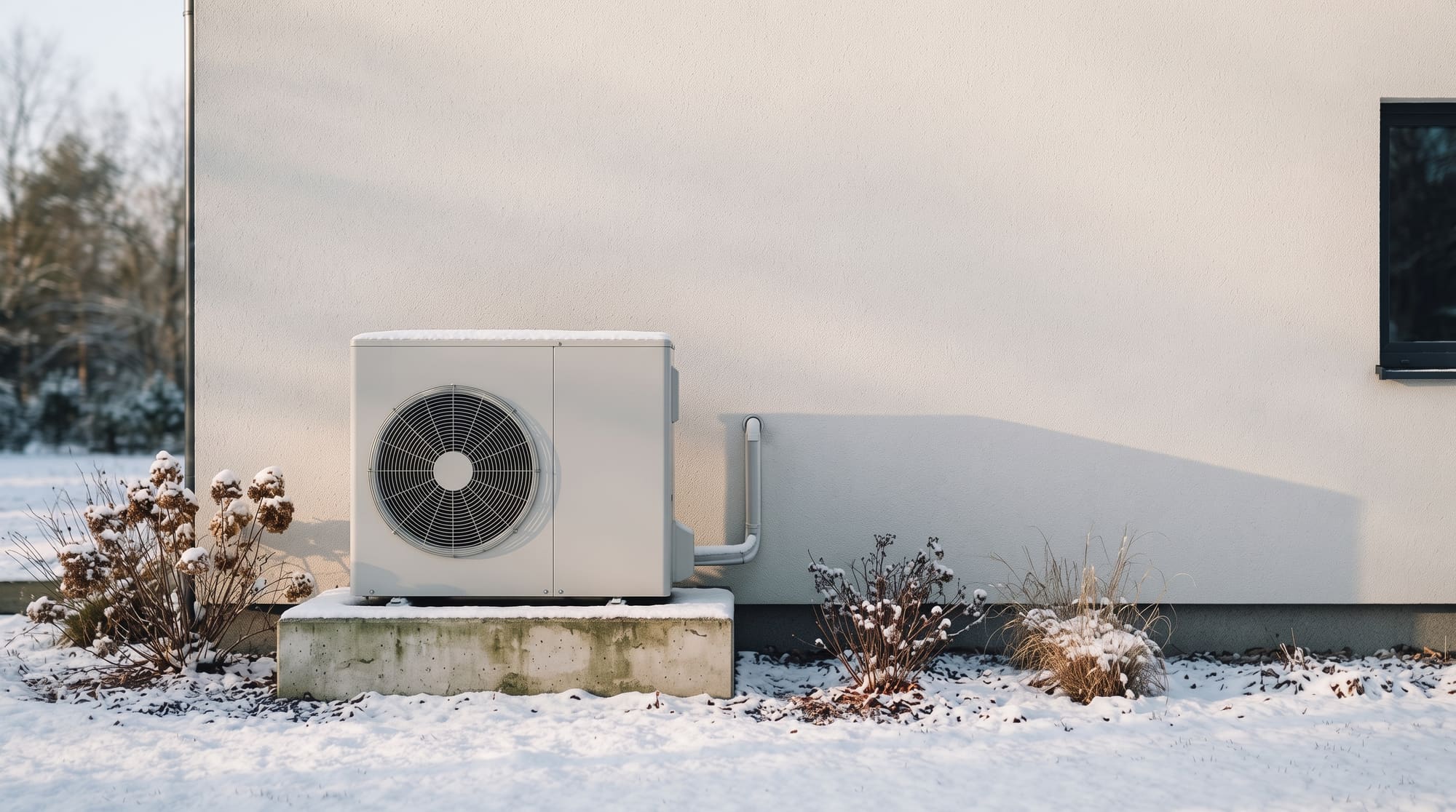
With air-based systems this box goes next to the house: with free airflow, a solid base and the condensate drained away. Its position and its noise towards the neighbour are a design question, so it is worth thinking through before requesting a quote.
How much does a heat pump use, and how much does it cost?
Consumption
A specific kWh figure can only be given responsibly with knowledge of the house, because consumption is decided by the heat loss. The order of magnitude is easy to calculate, however: heating electricity consumption is approximately the annual heat demand divided by the SCOP. If, for example, a house needs 12,000 kWh of heat in a season, then at a seasonal coefficient of performance of 3.5 the heat pump draws roughly 3,400 kWh of electricity, and at 2.5 already 4,800 kWh. For figures on your own house, see our consumption page, which shows the planned annual heat demand of ten real buildings.
Investment
We do not sell heat pumps, so on the investment we can only quote public market price compilations, as an indicative range, not as a quote. According to a 2026 professional price compilation, an air-to-water heat pump system for a 120–150 m² family house costs about HUF 3.5–4 million; another source gives a net range of HUF 3.13–6.25 million. These cover the unit and installation; the heat-emitter network (underfloor heating or replacing radiators) comes on top if it is not yet in place.
Annual fixed cost
A heat pump needs maintenance: the refrigerant circuit, heat exchangers, filters and electrical connections. According to a 2026 service provider's price list, this is of the order of HUF 40,000–65,000 a year. There is no chimney sweeping, because there are no combustion products.
Price of 1 kWh of useful heat
For the comparison we relate every system to the same 1 kWh of useful heat, at 2026 residential prices. For a heat pump this is the electricity price divided by the SCOP; for heating film it is the electricity price itself. On the residential A1 tariff, electricity costs HUF 36.386/kWh up to 2,523 kWh a year and HUF 70.104/kWh above that. On the current gross price of the H tariff our sources contradict each other (they give values between HUF 23.5 and 36/kWh), so in the table below we give it as a range, with the source indicated; we do not write down an invented number.
What are the limits of a heat pump?
A heat pump is a good technology, but not in every situation and not in every building. These are its limits, with the numbers for which we have a source:
- Power and coefficient of performance fall with the cold. With air-based systems the COP is lowest on exactly the coldest days. In the manufacturer's catalogue cited above, at −7 °C outdoor temperature with 55 °C heating water the COP is 1.71–1.94, so 1 kWh of electricity yields less than 2 kWh of heat, compared with 2.59–2.80 at 35 °C heating water.
- Defrosting. In humid weather around 0 °C, frost forms on the outdoor heat exchanger; the unit then runs a defrost cycle during which it does not heat, and consumes energy.
- High investment. According to the price compilations above, the unit and installation are of the order of millions of forints, and the emitter network comes on top if it is not yet in place.
- It needs maintenance. It contains moving parts, a refrigerant circuit and filters; servicing is an annual, recurring cost.
- Space requirement. An outdoor unit and, depending on the installation, a buffer and hot-water tank; in a condominium, touching the facade is a separate permitting matter.
- It cannot be done on every plot. Ground-probe and water-to-water systems depend on the conditions of the ground or the water-bearing layer, and involve earthworks that need a permit.
These are not arguments against heat pumps but design conditions. Where they are met, a heat pump gives one of the lowest specific heating costs.
Heat pump and infrared heating with heating film side by side
Two systems working on different principles, so it is not a matter of "better and worse" but of suiting different situations. In the table below, the heat pump data come from referenced external sources, and the heating film data from our own installed systems. Where we have no reliable source, we say so.
| Aspect | Air-to-water heat pump | Infrared heating with heating film |
|---|---|---|
| What it heats | Heating water, delivered by underfloor heating, radiators or fan coils | Heating film under the floor covering warms the floor, objects and people directly by radiation |
| Investment | About HUF 3.5–4 million for a 120–150 m² house (kazanmuhely.hu, 2026-02-20); another source: net HUF 3.13–6.25 million (tudjukki.hu, 2026). The emitter network is a separate item. | HUF 11,250–18,000 per m² gross for the area to be heated, installation included (Lite to Premium package). The exact price after an on-site survey. |
| Outdoor unit | Needed, with free airflow and condensate drainage | None |
| Space for plant | Depending on the installation, buffer and hot-water tank, pump, fittings | 6 mm layer build; no boiler room, chimney or outdoor unit |
| Nature of installation | Mechanical installation, with building or converting the emitter network | The 0.4 mm thick heating film goes under the floor covering; electrical work and floor covering |
| Heat-up | Slow because of the thermal inertia of the heating water and the screed; made for continuous, steady operation | Felt within 5–15 minutes, depending on the floor covering |
| Controllability | Depends on the hydraulics; zoning can be solved with valves | Separate thermostat and supply per room or heating circuit |
| Annual maintenance | HUF 40,000–65,000 a year (klimatszeretnek.hu, 2026) | No maintenance tasks: no moving parts |
| Hot-water production | Yes, with a suitable tank | No |
| Cooling | Yes, in a reversible version | No |
| Discounted tariff | H tariff, with a seasonal heating coefficient of performance of at least 3.4, on a separately metered circuit, 15 Oct to 15 Apr | Cannot be put on the H or GEO tariff |
| HUF per 1 kWh of useful heat | HUF 6.7–10.3 at a SCOP of 3.5, on the H tariff (our sources on the tariff's price contradict each other); on the A1 tariff, above the discounted quantity HUF 20.0 | HUF 36.4 (A1, up to 2,523 kWh a year), HUF 70.1 above |
| Noise | The fan and compressor noise of the outdoor unit; in residential areas the limit is 50 dB by day and 40 dB at night | No moving parts, no operating noise |
| Subsidy 2026 | Supported modernisation in the Home Renovation Programme | We have no information on whether it is supported |
| Lifespan, warranty | We have no reliable source on lifespan; the warranty is given by the manufacturer | No publishable lifespan figure; no wearing or rotating parts. 15.5-year warranty on the 4th-generation heating film if we carry out the installation |
| In a condominium flat | The outdoor unit involves common property, so the community's consent is needed | Stays inside the flat |
The heat pump prices are indicative market ranges from 2026 public price compilations, not quotes. The specific heat prices were prepared on the same basis with 2026 residential prices; our sources on the gross price of the H tariff contradict each other, which is why a range appears. The sources are at the bottom of the page.
Which one when? Our recommendation
Choose a heat pump if...
- there is or will be underfloor heating, or a radiator system sized for low temperature;
- producing domestic hot water is also needed;
- you would like to cool in summer with the same machine;
- there is room for the outdoor unit and the plant, and the noise of the outdoor unit towards the neighbours can be solved;
- the budget for the investment is there, and a grant subsidy may also come into question.
Look at infrared heating with heating film if...
- in a renovation there is no room for plant, a boiler room or a tank;
- the investment budget is tighter, and the area to be heated is not the whole house;
- use differs greatly from room to room: there are rooms you would heat only occasionally;
- you need quick installation that can be done in one go, and do not want an annual service;
- it is a condominium flat where the facade cannot be touched.
What is the same for both
The price of heating is ultimately decided by the house's heat loss. With poor insulation and old windows and doors, both systems heat expensively, and even the best coefficient of performance cannot bring back the heat escaping. That is why we always start by looking at the building. If the survey shows that a heat pump is the better solution for you, we will tell you that too: we do not sell heat pumps, so we have no interest in it.
Frequently asked questions about heat pumps
How does a heat pump work?
It does not produce heat, it moves it: it draws heat from the outdoor air, the ground or groundwater, and by investing electrical energy raises it to heating temperature. The four steps of the cycle are evaporation, compression, condensation and expansion. That is why the heat delivered can be a multiple of the electricity consumed: the difference comes from the environment.
What is the difference between COP and SCOP?
The COP refers to a single operating state: the ratio of heat delivered to electrical power drawn at a given outdoor and heating-water temperature. The SCOP is a seasonal coefficient of performance calculated for a whole heating season, and it is what appears on the EU energy label of units up to 70 kW. When buying, it is worth comparing the SCOP, because it is closer to the annual reality.
What types of heat pump are there?
Four main types: air-to-water (heats water from the outdoor air), air-to-air (heats the room air directly, in effect an air conditioner that can heat), ground-to-water, that is, ground-probe or ground-collector, and water-to-water, which uses groundwater as a heat source. In Hungary air-to-water is the most common, because it needs no drilling or well.
How much power does a heat pump use?
Heating electricity consumption is approximately the annual heat demand divided by the seasonal coefficient of performance. If a house needs 12,000 kWh of heat, this is roughly 3,400 kWh of electricity at a SCOP of 3.5 and 4,800 kWh at 2.5. The specific number depends on the house's heat loss, so it can only be given responsibly by calculation, with knowledge of the building.
Is discounted electricity available for a heat pump?
Yes: a heat pump with a seasonal heating coefficient of performance of at least 3.4 can be put on the discounted Hungarian H tariff if it runs from a separately metered, permanently connected circuit, not plugged in. The discounted price applies in the heating season, from 15 October to 15 April. The conditions are laid down in the regulation on pricing in universal service.
Does a heat pump work with old radiator heating?
It can, but the coefficient of performance deteriorates considerably, because old small-surface radiators need a high heating-water temperature. According to a manufacturer's catalogue, the same unit gives a SCOP of 4.90–5.07 with 35 °C heating water and only 3.32–3.47 with 55 °C. That is why radiators are often replaced with larger-surface ones or the system is changed to underfloor heating.
How much does a heat pump system cost?
We do not sell heat pumps, so we can only quote public market price compilations: one 2026 source gives about HUF 3.5–4 million for a 120–150 m² house, another a net HUF 3.13–6.25 million. These cover the unit and installation; the heat-emitter network is a separate item if it has not been built yet.
How noisy is the outdoor unit?
The fan and the compressor make noise; the specific value is on the manufacturer's data sheet. The legal limit in Hungary is clear, however: in residential areas the limit value for an operational noise source is 50 dB by day, between 6:00 and 22:00, and 40 dB at night, between 22:00 and 6:00. That is why it matters where the unit goes and at what distance.
Can a heat pump be installed in a condominium flat?
The outdoor unit would go on the facade, balcony or roof, but these are common property, so the condominium community's consent is needed for placing it. The detailed rules are given by the Hungarian condominium act and the building's organisational and operating rules. That is why in a flat another heating solution often ends up being considered.
What are the disadvantages of a heat pump?
With air-based systems the coefficient of performance falls with the cold: in the manufacturer's data cited above, at −7 °C with 55 °C heating water the COP is 1.71–1.94. On top of that come the defrost cycle, the high investment cost, annual maintenance, the outdoor and plant space requirement, and the fact that ground-probe and water-to-water systems involve earthworks that need a permit.
Heat pump or infrared heating: which should I choose?
If there is or will be underfloor heating, hot water and summer cooling are also needed, and there is room for the outdoor unit, a heat pump is the right choice. If in a renovation there is no room for plant, the budget is tighter, use differs from room to room, or quick installation is needed, it is worth looking at infrared heating with heating film. The characteristics of the house make the decision.
Does a heat pump also cool?
In a reversible version, yes: the direction of the cycle can be reversed, so in summer it carries heat out of the interior. An air-to-air system cools in the same way, since it is in effect an air conditioner that can also heat. Infrared heating with heating film, by contrast, does not cool, which is an important difference where cooling is also needed.
Does a heat pump need maintenance?
Yes. It contains a refrigerant circuit, a compressor, heat exchangers and filters, so it needs regular servicing; according to a 2026 service provider's price list this is of the order of HUF 40,000–65,000 a year. There is no chimney sweeping, however, because there are no combustion products. Infrared heating with heating film has no maintenance tasks, because it has no moving parts.
Do you sell heat pumps?
We do not sell heat pumps. We deal with infrared heating with heating film: floor, wall and ceiling heating. This page was made so that anyone considering a heat pump gets an objective comparison backed by sources, and does not have to gather the data from ten places. If the survey shows that a heat pump is the better solution for you, we will tell you that too.
More on the subject
Infrared heating
How infrared heating with heating film works, where it can be built in, and when it is not a good choice.
Electric underfloor heating
Layer builds by floor covering, price per m² and installation, with no wet pipework.
Heating consumption
The planned annual consumption of ten real buildings in kWh.
Types of electric heating
Heating film, infrared panels, panel heaters, heating mats and heating cables side by side.
Gas boiler
Boiler types, the 2026 price of replacement, and the same comparison from the gas side.
Request a quote — installation anywhere in Hungary
We survey, design and install heating film and infrared heating throughout Hungary. Tell us about your home and we will get back to you.
Sources
- Panasonic Aquarea product-family catalogue (manufacturer's catalogue, Hungarian-language): COP and SCOP data for 35 °C and 55 °C heating-water temperatures, J-generation models (2020–2021; retrieved 2026-09-22)
- Commission Delegated Regulation (EU) No 811/2013: energy labelling of space heaters (SCOP to be stated up to 70 kW) (2013; retrieved 2026-09-22)
- Hungarian NFM Decree 4/2011 (I. 31.) on pricing in universal electricity service: conditions of the "H" tariff (seasonal heating coefficient of performance of at least 3.4, separately metered circuit, heating season 15 October to 15 April) (text in force; retrieved 2026-09-22)
- MVM Optimum: H tariff: conditions and application for the discounted tariff (2022-10-17; retrieved 2026-09-22)
- Hungarian KvVM–EüM joint Decree 27/2008 (XII. 3.) on setting limit values for environmental noise and vibration load, Annex 1: limit for an operational noise source in residential areas 50 dB by day, 40 dB at night (text in force; retrieved 2026-09-22)
- Hungarian Act CXXXIII of 2003 on condominiums: use of common property (facade, roof) and the organisational and operating rules (text in force; retrieved 2026-09-22)
- Hungarian BM Decree 41/2017 (XII. 29.) on the content of documentation required for water-rights permitting procedures: permitting the establishment of a well (text in force; retrieved 2026-09-22)
- Permitting a geothermal heat pump system: the mining-authority procedure for drilling a ground probe (professional summary of the relevant laws, in Hungarian) (retrieved 2026-09-22)
- kazanmuhely.hu: Heat pump installation prices in 2026, total cost (market price compilation, in Hungarian) (2026-02-20)
- tudjukki.hu: Heat pump prices (market price compilation, in Hungarian) (2026; retrieved 2026-09-22)
- klimatszeretnek.hu: Price of heat pump servicing (annual maintenance, in Hungarian) (2026; retrieved 2026-09-22)
- MVM Next: residential electricity price (A1 tariff: HUF 36.386/kWh up to 2,523 kWh a year, HUF 70.104/kWh above) (2026; retrieved 2026-09-22)
- palyazatmenedzser.hu: Home Renovation Programme 2026: supportable works for heat pump modernisation (in Hungarian) (2026; retrieved 2026-09-22)
- futofoliatervezoknek.hu: investment prices of a heating-film system (Lite HUF 11,250, Standard HUF 14,625, Premium HUF 18,000 per m² gross, installation included) (2026-09)