

Comparing Outdoor Heating Systems
Author: Tóth Tamás · 6 min read
A gas patio heater, a convection electric heater, an infrared radiant heater or a garden fire pit? How outdoor heating systems work, their pros and cons side by side, and why radiant electric heating is the best choice for most terraces.
Outdoors, because of wind and open space, the warmth of systems that heat the air quickly disappears, so for a terrace, balcony or garden it is worth choosing radiant heating. In the comparison, electric infrared systems come out best: they warm people directly, have no open flame or gas cylinder, and need little maintenance. A gas patio heater is mobile and a garden fire pit is atmospheric, but both have serious limitations.
The demand for an outdoor lifestyle keeps growing, and the outdoor areas of homes and hospitality venues play an ever larger role. Cool spring and autumn evenings, and even summer nights, often spoil time spent outside – outdoor heating systems offer a solution. Many technologies are available on the market, however, and it is not always clear which is the most economical, the safest and the most comfortable. This comparison helps you decide.
The challenges and basic principles of outdoor heating
Unlike indoor heating, heating outdoor spaces is much more complex. Because of wind, open space and rapid heat loss, convection systems that heat the air would be extremely wasteful. That is why the vast majority of outdoor heating systems are based on radiant heating, which warms objects and people directly rather than the air.
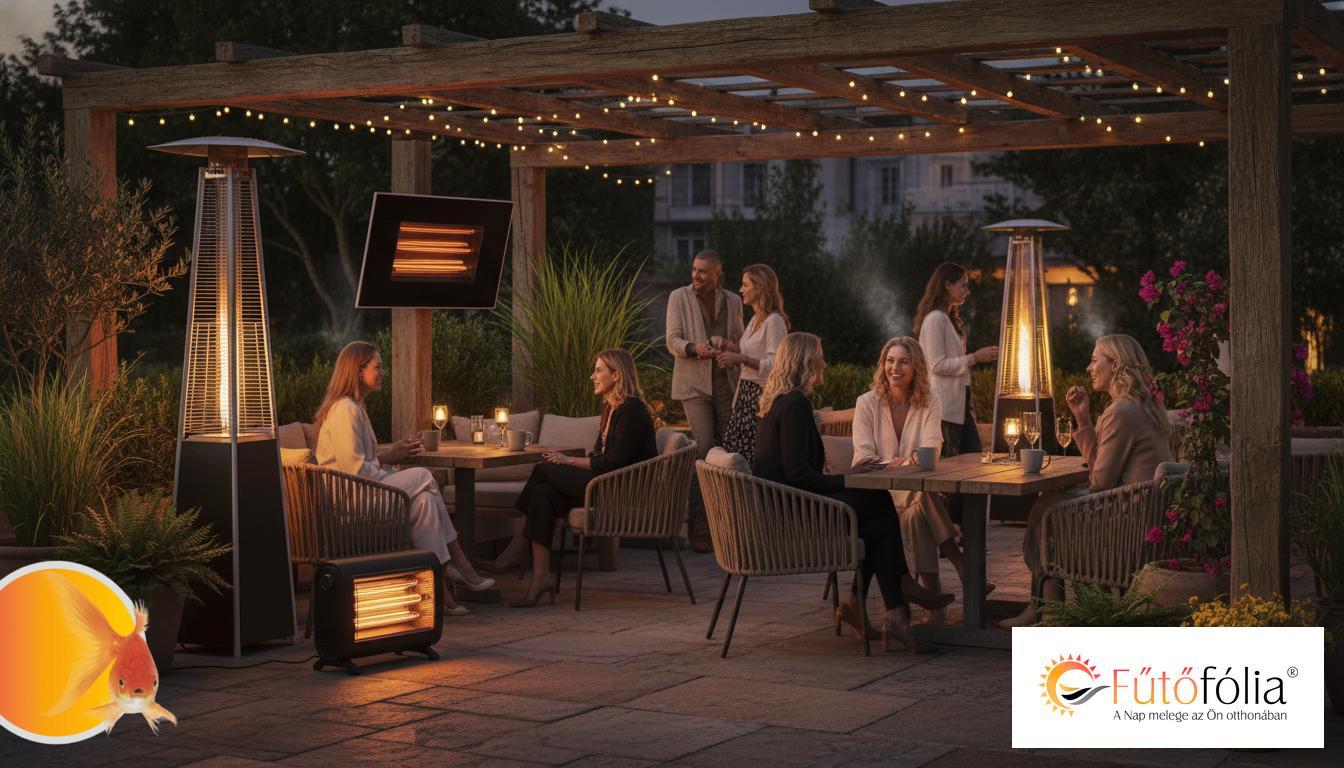
The most common outdoor heating systems
Let us look at the three main categories in more detail.
Gas-fired systems (patio heaters, gas radiant heaters)
These devices run from a propane-butane gas cylinder: they produce heat by burning the gas, which is usually directed into the surroundings by a reflector.
Advantages:
- Mobile: easy to move, although the weight of the gas cylinder limits this.
- Fast heat production: warmth is felt relatively quickly.
- No electrical connection needed: works without a power source.
Disadvantages:
- Cylinder changes: needs regular cylinder replacement, which is inconvenient, costly and requires planning ahead.
- Running cost: the price of gas can fluctuate, and the cost of cylinder changes is added, so it can be more expensive in the long run.
- Safety: it works with an open flame, so the fire risk is higher.
- Combustion products: it emits carbon dioxide and water vapour while burning, which is not ideal on a more enclosed terrace.
- Efficiency: part of the heat escapes into the air, and in open space efficiency drops.
- Maintenance and storage: burner heads and nozzles may need periodic cleaning, and storing gas cylinders requires separate space and care.
Convection electric heaters
These include simple electric radiant heaters and fan heaters: electricity heats the heating element, which warms the air by natural flow or with a fan.
Advantages:
- Simple to use: you just plug it into the socket.
- Low purchase price: typically cheaper.
Disadvantages:
- Very low efficiency outdoors: the warm air disperses immediately, the heating is hardly noticeable – outdoors this is the least effective solution.
- High consumption: they use a lot of electricity to achieve any effect, which means high running costs.
- Air movement: the fan can be noisy and stirs up dust.
Overall, these devices are not really suitable for outdoor heating.
Electric infrared systems
This category works on the principle of infrared heating: like the sun, it gives off heat by radiation and warms people and objects directly, not the air. It includes dark radiant terrace heaters, infrared panels and infrared radiant heaters. Electricity generates infrared radiation, which turns into heat when absorbed by surfaces.
Advantages:
- Quick feeling of warmth: warmth is felt almost immediately after switching on.
- Targeted heating: it delivers heat where it is needed – to people and objects – rather than wasting it on the air, which is why it is effective outdoors too.
- More favourable consumption: since it does not heat the air, its energy use is put to better use outdoors than that of convection devices.
- No air movement: it does not stir up dust.
- Quiet, odourless: it works silently and emits no combustion products or unpleasant smell. On the electromagnetic field of electrical devices, we present our own measurements on the electrosmog page.
- Little maintenance: no gas cylinder changes; the device can be plugged into a socket or hard-wired.
- Environmentally gentle: no combustion products on site, and if the electricity comes from a renewable source such as solar panels, total emissions also stay low.
- Safe: no open flame or gas cylinder, so the fire risk is lower too.
- Varied designs: wall-mounted, ceiling-mounted and freestanding terrace heaters, infrared panels and panel heaters are all available.
- Aesthetic: discreet, elegant appearance.
Disadvantages:
- The initial investment can be higher – in the long run this can be offset by the lower consumption.
- Efficiency requires direct radiation: where the radiation does not reach, it has no effect.
Supplementary solutions and considerations
- Wood-burning heating (fire pit, garden fireplace): atmospheric and romantic; but it mainly warms its immediate vicinity, is smoky, smelly, polluting, a fire hazard, and involves a lot of work (obtaining and storing wood, cleaning). It is not effective as heating.
- Seedling heating, heating film or heating film (smart) in a conservatory: although not classic outdoor heating, in an enclosed but not fully heated conservatory or greenhouse these forms of electric heating can be useful for plants.
- Control and regulation: modern terrace heater systems often come with a thermostat or remote control, which allows precise control and energy-saving operation.
Which outdoor heating system is best?
Based on the comparison, electric infrared outdoor heating systems stand out as the most efficient, safest and, in the long run, most economical solution for most terraces, balconies and gardens.
| Criterion | Gas patio heater | Convection electric heater | Electric infrared |
|---|---|---|---|
| Efficiency outdoors | medium, part of the heat escapes into the air | very low | good, heats in a targeted way |
| Safety | open flame, gas cylinder | no flame | no flame, no cylinder |
| Operation | cylinder changes, fluctuating gas price | high electricity consumption | little maintenance, more favourable consumption |
| Mobility | can be moved without power | needs a socket | movable in freestanding versions, needs a socket |
Why infrared? It heats the target directly, so heat loss is small even outdoors; it gives quick, even warmth similar to sunshine; there are no combustion products on site, and combined with solar panels its environmental load is also low; and although the initial investment may be higher than that of cheap convection devices, thanks to more favourable consumption and little maintenance it is typically more economical in the long run.
Summary
When choosing an outdoor heating system, it is worth weighing efficiency, running cost, safety, environmental impact and comfort together. Gas solutions attract with their mobility and wood-burning heating with its atmosphere, but in efficiency and economy electric infrared systems – such as dark radiant terrace heaters – lead.
If you want to spend time comfortably and economically on the terrace, balcony or garden over the long term, we recommend infrared technology. The cheapest purchase price does not always mean the most economical solution: careful planning and choosing a system that suits the site help you enjoy the outdoors on cooler evenings at moderate consumption. For a glazed, enclosed terrace another solution may also come into question – an example is the heating film built into the floor of a restaurant terrace in Debrecen.
Request a quote — installation anywhere in Hungary
We survey, design and install heating film and infrared heating throughout Hungary. Tell us about your home and we will get back to you.