

Infrared Panel Consumption: What Size of Infrared Panel Does a Home Need?
Author: Tóth Tamás · 4 min read
What size infrared panel does a room need? In an insulated room with a ceiling height of up to three metres, you can count on about 100 W per square metre. What sizing depends on, where to put the panel, and how power becomes consumption.
What size of infrared panel you need is decided by the room's floor area, ceiling height and insulation: in an insulated room with a ceiling height of up to three metres you can count on approximately 100 W of power per square metre. Consumption follows from this power and the daily operating hours – for an exact calculation we recommend our page that calculates infrared panel consumption.
Many people look for an infrared panel when a room is hard to heat, part of the home is always cool, a baby is arriving in the family, or they want to heat the bathroom properly. In that case the first question is size: what panel gives the desired warmth, and how much will it use?

What is an infrared panel?
The infrared panel is one of the best-known forms of infrared heating. It is made in many sizes, designs and power ratings, and fitting it is simple: it goes on the wall or ceiling. By infrared radiation it warms people, objects and walls directly, not the air – which is why we say it gives heat similar to the warmth of the Sun. It is generally used as supplementary heating, but can also work as stand-alone heating.
How to estimate what size of infrared panel you need
The starting point of sizing is the floor area of the room, but it is not enough on its own. You can get a good estimate with the steps below:
- Measure the floor area. In a room with insulated walls and a ceiling height of up to three metres you can count on approximately 100 W of power per square metre; the total power required follows from this.
- Check the ceiling height. If the room is taller, the radiant heat has to travel a greater distance and the air volume is also larger – in that case more power is needed, or the panel must be brought closer, for example onto a suspended ceiling.
- Take the insulation into account. With an uninsulated wall, old windows and a lot of glazing the heat loss is greater, so the per-square-metre value is not enough; in that case it is worth sizing with a heat loss calculation.
- Decide its role. For supplementary heating, to help a cool corner or the bathroom, a lower power may be enough than when the panel is the room's only heating.
- Think about control. Without a suitable heat controller, that is a thermostat, the panel runs unnecessarily even with the best sizing.
In a larger room it is often worth splitting the required power between several smaller panels so that radiant warmth reaches every part of the space.
Where should the infrared panel go?
Because it does not warm the air but directly people, objects and walls, it is also a good solution in places where the ceiling is high and the built-in heating does not give enough warmth. Proven places:
- in the living room in a central position, from where the radiation reaches the places where people stay;
- in the bedroom above the bed;
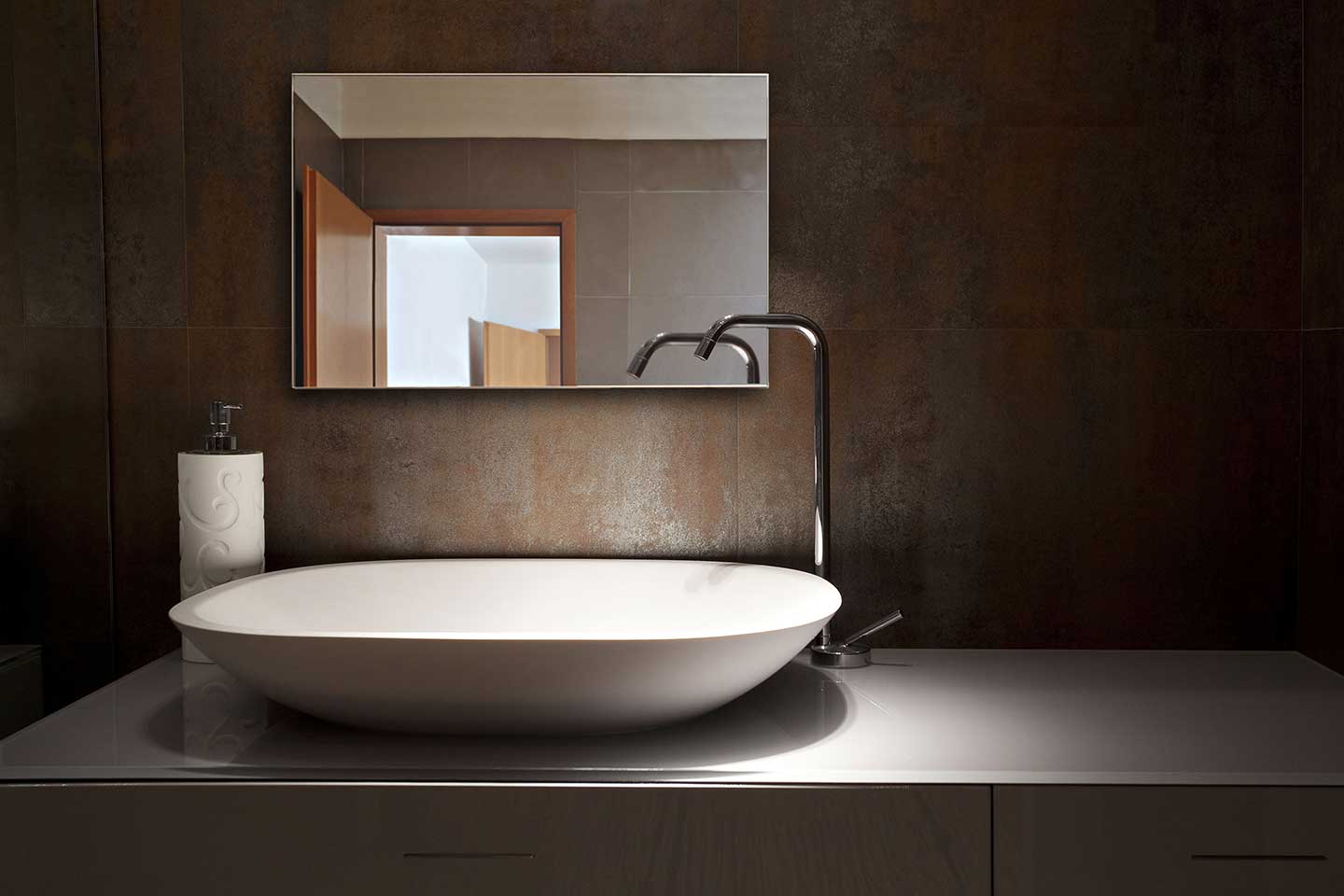
- in the bathroom behind the mirror or as a mirror – only a type approved for wet rooms should go in a damp room.

An infrared panel looks good on the wall on its own, but a popular solution is for its outer surface to be a picture or a mirror: then nobody suspects that the picture hanging on the wall is actually the heating. Interior designers like it too, because retrofit – or even complete – heating of houses can be solved in many ways and creatively with it, and modern panels suit a clean, elegant interior well.
How power becomes consumption
In operation an infrared panel uses as much as its rated power: a 500 W panel uses 0.5 kWh of electricity in one hour of continuous running. The actual consumption depends on how many hours a day it has to run – in some places one operating hour a day is enough, elsewhere much more is needed – and the thermostat adjusts this to the room's heat loss. Because radiant heating gives the same sense of comfort at a lower air temperature, the thermostat can be set lower.
In calculating consumption, the energy-efficiency value of the panel and the design of the heat controller can also matter. For a detailed, room-specific calculation use our online consumption calculator; what the consumption of infrared heating generally depends on is summarised on the consumption page.
Summary
The infrared panel size you need follows from the room's floor area, ceiling height, insulation and the role of the panel; in an insulated room of average ceiling height, the approximate per-square-metre value is a good starting point. Once you have gone through these criteria, it is easy to choose the suitable panel – our ready-made infrared panels are available on this subpage.
Request a quote — installation anywhere in Hungary
We survey, design and install heating film and infrared heating throughout Hungary. Tell us about your home and we will get back to you.