

How Does Heating Film Work?
Author: Tóth Tamás · 4 min read
In the thin heating layer of heating film, electric current turns into heat, which the film gives off mainly as infrared radiation to the floor, walls and people. What happens inside the film, where the heat goes, and why a room feels warmer.
Heating film is radiant heating that runs on electric current: in the film's thin heating layer the current turns into heat, and the large surface gives off this heat mainly as infrared radiation. The radiation warms not primarily the air but the floor, walls, furniture and the people in the room, and these surfaces then pass the warmth on to the air.
The principle of sunshine, in the room
Everyone knows the effect from outdoors. In summer, when we step out into the street, we immediately feel warm, because the sun's rays warm our skin. In winter, while skiing, sunshine feels good despite the sub-zero temperatures, even though the air is cold. Infrared heating uses the same way of transferring heat, only the heat source is not the Sun but heating film built into the floor, wall or ceiling, or an infrared panel mounted on a wall or ceiling.
What happens inside the film?
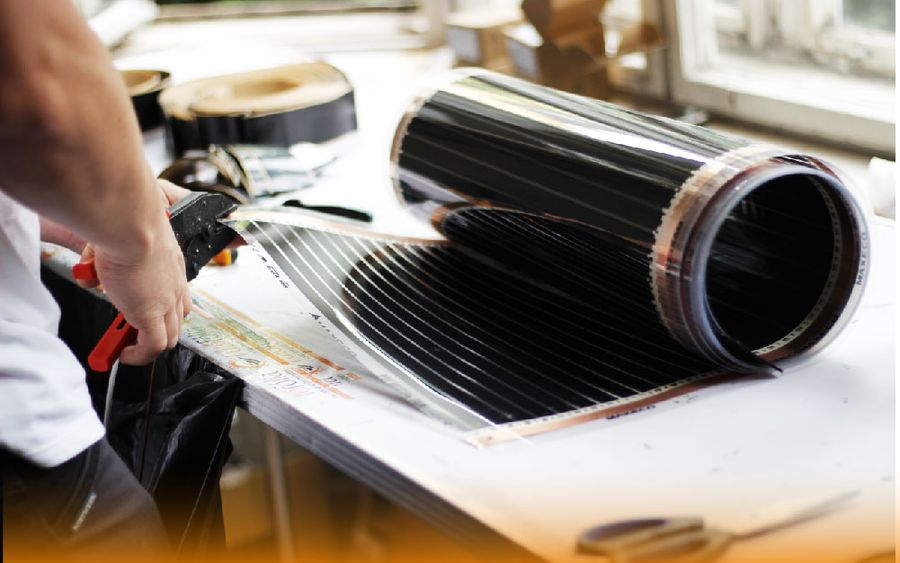
Heating film is a thin carbon-paste heating layer enclosed between insulating plastic layers. Copper strips running along the edges of the film conduct the current, which turns into heat as it passes through the heating layer. Because the heat is spread over a large area, the surface of the film is only moderately warm, yet it gives off a lot of heat. In today's 4th-generation film a full-width contact strip runs between the carbon paste and the copper strip, and the film is self-regulating: where furniture or a rug covers it, it automatically reduces its output. You can read about the development of heating films in our article presenting the generations, and about today's film on the 4th-generation heating film page.
Once installed, we do not see the film: in a floor it works under the floor covering, in a ceiling and wall under the plasterboard or plaster. The warmth is regulated by a thermostat, which switches the heating circuit off when the set temperature is reached and back on as it cools.
Where does the heat go?
Infrared radiation is absorbed by the solid surfaces of the room: the floor, ceiling, walls and furniture warm up, and later radiate heat back themselves. The warmth is thus present largely in the structures and objects, not only in the air.
This matters when you ventilate. With heating that warms the air - for example in an apartment with a gas boiler and radiators - together with the warm air, a large part of the invested heating energy goes out of the window, and the home can cool down within minutes. With radiant heating the fresh air cools too, but the heat of the warmed walls and objects stays inside, so after ventilation a pleasant thermal feel returns sooner. Exactly how much energy escapes depends on the length of ventilation, the outdoor temperature and the building.
Why does it feel warmer than the thermometer shows?
Our thermal sensation is determined not only by the temperature of the air but also by that of the surfaces around us. With radiant heating the floor and walls are warmer, and the radiation also warms us directly, so we often feel the same comfort at a lower air temperature. That is why in a house with infrared heating the thermostat often shows less than the room seems to be.
This can also show up in consumption. According to a frequently quoted rule of thumb, every degree you raise the thermostat means roughly 6% more energy - this is an empirical value, not a law, and it also depends on the building and the outdoor temperature. Someone who turns the thermostat up by 3 degrees heats nearly 20% more according to the rule; someone who can set it a few degrees lower thanks to radiant heating can save proportionally. Actual consumption is nonetheless decided by the heat loss of the house - we write about this on our page about the consumption of heating film.
It works outdoors too: an event tent in Debrecen
Radiant heating is also useful where the air cannot be kept warm. In the year before this article was published (2022), we heated the outdoor tent of an October event in Debrecen: guests were constantly going in and out, so the air of the tent could not stay warm. We built the infrared heating into the ceiling of the tent, and near it the guests could chat during the event even in T-shirts. We write about the details of tent heating in a separate article.
Request a quote
If you are curious how heating film would work in your home, request a quote from our colleagues by phone (+36-20-400-7400), by email (info@futofolia.hu) or on our quote request page (installation is available in Hungary).
Request a quote — installation anywhere in Hungary
We survey, design and install heating film and infrared heating throughout Hungary. Tell us about your home and we will get back to you.