

Tent Heating with Infrared Heating Film: How to Heat a Tent Efficiently in Winter
Author: Tóth Tamás · 13 min read
How can a tent be heated economically in winter? Radiant infrared heating planned together with insulation: a comparison of methods, the power-sizing steps and a sizing example for a 60 m² insulated storage tent.
A tent can be heated efficiently in winter if heating and insulation are planned together and radiant heat is used. Infrared heating film mounted on the arch and side wall of the tent warms the floor, the stored material and those inside, not the air rising under the roof. For a well-insulated tent, an installed output of typically 150–250 W per m² of floor area is the starting point for 20–22 °C; the exact value is given by an on-site survey and a heat loss calculation.
What is tent heating, and why is it a special task?
Tent heating means maintaining the internal temperature of hall and storage tents, industrial, agricultural and event tents – typically in winter, in the cold. It seems a simple task at first, but it is actually quite different from heating a brick or panel building, and with poor planning it easily becomes wasteful and ineffective.
There are several reasons for this:
- the tent's external envelope is large relative to the internal volume of air;
- the tarpaulin and the lightweight structure hardly insulate on their own;
- because of the high ceiling, rising warm air collects under the roof;
- gates and openings cause large air-exchange losses;
- the tent has no significant heat-storing mass, so it cools quickly once the heating is switched off.
That is why with tent heating it is not the floor area but the surface, the insulation and the airtightness that are decisive – a good solution always starts with planning heating and insulation together.
Tent heating methods – what can you choose from?
There are several solutions for heating tents, with different principles and efficiency. The table below compares the most common methods.
| Method | Heating principle | Advantage | Disadvantage in a tent |
|---|---|---|---|
| Gas hot-air blower | warm air | fast, high output | the warmth rises; combustion products, moisture, draught, fire risk |
| Electric fan heater | warm air | simple, cheap device | wasteful, uneven, noisy, stirs up dust |
| Oil radiator / convector | convection | quiet | slow, short range, too little for a large space |
| Infrared heating film | radiant heat | targeted, even, quiet, maintenance-free | needs planning and insulation |
The common weakness of heating that warms the air is the biggest disadvantage in a tent: warm air rises, and in a tall space it is not where it is needed. That is why more and more people choose radiant, infrared tent heating.
Why is infrared radiant heat advantageous in a tent?
Infrared heating warms like sunshine: it does not heat the air but the surfaces, the objects and those inside, and these pass the heat on to their surroundings. In a tent this is especially important, because with the high ceiling warm air would rise immediately.
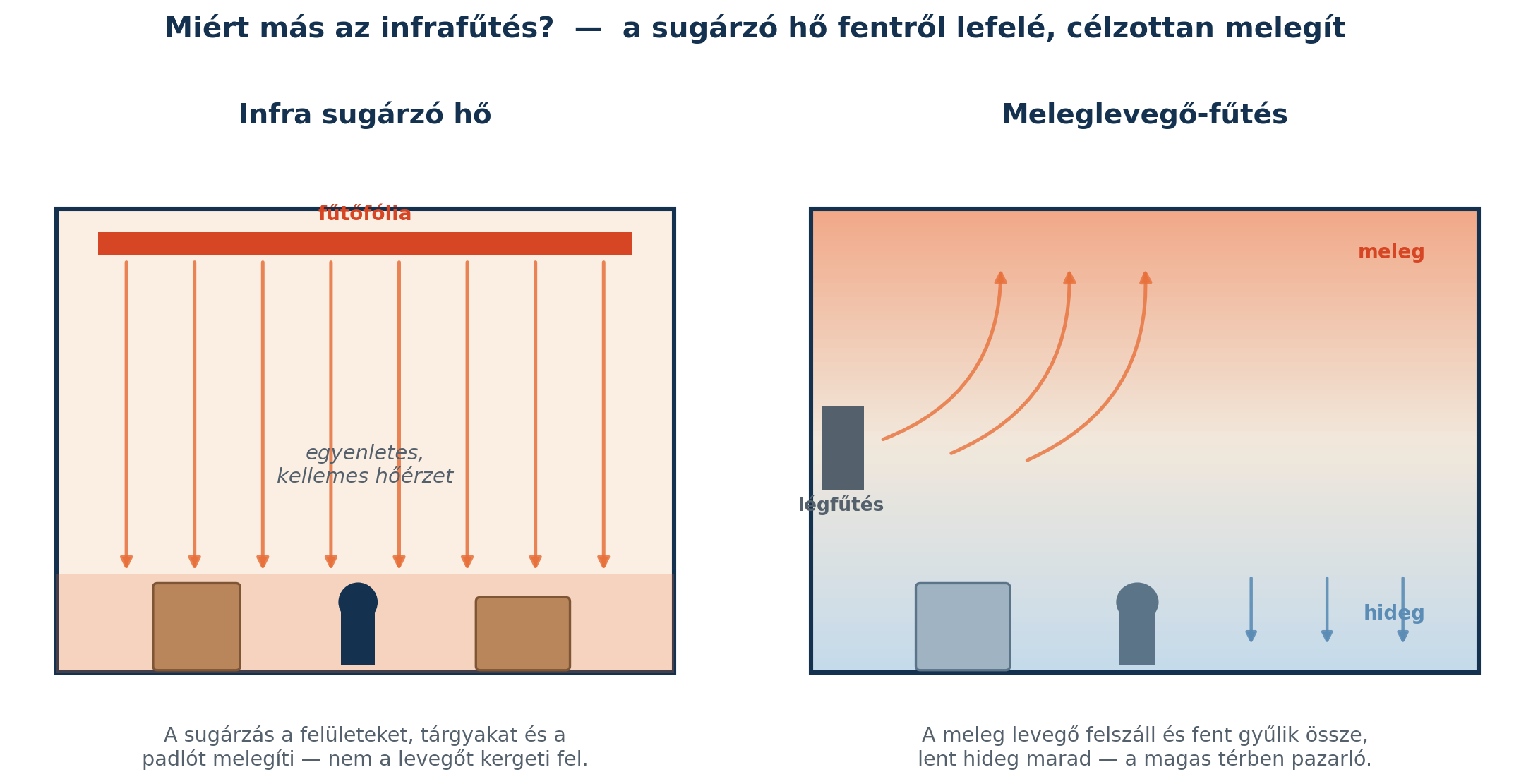
The advantages of radiant tent heating:
- The energy goes where it is needed – to the floor, the stored material, machines, people and animals, not to the air under the roof.
- Even feeling of warmth, because warm surfaces moderate the "draught feeling" caused by cold surfaces.
- Quiet and clean: no fan, air movement, dust stirring or combustion products.
- Maintenance-free, with no moving parts.
- Precisely controllable zone by zone, with a thermostat, and with timing too.
How does heating film work?
Heating film is a thin, large-area electrical heating element that converts electrical energy into infrared radiation of low surface power density. Because it radiates over a large area at a low surface temperature, it does not "burn" at points but gives even, soft warmth. We install the film in bands, so-called heating strips, organise these into zones and control them with a thermostat.
The 4th-generation heating film we install today is typically available in 50 cm wide modules, in different lengths and specific outputs (for example 220 W/m²), so the area and the output can be adjusted precisely to the task.
Insulation: the basis of efficient tent heating
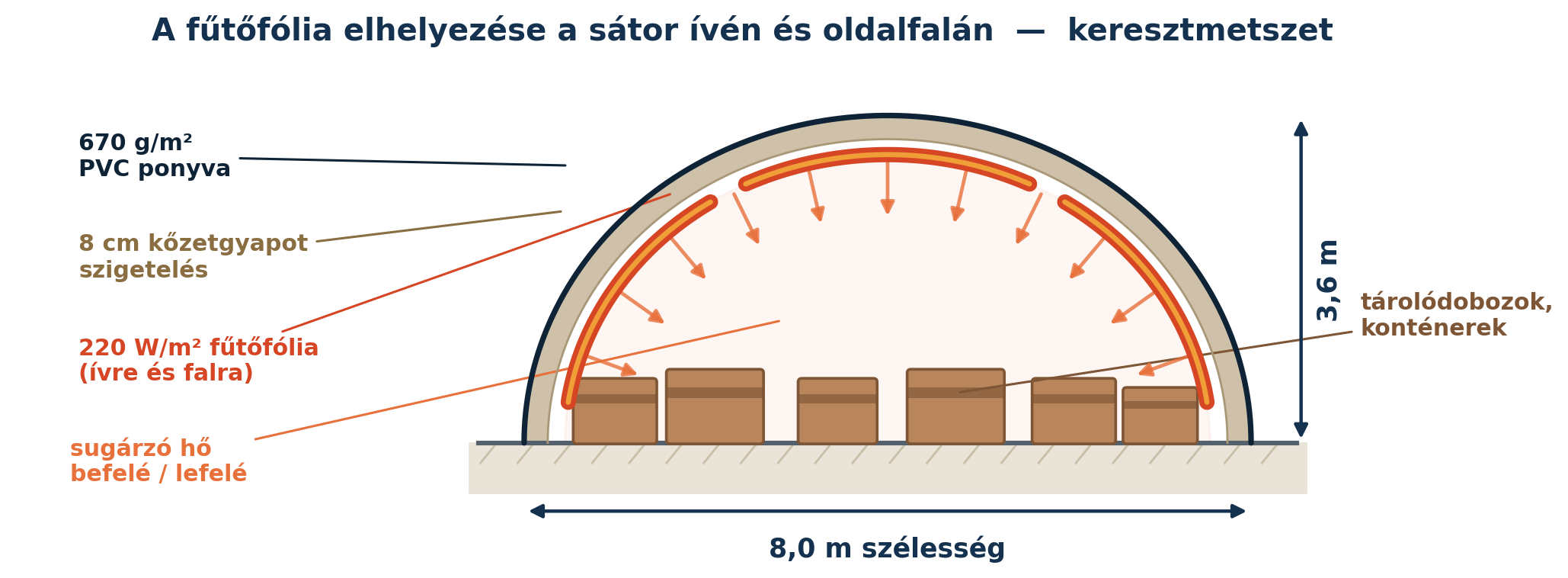
However good the heating, without insulation it will not be economical. On an uninsulated tarpaulin the heat escapes quickly, and the heating just keeps fighting the loss. That is why it is worth choosing an insulated tent version: here, typically 8 cm of rock wool goes between the outer tarpaulin and an inner film layer, which greatly reduces heat loss.
Besides insulation, the following decide the efficiency of tent heating:
- Closing gates and openings – frequent gate opening is the biggest source of heat loss.
- Insulation of the gable walls, because these are often weaker points.
- The design of the ground – significant heat also escapes toward uncovered, cold ground.
- Thermal bridges and joints, for example along the steel supporting structure.
Professional tip: always plan heating and insulation together. More thorough insulation generally pays back better than installing more heating output afterwards – the temperature can be maintained with less energy and more cheaply.
How much output does heating a tent need?
There is no single universal number, because the required output is decided by the large surface and air exchange of the tent, not its floor area. The logic of sizing, however, consists of a few easy-to-follow steps:
- Temperature difference. The difference between the internal target temperature and the external winter design temperature (about –15 °C in Hungary) gives the load. At a target temperature of 22 °C this is about 37 °C.
- Heat loss through the surfaces. Heat escapes over the whole external surface of the tent (roof, side wall, gable wall) to an extent depending on the quality of insulation.
- Floor and air exchange. Losses toward the ground, and on gate opening and ventilation, are also significant.
- Safety reserve. Adding all this up with an allowance gives the output to be installed.
As a practical starting point, for a well-insulated tent in winter it is worth counting on an installed output of roughly 150–250 W per m² of floor area for 20–22 °C; with weaker insulation and frequent gate opening, more than that. The exact value is always given by an on-site survey and an individual heat loss calculation.
Sizing example: a 60 m² insulated storage tent
We present the method on a concrete task we sized. The aim is to temper an insulated tent 8.0 m wide, about 7.5 m long (about 60 m²), with a ridge height of 3.6 m to 22 °C, for storing animals kept in boxes and containers.
| Parameter | Value |
|---|---|
| Floor area | about 60 m² |
| Internal air volume | about 165–175 m³ |
| External envelope | about 135 m² |
| Insulation | 80 mm rock wool + inner film lining |
| Target temperature | about 22 °C |
| External design temperature | –15 °C |
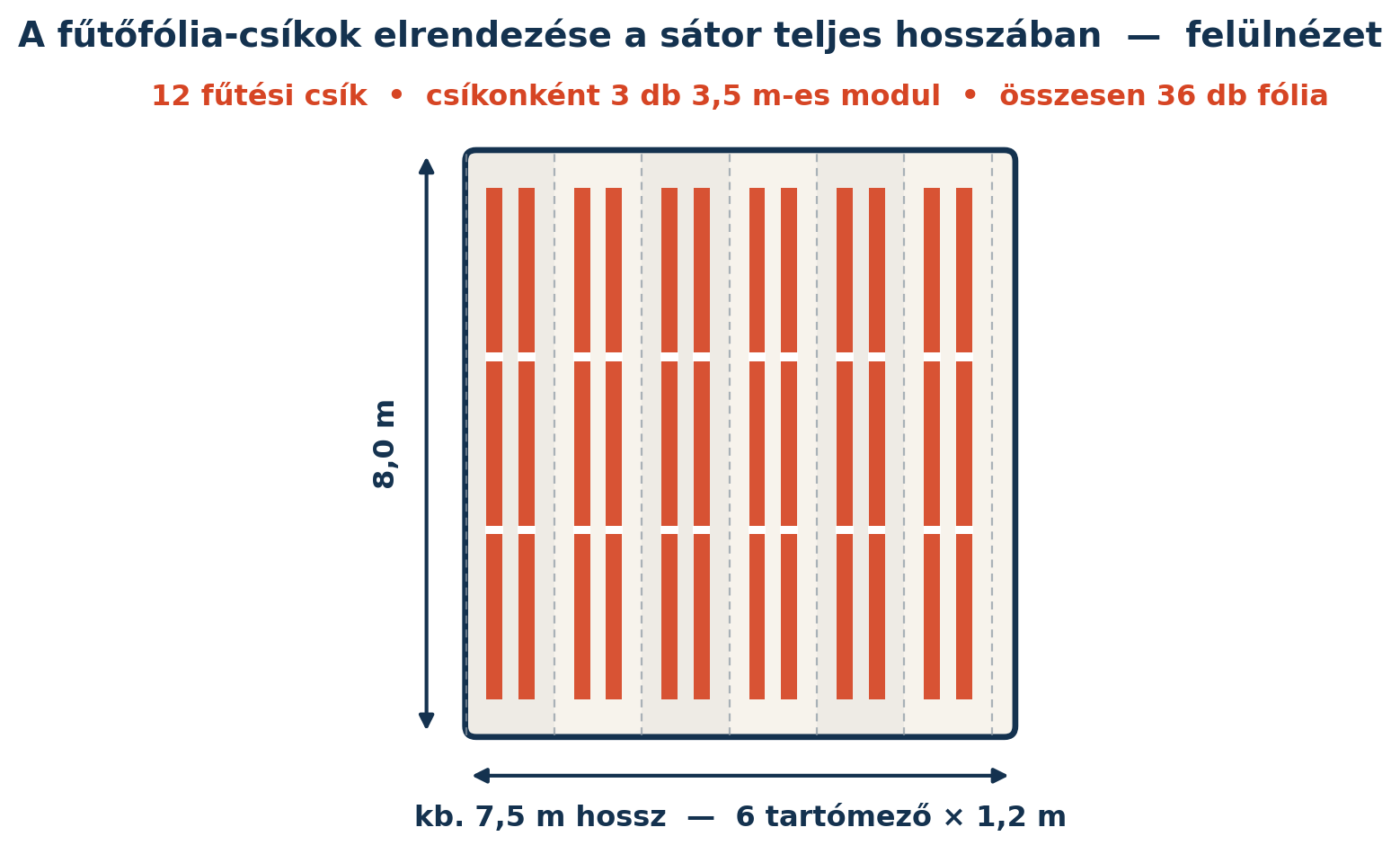
According to the calculation, about 12–15 kW of installed heating output is the safe range for holding 22 °C. We build it up from 220 W/m² heating film in modular strips: one strip along the arch consists of 3 modules of 3.5 m each, which reaches from the ground over the arch to the ground on the other side, with a small gap between the modules.
The proposed design is 12 heating strips, 3 modules per strip, 36 sheets of film in total, with 13.86 kW total output, evenly distributed along the length of the tent, with 2 strips per bay.
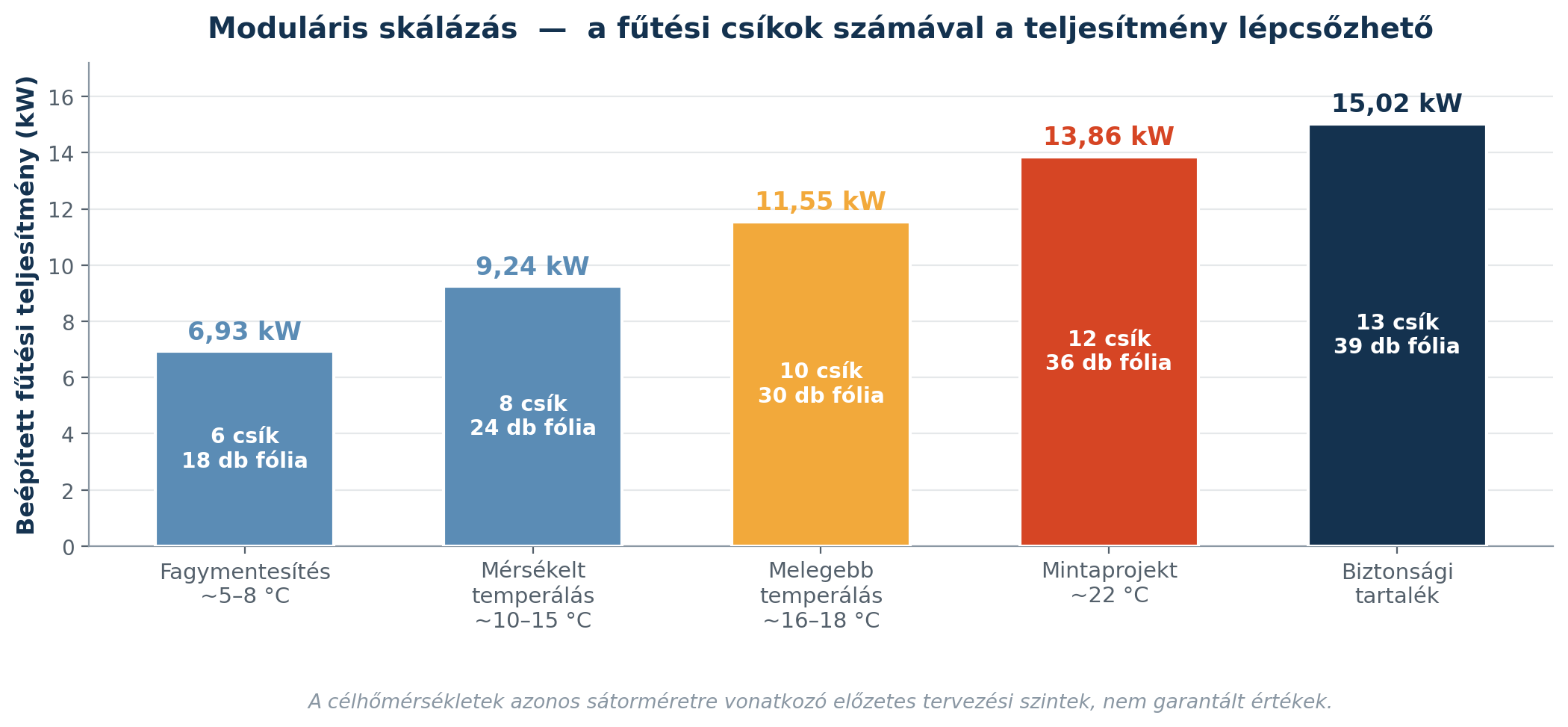
The system is modular and scalable: if the goal is not 22 °C but only frost protection or moderate tempering, we install fewer strips, with the same structural principle. With fewer heating strips the tent can be kept at a frost-free temperature of around 5–8 °C, which is enough for winter protection of machines, materials, liquids and bottled products.
Why does the heating film go on the wall and arch of the tent?
We mount the film on the inner edge of the tent, on the arch and the side wall, on the inner side of the insulation. This creates a warm, tempered inner lining zone over the whole surface of the tent: the cold comes from outside, and right there, at the edge, a warm, radiating surface faces it. In a tent this is often more practical and better protected than a solution built into the floor.
- The "draught feeling" of cold walls is moderated. People and animals continuously radiate their own heat toward cold surfaces; the warm inner edge reduces this loss.
- A radiant heat curtain at the edge. Film radiating inward over a large surface forms a warm protective layer, which moderates the feeling of cold breaking in – it complements, but does not replace, insulation.
- It warms the useful zone directly – the stored material, the floor, the equipment.
Energy consumption and running cost
The cost of tent heating is the product of the energy actually consumed (kWh) and the current electricity price. Consumption is much lower than the installed output suggests: the thermostat switches on only as long as the temperature has to be held, so in a well-insulated tent the average power drawn is only a fraction of the nominal.
The cost is influenced most by the following – which are also the tools for reducing it:
- The quality of insulation – by far the most influential factor.
- The target temperature – consumption rises meaningfully with every degree, so it must be chosen realistically.
- Zoning and thermostatic control – we heat only where and when needed.
- Airtightness – good closing of gates and openings and eliminating draughts.
A concrete sum can be responsibly stated only with knowledge of the site and on the basis of the current energy price – we calculate this for you at the survey.
What tents do we recommend infrared tent heating for?
Tent heating with heating film suits most hall and storage tents, and is especially advantageous in lightweight structures with high ceilings, where air heating would be wasteful:
- Warehouse and logistics tents – tempering the storage of goods and equipment.
- Industrial and workshop tents – heating the working environment without draughts and dust stirring. For a building with a large volume of air we worked on a similar principle in our hall heating in Jászberény as well.
- Agricultural and animal-keeping tents – targeted, direct warmth for animals, cages and boxes, without draughts. The output can be adjusted to the species and the desired temperature, and the film must be protected against moisture and pests.
- Event and sports tents – quick, radiant comfort warmth; wind-proofing also matters a lot here. We wrote about our earlier work in our articles on heating the National Equestrian Theatre tent and heating a festival tent.
- Spaces to be protected from frost – winter protection of machines, materials and liquids.
For an agricultural polytunnel (crop growing), sizing is special because the heat loss of the light-transmitting film is large – an individual survey is always needed then. Our article on infrared heating of polytunnels covers this in more detail.
Installation, control and safety
Installation always starts with an on-site survey and an electrical plan, followed by fixing the film to the arches and the wall, cabling, connecting the zones and thermostats, and finally commissioning and checking. The installation time depends on the size of the tent and the system, but modular heating film can be installed quickly and cleanly.
We divide the system into several independent zones, control each with a thermostat, and with smart control it can be timed and switched remotely too.
The conditions for safe operation: professional fixing, a stable, heat-reflecting layer behind the film, protection against moisture, mechanical damage and – in animal keeping – pests, and a standard electrical supply with overcurrent, electric shock and fire protection. The heating film has a low surface temperature, with no open flame or combustion products. We record these conditions in the electrical plan for every project. Installation is available in Hungary.
Request an individual tent heating sizing
Send us the data of your tent, and we will prepare an infrared heating concept for your tent – with output, layout and a cost estimate. Contact us.
Frequently asked questions about tent heating
What is the best heating for a tent?
In a tent, radiant infrared heating, and within it large-area heating film, is typically the more efficient choice. Radiant heat does not heat the air – which in a high tent space would rise immediately – but directly the objects, the floor and those inside, so a pleasant feeling of warmth can be reached with less energy than with gas or electric hot-air blowing.
Why is infrared heating better than hot-air blowing in a tent?
Because warm air rises. In a tent 3.5–4 metres high, most of the warmth brought in by hot-air blowing collects under the roof, while it stays colder below, in the useful zone. Infrared radiant heat goes in a targeted way to the floor, the stored material and objects, without air movement, dust stirring or combustion products.
Can an uninsulated tent be heated?
It can, but it is not economical. With an uninsulated tarpaulin the heat loss is so great that it is worth undertaking only for frost protection or short-term, spot tempering, with much higher output. For lasting, comfortable heating we recommend an insulated version or retrofitted insulation.
What external cold should tent heating be sized for?
In Hungary, for safe winter sizing it is worth counting not with 0 °C but with an external temperature of about –15 °C, so that the system holds the desired temperature on the coldest days too. The reserve does not mean needless consumption, because the thermostat switches on only when needed.
How much electricity does tent heating consume?
Consumption is the product of the installed output and the actual running time. In a well-insulated tent the system runs at full output only part of the time because of the thermostat. Consumption is influenced most by the quality of insulation, the target temperature and the external temperature.
Why is installed output given and not a fixed temperature?
Because the same tent behaves differently in different conditions: the external temperature, gate openings and airtightness significantly influence the temperature that can be held. That is why we size the system to installed output and scale it to the goal with modular strips – from frost protection to full 22 °C heating.
Summary
The key to successful tent heating is the combination of radiant infrared heat and good insulation. Heating film mounted on the arch and wall of the tent brings warmth where it is needed, evenly, quietly and controllably, and the system can be scaled with modular strips from frost protection to full winter heating. The exact output is in every case given by an on-site survey.
Request a quote — installation anywhere in Hungary
We survey, design and install heating film and infrared heating throughout Hungary. Tell us about your home and we will get back to you.