

Heating Film: The Warmth That Spares Your Energy Bill
Author: Tóth Tamás · 5 min read
How can heating film spare your energy bill during a renovation? With zoned, timed control, a low build-up height and good insulation - with limits, myths and a checklist before renovating.
Heating film can spare your energy bill by heating only where and when it is needed: with a separate thermostat for each room, timing, and radiant warmth arriving from beneath the floor covering, the home is comfortable even at a lower air temperature. The size of the saving depends on the insulation of the house and on usage habits, so instead of promises it is worth doing the calculation.
During a renovation it is especially worth thinking through what we spend on. Installing heating film then involves little demolition and also improves comfort: on cold mornings the floor is pleasantly lukewarm, and the warmth arrives evenly, from under your feet.
What is heating film and how does it work?
Heating film is a thin, flexible, multi-layer electric heating element, which we typically install under a floor covering - mainly laminate, vinyl or engineered parquet. The film's conductive strips produce heat when current passes through, and pass it directly to the floor covering. The key to the thermal feel is that the warmth arrives from where the body meets the home: from under the feet, evenly. Today we install 4th-generation heating film.
- Surface heating: a large surface, low surface temperature, pleasant comfort.
- Fast response: low thermal inertia, quick heating up and cooling down.
- Zone control: a separate thermostat for each room, precise timing.
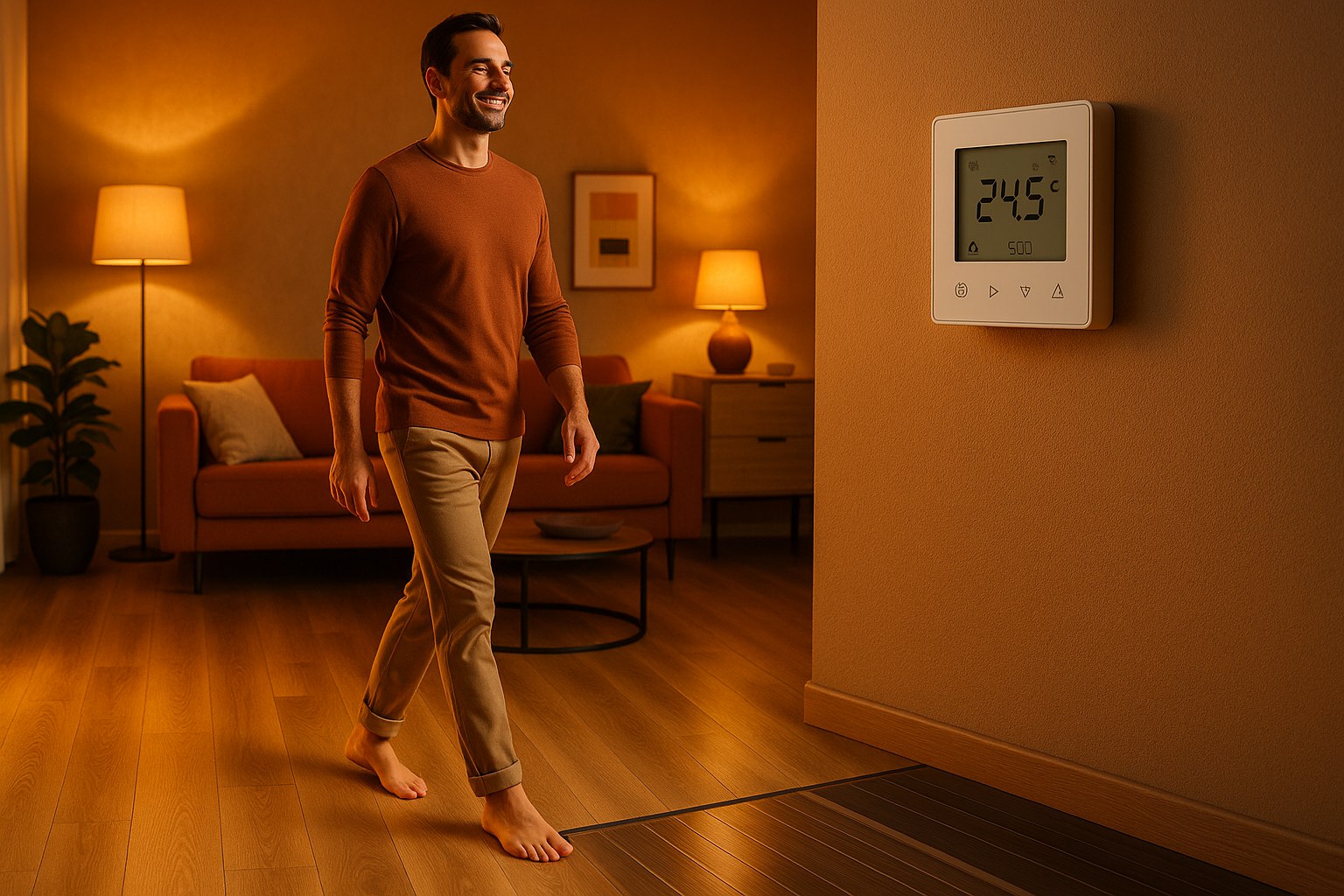
The advantages of heating film in a renovation
The idea that "in a renovation everything has to be torn apart" is outdated today. The advantages of heating film show especially when you modernise an existing home:
- Minimal build-up height: the film is paper-thin and does not meaningfully raise the floor level.
- Quick, clean installation: less chasing, less rubble, shorter downtime.
- Flexible zones: room-by-room control is easy to set up - it heats where people actually are.
- No boiler, no chimney: mechanical compromises disappear and space is freed up.
- Aesthetics: invisible heating, no radiators, freer furnishing.
In everyday life this means that a child can run out to the kitchen without socks, because the floor is pleasantly lukewarm. This is not luxury but comfort that makes everyday life easier.
The consumption and energy efficiency of heating film
With high energy prices, every kilowatt-hour counts. Heating film is economical when it is used wisely:
- Precise control: with a programmable thermostat and timing, unnecessary heating can be avoided.
- Zoned operation: the bedroom does not need living-room temperature, and in the bathroom a morning and evening boost is enough.
- Good thermal insulation: the lower the heat loss, the less energy is needed for the same comfort.
- Solar panels: if the house has solar panels, they can cover part of the heating's electricity needs; the saving depends on the billing method and the timing of generation - we write about this on the solar panel page.
The efficiency of heating film is not magic but physics: heat arises where it is used. There is no piping, no circulation loss; the warmth reaches the body directly from the floor. That is why a space often feels comfortable at a lower air temperature, which also shows on the bill. The factors affecting consumption are detailed on the consumption page.
Electric heating film or infrared heating film: what is the difference?
On the market you come across systems under both the name "electric heating film" and "infrared heating film". It is worth being clear about what the names cover:
- "Infrared" refers to the fact that most of the heat transfer takes place by radiation - this is natural to surface heating. In practice both solutions heat evenly through the floor.
- When choosing, the type of floor covering (laminate, vinyl, parquet), manufacturer compatibility and the system's certificates are important.
- What is decisive is quality control and professional installation: these determine everyday comfort and consumption.
Common myths - and the reality
- "Electric heating is expensive." Waste is expensive. Zoned, timed operation together with good insulation can give a consumption that pleasantly surprises many people - but it is always worth calculating for the characteristics of your house.
- "It is only good for new builds." It is precisely in a renovation that it is advantageous: small build-up height, quick installation, little mess.
- "It is dangerous to run electricity under the floor." With film of suitable quality, protective elements and professional installation, the system is safe and reliable in the long term.
When is it not ideal as primary heating?
If the house is very poorly insulated, has a high ceiling height, or has constant air exchange, the heat loss will be high - with any kind of heating. In that case either the thermal insulation has to be improved, or heating film is best used as supplementary heating in targeted zones (for example the bedroom, bathroom, study). In a renovation, upgrading insulation and heating can be combined well, and comfort improves significantly.
Advantages you feel every day
- Barefoot comfort: a lukewarm floor, natural thermal feel.
- Quiet and cleanliness: no fan, less stirring up of dust - which is why it is popular in homes with allergic family members too.
- Free space: no radiators, no pipes - more room, nicer interiors.
- Predictability: digital thermostat, consumption monitoring, cost control.
- Fast response: after you get home the desired thermal feel sets in quickly; no waiting for hours.
Before renovating - how to decide wisely
- Have the energy condition of the building reviewed: heat loss, windows and doors, ceiling and floor insulation.
- Choose the floor covering and have the manufacturer's compatibility with heating film checked.
- Plan the zones: which rooms should get independent control?
- Choose a reliable thermostat: Wi-Fi, timing, consumption statistics.
- For the installation, ask for a transparent, itemised quote and insist on standard protection against electric shock.
Why decide now?
Nobody can predict energy prices for certain, but a wasteful heating system costs more than necessary in every heating season. In a renovation, installing heating film gives comfort, cost control and modern, well-controllable heating at once - with less hassle and cleaner installation.
The next step
- Ask for an on-site survey and an itemised calculation for the heating film system - you can read about the survey process on the on-site survey and consultation page.
- Ask about the expected consumption of the heating film room by room, together with zoned control.
- Decide on the floor covering and the thermostat, and schedule the work together with the renovation.
Request a personalised quote and work out with us what heating film could mean in your home (installation is available in Hungary).
Request a quote — installation anywhere in Hungary
We survey, design and install heating film and infrared heating throughout Hungary. Tell us about your home and we will get back to you.