

Dog House Heating: Luxury or Necessity?
Author: Tóth Tamás · 5 min read
Does a dog house need heating? It depends on the breed, the dog's build and the conditions. When it is needed, what temperature is enough, which heating is safe – and why to avoid fan heaters and infrared heat lamps.
Whether a dog house needs heating depends on the dog. An undemanding komondor that tolerates cold well typically needs only a well-built, draught-free dog house, while a short-haired, small, sensitive French bulldog may need a heated shelter. If you heat, choose an easily controlled solution giving radiant heat – an infrared panel or heating film – and avoid fan heaters and infrared heat lamps.
Luxury or necessity?
Opinions are divided. Some say that heating a dog house is an unnecessary luxury, because a dog does not need heating. Others say that chilly, short-haired breeds really do need it so that they do not catch a chill and fall ill. Both sides may be right – the decision depends on the dog's breed and build and on how much time it spends in the dog house.
When may a heated dog house be needed?
- A breed that tolerates cold well and is modest in its needs (for example a komondor): a well-built, draught-free dog house is enough, where it can hide from the wind, rain or scorching sun.
- A short-haired, small, sensitive dog (for example a French bulldog): if it is in the yard during its owners' working hours, only a heated dog house meeting more serious requirements gives it real shelter.
- Puppies in a kennel: breeders increasingly provide in advance for keeping puppies at a comfortable warmth, because even within one litter it matters a great deal how many puppies survive.
What heating suits a dog house?

The most important criterion is the dog's need – do not choose the temperature that we ourselves find pleasant. A dog, like a human, does not benefit from a constant draught, so heating that circulates the air can be uncomfortable for it. Heating that gives radiant heat does not move the air, so it suits a dog house better.
| Heating method | Suitable for a dog house? | Why? |
|---|---|---|
| Fan heater | not recommended | it creates a draught, which makes the dog house uncomfortable, even unhealthy |
| Infrared lamp (heat lamp) | not recommended | it can burn the dog, gives too much and uncontrollable heat, and raises the electricity bill |
| Infrared panel | yes | simple and easy to control; fixed in the upper part of the dog house it warms the animal directly |
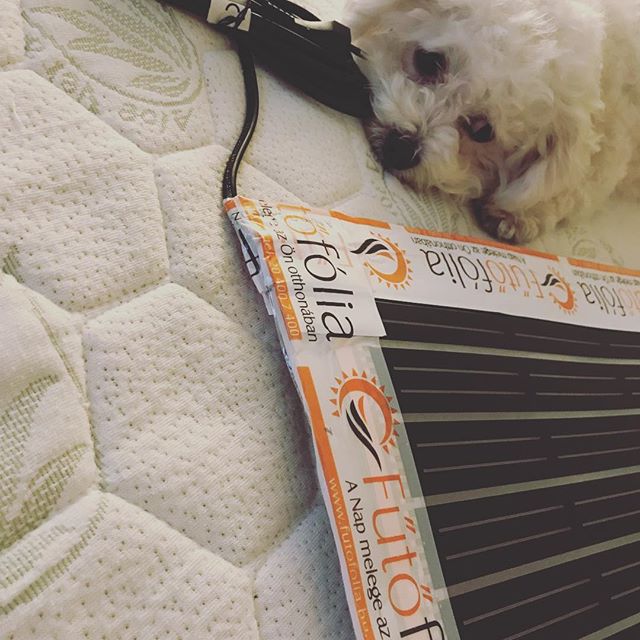
| Heating film in the floor | yes | with the right build-up it is safe, and the floor temperature can be set with a thermostat |
| Padded bed with heating film | yes | it only needs to be connected to a power source; details in our article on padded dog house heating |
Infrared panel
A simple construction with little room for faults: in our view it is best to choose the simplest. With an easily controlled, simple-to-fit infrared panel, frost-free conditions can be ensured in the dog house, by our estimate with a daily consumption of the order of 1 kWh. Low-temperature infrared panels are now available, whose surface is protected against overheating. Because infrared radiation heats not the air but objects and living things, a dog house can be heated this way even in an uninsulated, partly open place. It is advisable to fix the panel in the upper part of the dog house.
Heating film in the floor of the dog house
Infrared underfloor heating with heating film is also a popular solution: the infrared rays warm the dog directly, and the owner can set a pleasant floor temperature. With the right build-up, safe heating can be created, and even a cheap laminate flooring will do as the top layer. With this solution control is recommended, because the floor temperature can be set with it.
How warm should the dog house be?
Because we want what is good for the dog, we tend to switch the heating on for it on the very first cooler day. By doing so, however, we only ensure that it does not get used to the cold and falls ill more easily. Its resistance is also weakened if the difference between the inside and outside temperature of the dog house is too large.
A preheated, tempered dog house at roughly 10 degrees is one the dog gladly returns to, and if it lies down there, this has no harmful consequence for its health. Sensibly choosing the type of heating and the temperature is the best we can do for our dog on cold winter days.
Safety is the most important
Heating a dog house must not harm the dog in any way. A checklist:
- The electric cable and the connection must not be accessible to the dog, so it cannot chew them.
- The heat-emitting surface must not become so hot that it could cause injury – which is why an infrared lamp does not belong in a dog house.
- The heating should be controllable: with a thermostat or a timer.
- The simpler the construction, the fewer the possible faults in it.
Our dog house heating products
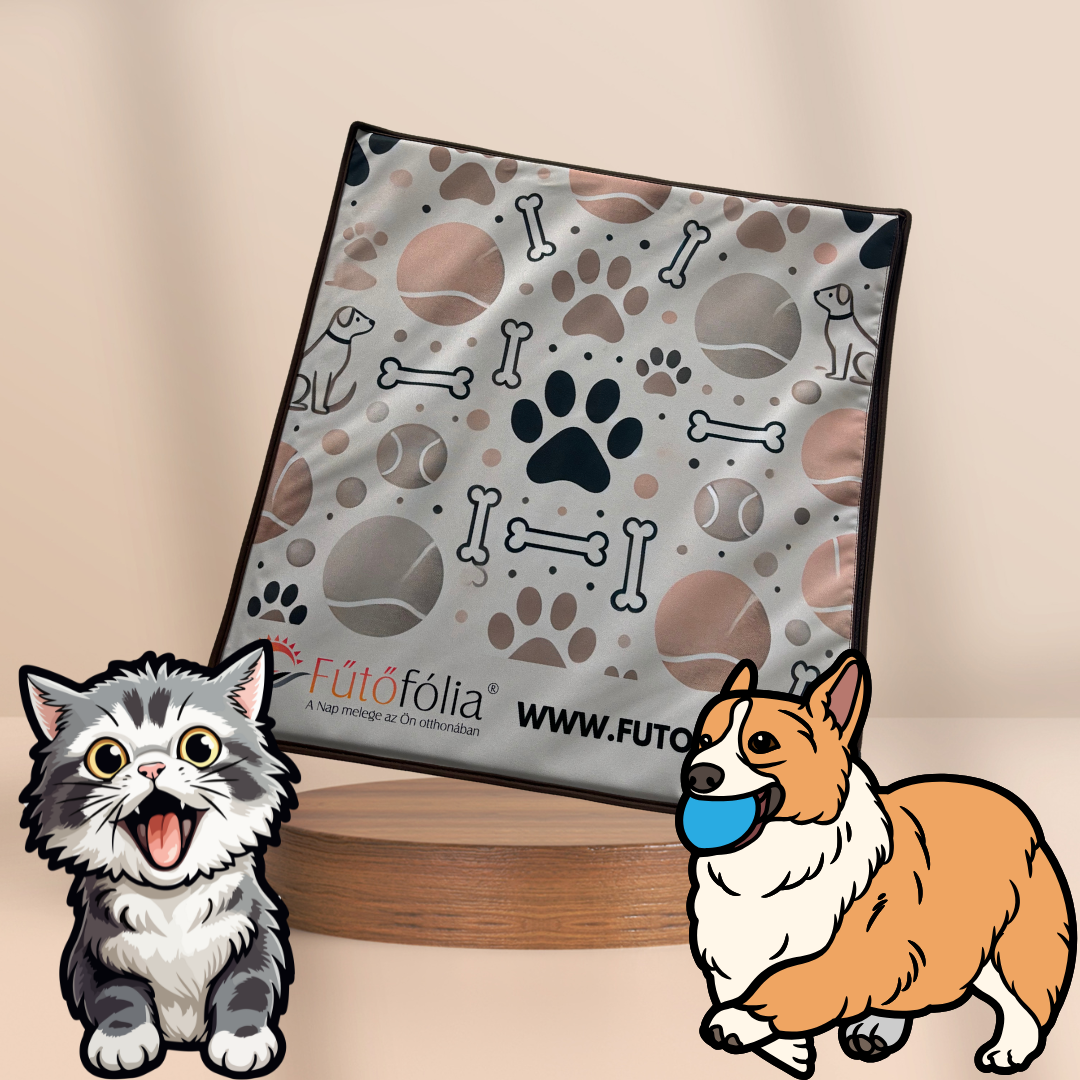
Dog house heating film package: designed for owners' needs, with a 0.5×0.5 m film fitted with a plug and a choice of controller that regulates the temperature of the dog house.
Low-temperature infrared panels: they can also be used in an uninsulated, partly open place; route the cable so that the animal cannot reach it.
You can find the full range in the dog house heating product category (Hungarian-language shop, delivery within Hungary).
Infrared Foot Warmer Pad – 25x50 cm – With Thermostat
View
Infrared Dog House Heating – 50×50 cm – With Thermostat
View
Infrared Warming Pad for Small Animals – 25×50 cm – With Thermostat
View
Satisfied owners with dog house heating


Request a quote — installation anywhere in Hungary
We survey, design and install heating film and infrared heating throughout Hungary. Tell us about your home and we will get back to you.