

DIY Underfloor Heating – Is It Worth Taking On?
Author: Tóth Tamás · 6 min read
Is it worth building underfloor heating yourself? You can save on labour, but fixing planning and installation errors means breaking up the floor covering. What you can do yourself, what to leave to a professional, and how to save without risk.
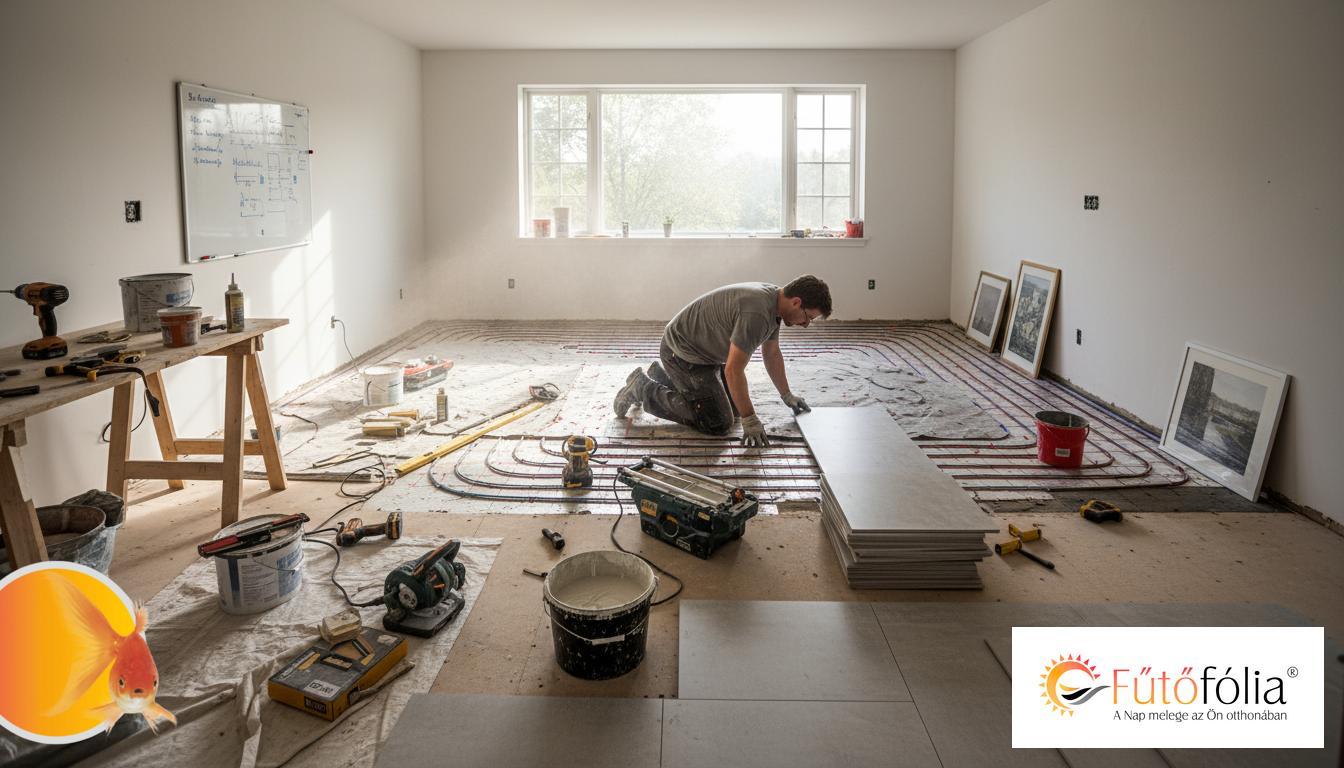
Installing complete underfloor heating yourself is not worth it in most cases: a single planning or installation fault can wipe out the labour saved, because the repair often requires breaking up the floor covering. Leave a water-based system, main heating and the electrical connection to a professional; with your own work you can at most save on a smaller supplementary heating or on some preparatory work.
Underfloor heating gives even warmth and takes up no space on the wall, and many people would like it, but the price of installation can hold them back. That is when the question arises whether it could be done by yourself. Below we look at what speaks for DIY installation, what risks it carries, and which jobs a layperson can realistically take on.
Water-based or electric: how doable is it yourself?
The two main types of underfloor heating need different knowledge:
- Water-based underfloor heating: water circulating in the floor gives off the heat, and the system is connected to a boiler, heat pump or other heat source. It cannot be installed safely without hydraulic and mechanical knowledge.
- Electric underfloor heating: heat is produced by an electrical heating element – heating film, heating film (infrared), heating mat or heating cable.
The electric solution looks simpler because there is no pipework, pump or manifold. The electrical part, however, requires qualifications here too, and exact adherence to the layer structure (thermal insulation, the heating element, the layers under the covering) is also a condition of good operation.
What speaks for DIY installation?
The main reason is almost always cost:
- Labour: a professional's fee is a significant item, which in principle can be saved with your own work.
- Scheduling: you can proceed at your own pace and do not have to fit in with someone else's schedule.
- Sense of achievement: a well-done, complex job really does feel good.
These advantages, however, materialise only if the installation is flawless and no hidden costs appear later.
Where can DIY installation go wrong?
Faults in underfloor heating typically do not come to light on the first day but in the heating season, when the floor is already covered. Below we briefly list the most common pitfalls of DIY work; a detailed description and prevention of typical errors is in our article on underfloor heating mistakes.
Planning: what is most often left out without a professional
- Heat demand calculation: without it the system will be undersized or oversized. An undersized one will not heat the house, an oversized one is needlessly expensive and harder to control.
- Thermal insulation under the heating element: if it is missing or insufficient, the heat goes into the ground or the room below, and this shows in consumption.
- Circuit layout (with a water-based system): the length, spacing and layout of the pipes decide whether the floor temperature will be even.
- Control: without a suitable thermostat and room-by-room zones, the whole house heats to one temperature, which is wasteful.
Installation: where lack of practice is most expensive
- Damaged heating element: damage to the pipe, cable, heating mat or heating film going under the covering or screed can cause a leak in a water-based system and a short circuit in an electric one – the repair involves breaking up the covering.
- Substrate and screed: a substrate that is not dry, flat and firm enough, a wrong screed thickness or skipping the waiting time for drying can lead to cracking and damage to the covering; on larger areas, expansion joints are also essential.
- Pressure test (with a water-based system): needed both before and after pouring the screed, otherwise a hidden leak is discovered only when damage occurs.
- Electrical connection (with an electric system): this should always be done by a qualified electrician. Faults in a DIY connection can lead to overheating, short circuits and fire risk, and irregular earthing matters from the electrosmog point of view too.
Choice of materials: the covering and the adhesive matter too
Not every covering suits underfloor heating: thick carpet and solid wood parquet have high thermal resistance, hinder heat transfer, and can deform because of thermal expansion. Tiles need a flexible adhesive, and under laminate flooring an underlay with low thermal resistance suitable for underfloor heating is needed. We write about this in detail in our article on choosing a floor covering.
Warranty and insurance
The manufacturer's warranty is typically tied to professional installation, so with DIY installation it can be lost. In the event of damage (fire, water ingress), the insurer may also refuse payment if the work did not comply with regulations. With our own installation it is different: we give a 15.5-year warranty on 4th-generation heating film if we do the installation (in Hungary).
When not to take it on, and when you can consider your own work
Do not do it yourself if:
- it is main heating over a large floor area – the consequences of errors are the most serious here;
- you would build a water-based system – hydraulic and mechanical knowledge cannot be replaced;
- it involves the electrical connection – always leave this to a professional;
- you have no technical practice, suitable tools or enough time.
You can consider it (in part) if:
- it is only supplementary heating, for example a heating mat or heating cable for a small bathroom, and an electrician makes the connection;
- you help alongside a professional, agreed in advance, with non-critical jobs: preparing the substrate, laying thermal insulation, moving materials;
- you have serious technical knowledge and practice – even then it is worth leaving the planning and key checks to a professional.
How can you save without risk?
- Division of work: discuss with the installer which phases of work you can take over (for example moving materials or preparing the substrate), and how much this reduces the labour fee.
- Another form of electric heating: if radiant heat is the main goal and underfloor heating is too big an intervention, other forms of infrared heating – an infrared panel or panel heater – can be installed with less alteration.
- Good planning: a carefully sized system can be more economical in the long run, even if the initial cost is somewhat higher.
Summary
DIY installation is tempting, but with underfloor heating the consequences of planning, installation and material-choice errors – higher consumption, poor comfort, failure, breaking up the covering – can easily cost more than the labour saved. Since these faults stay invisible under the floor, they often come to light only years later.
For lasting and safe underfloor heating, leave the planning and the key work phases – especially the electrical connection and commissioning of a water-based system – to a suitably qualified professional. With your own work you can help where a mistake does not end up under the floor.
Request a quote — installation anywhere in Hungary
We survey, design and install heating film and infrared heating throughout Hungary. Tell us about your home and we will get back to you.