

Why Do Builders Like to Choose Heating Film?
Author: Tóth Tamás · 6 min read
Why do more and more new houses and property developments go with heating film? We have collected builders' arguments – comfort, controllability, low maintenance, aesthetics, quick installation – and what to watch out for.
Builders choose heating film more and more often because in a single system they get even comfort with a warm floor, consumption controllable room by room, interiors with no visible building services, and fast, dry installation. There is no boiler, chimney, pipework or annual boiler service, and behind the floor covering the film goes unnoticed.
Modern architecture and property development pay more and more attention to energy efficiency, sustainability and comfort. As technology advances, expectations of heating change too: instead of visible, space-hungry solutions, hidden systems are being built in more and more places. In this article we go through the experience and arguments behind builders' decisions – and also what to watch out for.
The challenges of modern architecture and the role of heating
In today's construction industry it is not enough to create a functional building. Buyers and tenants look for homes and workplaces that are aesthetic and comfortable, can be run economically in the long term, and fit today's lifestyle. In this set of expectations the choice of heating is a key question, since modern architecture reduces the number of visible building services elements, makes the best possible use of interiors, and strives for good energy efficiency.
What is heating film (infrared heating)?
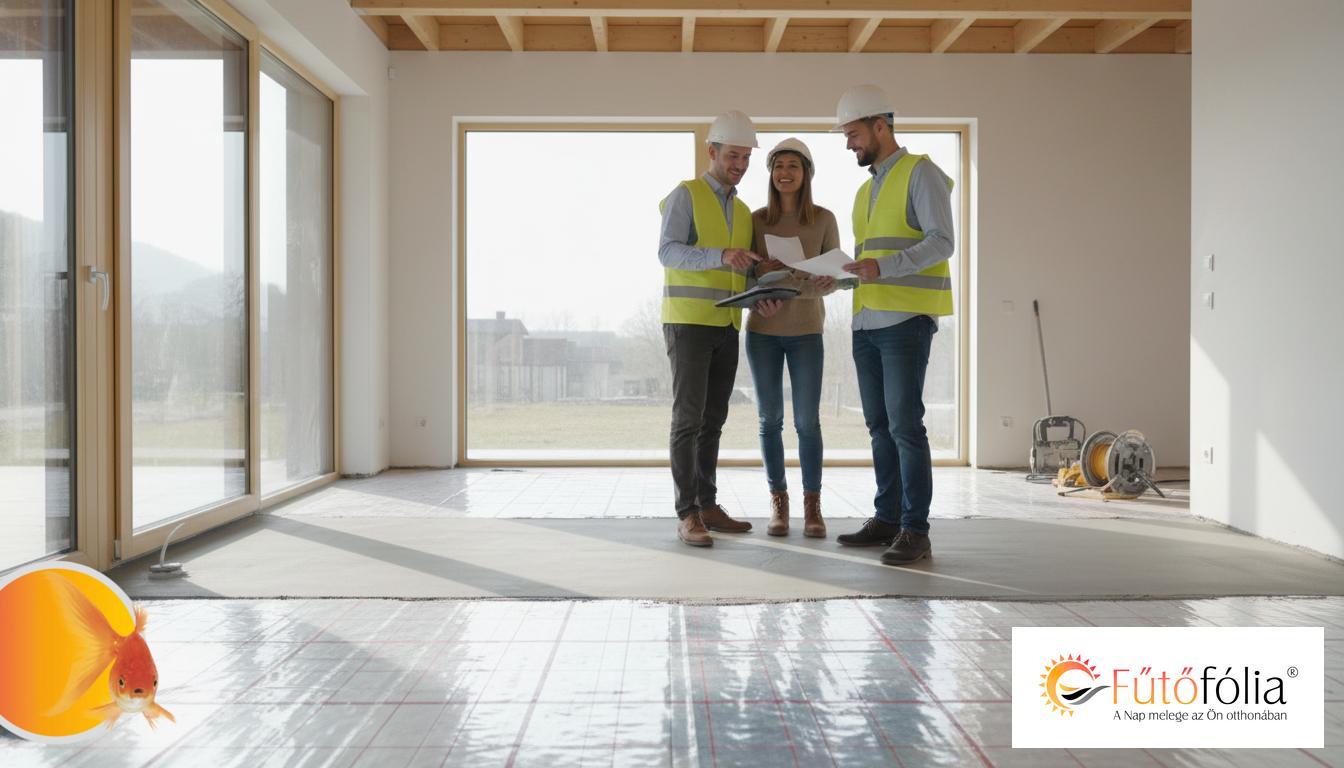
Heating film is electric heating that gives off heat by infrared radiation. The thin, flexible polyester foil coated with a graphite layer warms up under the influence of electric current and, like the Sun, emits infrared rays. These do not primarily warm the air but directly the objects, walls, floor and the people in the room, so the thermal sensation is more even than with convection heating. Heating film typically goes under the floor (under laminate, vinyl or ship's-deck flooring), on the ceiling or on the wall (behind plasterboard), so it is not visible. Today we install 4th-generation heating film.
Builders' arguments for heating film
Comfort and sense of comfort
- Even heat distribution: with radiant heating there is less heat stratification, so it happens less often that "our feet are cold while it is warm above" – which is common with radiator heating.
- Warm floor: as underfloor heating, heating film gives a pleasant, warm floor feel, which adds a lot to the feeling of homeliness.
- Comfortable even at a lower air temperature: because radiant heat warms bodies and surfaces, experience shows that a 2-3°C lower air temperature can give a similar thermal sensation as with conventional systems – this also matters from the energy efficiency point of view.
Energy efficiency and running costs
- Direct heat transfer: infrared heating does not primarily heat the air, but the surfaces and people that absorb the heat.
- Room-by-room control: with thermostats the temperature can be controlled per room or zone, so it heats only where and when needed, and unnecessary consumption is avoided.
- Can be combined with solar panels: since heating film is electric heating, it pairs well with a solar panel system, and your own generation can reduce the electricity cost of heating. How much depends also on the metering: since 1 January 2024, newly connected household solar systems in Hungary are on gross metering, so fed-in and drawn electricity are accounted for separately. Net metering could only be kept by systems applied for by September 2023 and commissioned by 1 January 2026, for up to 10 years. Details on our solar panel page.
- Quick response: the electric system follows temperature changes quickly, and holds the set value precisely.
Low maintenance, long-term use
- No moving parts: no pump, valve, boiler, burner or fan to wear out or make noise.
- No combustion: no chimney, flue gas discharge or gas connection needed; no soot, no condensate, and no risk of carbon monoxide poisoning.
- No liquid medium: no water or antifreeze, so no leaks, pressure fluctuations or bleeding.
- No annual boiler service: unlike gas boiler systems, heating film does not need an annual boiler service or chimney sweeping, which saves time and money.
- Designed for the long term: heating film is built in behind the floor covering for long-term use. We give a 15.5-year warranty on 4th-generation heating film if we carry out the installation.
Aesthetics and use of space
- Invisible: heating film goes under the floor covering, so there are no radiators, pipes or building services elements to spoil the overall look of the interior.
- Free walls and floor: furniture placement and interior design ideas are not limited by heaters – which can also be an advantage when selling the property.
- Minimalist design: the system suits clean, modern homes well.
Pleasant indoor climate
- Less dust stirred up: heating film does not move the air, so it stirs up less dust than heating that circulates air – occupants sensitive to dust and families with small children may also find this favourable.
- Less drying: it does not dry the air as much as convection heating, which can also have a good effect on well-being.
Quick and simple installation
- Dry technology: no wet pipe system, pressure test, antifreeze liquid or bleeding, which simplifies and speeds up installation.
- Fewer trades: no need for a gas fitter, chimney specialist, heating installer or boiler installer. The wiring is done by a qualified electrician.
- Thin layer structure: as underfloor heating the film is very thin and does not raise the floor level significantly – an advantage in both new construction and renovation.
Smart home integration
- Intelligent control: heating film systems can also be connected to smart home platforms, so they can be controlled remotely and automated programmes can run on them.
- Remote monitoring: with smart heating control, energy use can be optimised and the operation of the system can be followed remotely.
What should the builder watch out for?
The advantages apply if the system is well designed. The required power is determined by the building's heat loss, so sizing is easiest at the design stage – the process is described on our on-site survey and consultation page. Electric heating also increases the house's electrical power demand, which has to be taken into account when planning the grid connection. And the installation of the heating film has to be matched to the scheduling of flooring and suspended ceilings.
Summary: a conscious decision for the home of the future
That builders choose infrared heating more and more often is not a passing trend but a conscious decision that answers the expectations of modern architecture. Heating film offers comfort, room-by-room controllability, low maintenance, aesthetics and a pleasant indoor climate in one system.
The initial investment cost can be comparable to that of a conventional system, and sometimes higher. Which is more economical in the long term is decided by the building's heat loss, energy prices and usage habits – our cost comparison helps with this. Whoever builds well-designed heating film today offers the occupants heating that serves them unnoticed behind the floor covering, with little trouble. Installation is available in Hungary.
Request a quote — installation anywhere in Hungary
We survey, design and install heating film and infrared heating throughout Hungary. Tell us about your home and we will get back to you.