

Are Infrared Panels a Long-Term Investment? Pros and Cons
Author: Tóth Tamás · 4 min read
Is buying an infrared panel worth it in the long run? The advantages and disadvantages of infrared heating from an investment point of view: quick warmth, no boiler, expandability – versus electricity cost, sizing and lack of heat storage.
An infrared panel can be a good long-term investment if the insulation of the house is in order, the panel is sized to the room, and it is run economically with a thermostat. Buying and installing it is simpler than a central heating system, but in operation it consumes electricity – so the payback is decided by the investment and the expected electricity cost together.
The article appeared in 2022, when many people were starting to think about infrared panels as primary or supplementary heating. Below we go through the advantages and disadvantages of infrared heating from the investment point of view; you will find a detailed, practical list of the disadvantages in our article on the disadvantages of infrared heating.
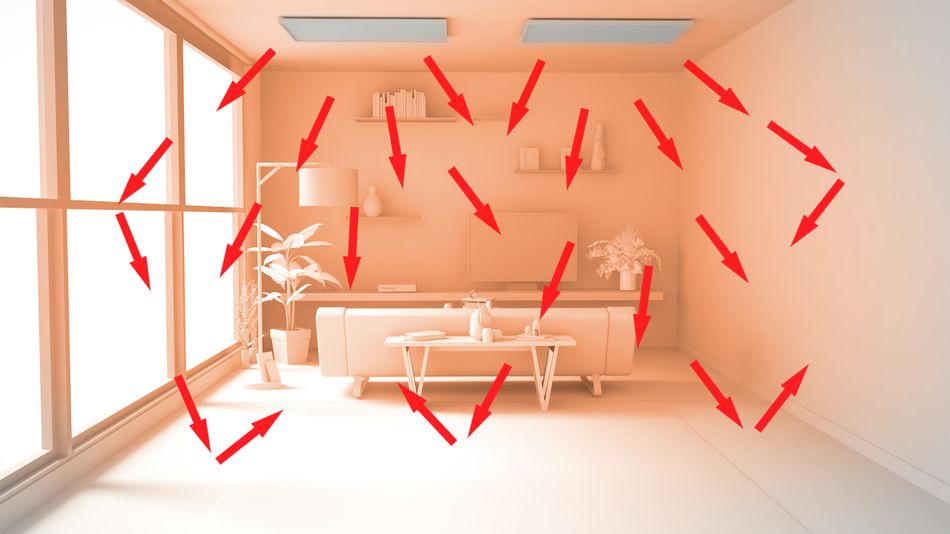
How does an infrared panel heat the room?
An infrared panel produces long-wavelength, invisible infrared radiation from electricity. The radiation largely passes through the air and is absorbed in walls, objects and people: it warms these, and the warmed surfaces in turn pass heat on to the air. That is why warmth is felt quickly, and there is no need to wait for hours until the whole volume of air in the room has warmed up.
Sunlight also carries an infrared range, but not all infrared heating is the same. High-temperature emitters working in the near-infrared range also give off visible light. Panels meant for homes radiate at a lower surface temperature, without light, in the far-infrared range – which is more favourable for indoor heating.
What speaks for the investment
- Warmth felt quickly. Since the whole volume of air does not have to be heated first, the panel is especially practical where the room has been unheated for a long time: in a mountain cabin, a weekend house or a basement room.
- No boiler, pipework or chimney. The panel goes on a wall or ceiling, there is no combustion in it, and it needs no regular service, so the cost of boiler servicing disappears.
- Expandable room by room. You do not have to convert the whole house at once: it is enough to start with one cold room, and the system can be extended later.
- Quiet. It works without a fan or moving parts, so it does not disturb sleep in the bedroom or the children's room.
- Design. Available in several versions – with a white, picture or mirror front – so it can become part of the furnishings.
- Less dust stirred up. Radiant heating does not rely on strong air flow, so it stirs up less dust. We promise no health effect beyond this; we write about questions on the electromagnetic field on our electrosmog page.
What may speak against it
- Running it has a price. Buying the panel is a one-off expense, but in the heating season it consumes electricity, and in the long run this is a significant part of the total cost. How much depends on the heat loss of the house, the set temperature and the price of electricity.
- The purchase price. Many people consider the price of the device a deterrent: a good-quality panel can cost more than a simple radiant heater. Compared with building a water-based central heating system, however, the investment is typically smaller.
- Sizing and placement. The output of the panel must match the heat demand of the room: undersized it will not heat the room, oversized it is needlessly expensive. Warmth is felt less at a distance, so the panel should go in a central place – on the ceiling or on a wall facing the middle of the room – and should not be covered by furniture.
- It does not store heat. After switching off, the panel cools down quickly; in a poorly insulated house it therefore has to run for a long time.
- Wasteful without control. It can be run economically only with a thermostat or timer.
Panel or built-in heating film?
If you are planning for the long term, it is worth considering built-in heating film alongside the panel. The film is not visible and takes up no space, but goes into the floor, wall or ceiling during renovation or construction; a panel, on the other hand, can be mounted afterwards without demolition. We detail the differences between the two solutions in our comparison of the infrared panel and heating film. We give a 15.5-year warranty on 4th-generation heating film if we do the installation (in Hungary).
When is an infrared panel a good investment?
- in a well-insulated house where little heat has to be replaced;
- as supplementary heating in a cold or rarely used room;
- in a holiday home or weekend house where quick heating up matters;
- where a gas connection and a central system would otherwise be a big cost.
If the heat loss of the house is large, it is worth investing first in insulation and windows. Before deciding, request several quotes and compare the quality, output and warranty terms of the panels. For a fresh cost calculation, our cost comparison of heat pumps and infrared heating gives a starting point, and you will find our range at futofolia.hu.
Request a quote — installation anywhere in Hungary
We survey, design and install heating film and infrared heating throughout Hungary. Tell us about your home and we will get back to you.