

Heating Film vs. Radiators: Differences in Comfort and Cost
Author: Tóth Tamás · 9 min read
Heating is the heart of our home: it decides our comfort and can eat up a large part of our monthly spending. We compare two popular heating methods, heating film and radiators, in detail, covering comfort and cost.
Heating is the heart of our home: it determines not only our comfort but can also eat up a significant part of our monthly spending. As technology advances, we can choose from more and more alternatives beside the traditional solutions, and this often puts us before a decision: stay with the tried-and-tested but perhaps less efficient systems, or switch to modern, innovative technologies? In this article we compare two popular heating methods, heating film vs. radiators, in detail, looking at their differences in comfort and cost, to help you make an informed decision.
Traditional Radiator Heating in Brief
Radiator heating is a technology proven over centuries, found in most Hungarian households. It is based on circulating hot water, heated by a boiler (gas, wood gasification, electric, heat pump), which travels through a pipe system to the radiators placed in the rooms. The radiators give off heat to the air through their surface, and it spreads through the room by convection.
Advantages:
* Familiar and tried: Widely used, and installers know it well.
* Flexible heat source: Can be paired with almost any boiler.
* Lower initial investment: Replacing a single radiator is relatively cheap.
Disadvantages:
* Takes up space: Radiators are wall-mounted units that occupy valuable wall surface, limiting furniture layout.
* Uneven heat distribution: Because of convection, warm air migrates to the ceiling and cold air to the floor, so your feet can be cold while your head sweats. This stratification reduces comfort.
* Dry air and dust: The circulating air moves dust and allergens with it, which can be a problem for allergy sufferers, and it dries the air.
* Slow response time: Heating the volume of water and warming up the air takes time, so it reacts more slowly to changes in temperature demand.
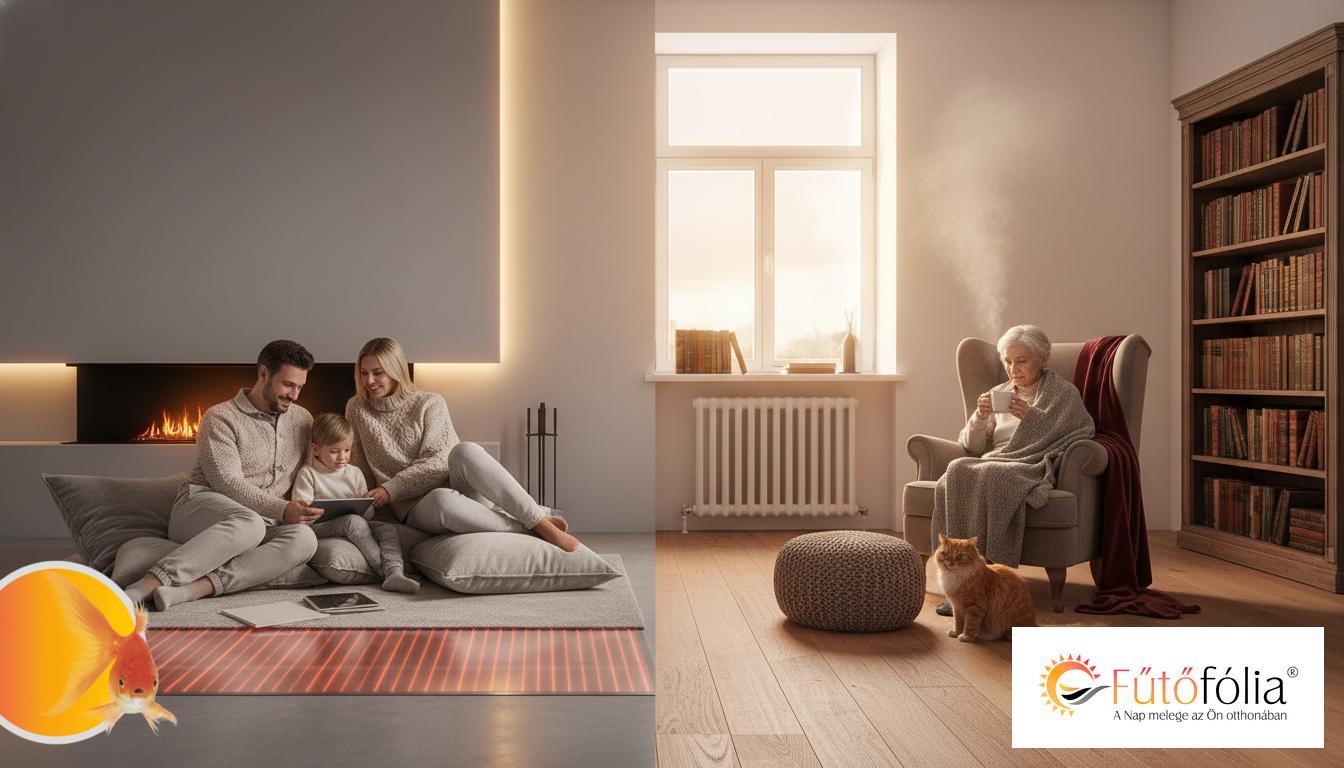
Introducing Modern Heating Film Technology
Heating film, as a form of infrared heating, is an increasingly popular alternative to traditional systems. This thin electric heating element works by emitting infrared rays, which heat not the air but directly the objects and people, similar to the rays of the sun. Heating film is typically installed under the floor (under laminate, vinyl or ship's-deck flooring) or in the ceiling or wall (under plasterboard), so it stays completely invisible.
Advantages:
* Invisible and space-saving: Since it goes under the floor covering, it takes not a single square centimetre from the room.
* Even thermal sensation: Thanks to infrared radiation, the temperature distribution in the room is even, there are no cold and hot zones, and the feeling of a "warm floor" is extremely comfortable.
* Healthier environment: It does not circulate the air, so dust and allergens do not fly about, and it does not dry the air, contributing to optimal humidity.
* Fast heat-up and precise control: The electric system reacts to commands immediately, and with smart thermostats it can be controlled very precisely, even room by room.
* Energy efficiency: Because it heats surfaces and people directly, the thermal sensation is pleasant even at a lower air temperature (a temperature 2-3°C lower can be enough).
* Quiet operation: Absolutely silent.
* Maintenance-free: No moving parts, no boiler, so it needs no regular maintenance.
Disadvantages:
* Initial investment: Building out the complete heating system can sometimes involve a higher initial cost if the whole electrical network also needs upgrading.
* Dependence on electricity: It is fully electric, so it does not work in a power cut, although no other heating system does either.
Comfort: Which Improves Quality of Life?
When choosing a heating system, besides cost, everyday comfort is also key. Let us see how heating film vs. radiators differ in terms of comfort factors:
* Thermal sensation and evenness:
* Radiator: Because of convection heating, warm air rises and the area near the floor stays cold. This "heat stratification" can cause an unpleasant feeling of draught and a general decline in comfort. It does not help that the room air is 22°C if your feet are cold.
* Heating film: Infrared radiation warms bodies and surfaces directly, so the thermal sensation is much more even and pleasant. Warmth radiating from the floor is especially comfortable, as if we were on a seaside walk. The air temperature can be a few degrees lower, yet we feel warmer.
* Aesthetics and use of space:
* Radiator: Visible, they spoil the look of a clean interior and limit the placement of furniture. A larger radiator can take up a significant wall area.
* Heating film: Completely hidden, so it gives maximum freedom in space planning and furniture layout. An ideal choice for minimalist, modern homes.
* Air quality and health:
* Radiator: Circulating the air also moves dust and dust mite droppings, pollen, viruses and bacteria, which can be a problem for allergy and asthma sufferers. It also dries the air.
* Heating film: Because it does not move the air, it provides a much cleaner and healthier indoor climate. There is no dust flying, fewer allergens, and humidity stays more optimal, which contributes to preventing respiratory illness and general well-being. This is one of the pillars of the concept of healthy heating.
* Noise level:
* Radiator: The boiler, the water circulating in the pipes and the sounds from thermal expansion can be disturbing.
* Heating film: Works absolutely silently, contributing to a calm home environment.
* Control and flexibility:
* Radiator: With traditional systems, precise room-by-room control is harder. Because of the slow response time, it adapts less flexibly to suddenly changing needs.
* Heating film: With smart thermostats it can be controlled to the minute room by room, even zone by zone, even remotely. This increases not only comfort but is also outstanding in terms of energy efficiency.
Cost Differences: The Wallet Decides
One of the most important aspects of choosing heating is cost, which can be divided into three main categories: purchase, running and maintenance costs.
Purchase and Installation Costs
* Radiator heating: Building a complete radiator heating system includes the price of the boiler, the pipe system, radiators, valves, pumps and labour. With a gas boiler system, the gas connection and the flue are also significant costs. In a partial renovation of an existing system, for example replacing a radiator, costs are lower.
* Heating film: The elements of the system are the heating film, the control thermostats, cabling, any underlay foils and the installation fee. Although the film itself is not expensive, setting up the whole system can be significant, especially in a larger house with many heated surfaces, or where the electrical network also needs upgrading. However, bear in mind that there is no boiler, flue or pipe system, which greatly reduces the related investments. In a newly built, well-insulated house or in a thorough heating modernisation, costs are often competitive, even more favourable, than those of a complex radiator system.
Running Costs
This is the area where, in a heating film vs. radiator comparison, significant differences can show up in the long term.
* Radiator heating: The running cost depends primarily on the price of the fuel used (natural gas, wood, pellets, electricity). Fluctuating gas prices and the rising cost of fossil energy sources cause uncertainty. Heating the water in the pipe system and heat output by convection can also mean greater heat loss. Maintaining a higher air temperature (22-24°C) to reach comfort requires more energy.
* Heating film: Since it is electric heating, the running cost depends largely on the price of electricity. However, thanks to the efficiency of infrared heating (direct heat transfer, no loss from needlessly heating the air) and precise, room-by-room control, significant savings can be achieved. As mentioned, the thermal sensation is comfortable even at a lower air temperature (e.g. 19-20°C), which can mean a 10-15% energy saving. Furthermore, heating film can ideally be combined with a solar panel system, so the cost of heating can be reduced to almost zero in the long term. This future-proof electric heating is coming more and more to the fore as renewable energy sources advance.
Maintenance and Lifespan
* Radiator heating: The boiler has to be serviced regularly, radiators have to be bled, and over time the pipe system can also fail (leaks, blockages). Boilers generally last 15-20 years.
* Heating film: Practically maintenance-free. There are no moving parts, no bleeding, no combustion products and no risk of explosion. Its lifespan is extremely long, as much as 30-50 years.
Heating Film vs. Radiator: When Is Which the Right Choice?
The decision about which heating system to choose depends on many factors, such as the type of building, the available budget, personal preferences and long-term goals.
Heating film can be the ideal choice if:
* It is a newly built home, where the system can be integrated from the start of the design.
* You are facing a complete heating modernisation or a comprehensive renovation.
* Aesthetics, saving space and a modern, clean interior are important.
* The focus is on energy efficiency, environmental protection and using renewable energy sources (e.g. with solar panels).
* Family members with allergies or asthma live in the home, and healthy heating is important.
* You want a low running cost and a maintenance-free system in the long term.
* Comfort and even heat distribution are a priority.
Radiator heating can be the better choice if:
* You have an existing, well-working boiler and pipe system, and only want to replace one or two radiators.
* Minimising the initial investment is the most important consideration, and you do not plan to build a complex heating system.
* The gas supply is stable and you judge gas heating to be cheaper.
* The building's insulation is not optimal, and fast heat-up may be essential in certain situations.
Summary and Recommendation
The heating film vs. radiator comparison clearly shows that both heating solutions have their own advantages and disadvantages. Radiator systems represent the proven, flexible solution, especially for partial renovations or where the initial investment needs to be lower. However, in terms of comfort, aesthetics, a healthy indoor climate and long-term energy efficiency, heating film offers a modern, innovative alternative that could be the heating system of the future.
When deciding, weigh carefully your individual needs, the features of your home, your long-term goals and, of course, your wallet. It is important to consider not only the purchase cost but also the running cost and maintenance needs. We recommend that you consult experts who can advise tailored to your specific situation and help you choose the most suitable heating system for your home. The future clearly points toward maximising energy efficiency and comfort, and in this respect heating film performs outstandingly.
Request a quote — installation anywhere in Hungary
We survey, design and install heating film and infrared heating throughout Hungary. Tell us about your home and we will get back to you.